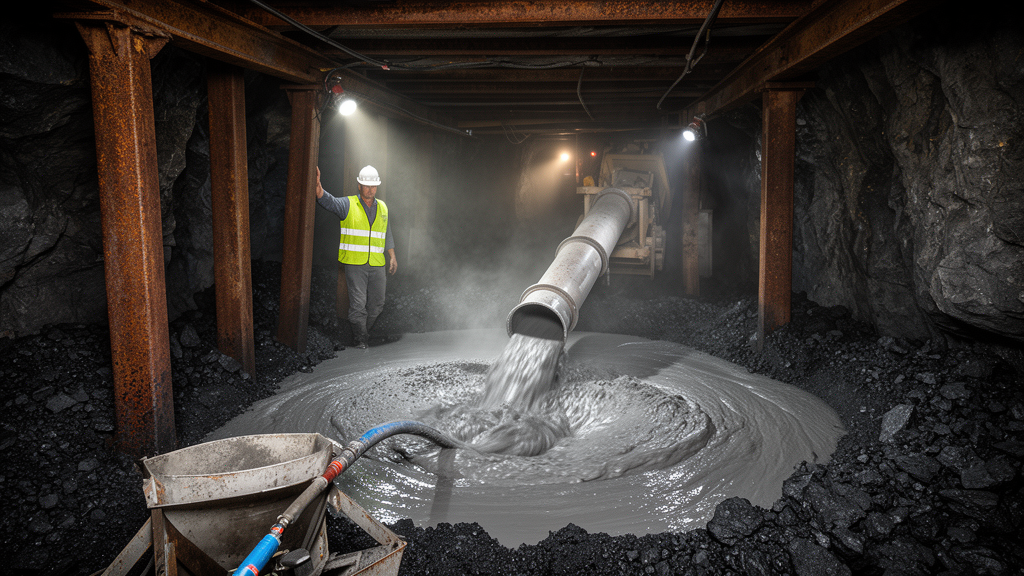
Deep beneath the coalfields of eastern China, two stubborn waste problems are being fused into a single solution. In a study published in Case Studies in Construction Materials, researchers report that highly saline concentrated mine water — a briny byproduct that mines normally pay dearly to evaporate — can be used as the mixing water for a cemented backfill made almost entirely from coal gangue, fly ash, and a modest dose of Portland cement. The resulting material not only flows well enough to be pumped underground but, under the right cement dosage, grows stronger than an identical mix made with ordinary tap water.
The team, led by Wenchang Feng and Jixiong Zhang with colleagues including Meng Li, Zhibo Cui, Zhangyu Li, and Yuzhe Zhang, set out to tackle two intertwined environmental burdens. Decades of high-intensity coal extraction have left vast stockpiles of coal gangue and fly ash that occupy land, risk spontaneous combustion and landslides, and can leach contaminants into soil and groundwater. Meanwhile, groundwater dissolving soluble minerals in coal-bearing strata produces mine water so laden with salts that discharging it untreated would salinize soils and pollute waterways. Desalination plants at the mines can strip the salts out, but the process concentrates them into a brine whose disposal is both difficult and expensive, with evaporative crystallization currently the dominant — and energy-hungry — fallback.
The researchers’ proposal was elegantly simple: let the brine do useful work. They prepared a high-salinity concentrated mine water-based coal-based solid waste cemented backfill, abbreviated HW-CB, using crushed coal gangue as coarse aggregate, fly ash as fine aggregate and supplementary cementitious material, and Portland cement as the binder. A parallel series made with tap water, TW-CB, served as the control. The brine itself came from the treatment plant at Jinqiao Coal Mine in Jining City, and its chemistry was striking: sulfate concentrations 313 times those of tap water, sodium 244 times higher, potassium nearly 40 times higher, and chloride about 17 times higher, all at a near-neutral pH of 7.52.
Flow behavior proved to be the first sensitive variable. As the solid content of the slurry rose from 74 to 82 percent by weight, slump declined gently at first and then collapsed — the material held a workable 278 to 282 millimeters up to 76 percent solids, then lost 28, 60, and 76 millimeters for each successive 2 percent increase. The team attributes the cliff-like drop to a threshold near 78 percent solids, beyond which free water can no longer coat every particle, friction and particle bridging take over, and flowability deteriorates drastically. Replacing fly ash with more cement improved slump in both water types, because the fly ash’s free calcium oxide slakes rapidly and consumes water within minutes, while cement’s calcium is locked in slow-hydrating silicate minerals. Yet at every cement dosage, the saline mix flowed slightly worse than its tap-water twin, since the dense ion soup suppresses electrostatic repulsion between particles and accelerates the formation of early hydration products that thicken the slurry.
Strength told a more surprising story. The 28-day unconfined compressive strength of the saline backfill rose linearly with solid content, gaining roughly 0.86 megapascals for every 1 percent increase in solids, with a coefficient of determination of 0.997 — climbing from 2.9 to 9.6 megapascals across the tested range. More intriguing was the interplay between cement dosage and salinity. At cement proportions of 6 percent or higher, the saline mix outperformed the tap-water mix at every age, with 3-day, 7-day, and 28-day strengths all higher. Below about 4 percent cement, the pattern inverted: early strengths were still boosted, but the 28-day strength fell below the tap-water control, with the 4-to-6 percent range acting as a transition interval.
Microscopy and diffraction explained why. X-ray diffraction revealed that the intensity of the ettringite peak tracked the strength results exactly. When calcium was plentiful, the sulfate, chloride, sodium, and potassium ions in the brine continuously drove ettringite formation while accelerating the dissolution of the aluminate phase, producing a dense microstructure in which well-developed, thick ettringite crystals interlocked into a three-dimensional skeleton and abundant calcium silicate hydrate gel filled the pores. Scanning electron microscopy showed the saline mix riddled with only small, disconnected pores, whereas the tap-water counterpart contained large connected voids and finer, shorter crystals. Thermogravimetric analysis sealed the case: mass loss between 100 and 200 degrees Celsius, which reflects bound water in the hydration products, ranked in precisely the same order as the measured strengths.
The mechanism behind the low-cement failure is a classic case of too much of a good thing. With insufficient calcium available, the brine’s acceleration caused hydration products to form so quickly that they encapsulated the unhydrated particles, sealing off the pathways later reactions needed. The result was short, sparse ettringite, unfilled voids, and a weaker final structure than the slower, steadier tap-water hydration achieved. In effect, the high-salinity environment acts as a throttle on the hydration clock — helpful when there is enough fuel to sustain the reaction, harmful when the fuel runs out early.
The economics may prove as compelling as the chemistry. At Jinqiao Coal Mine, the current zero-liquid-discharge scheme combining membrane concentration with evaporation and crystallization costs about 15.83 yuan per cubic meter of treated water, with throughput that can exceed 10,000 cubic meters per day during high-inflow periods. If the concentrated brine from the reverse-osmosis stage is diverted into backfill production instead, the downstream evaporation and mixed-salt disposal steps can be skipped, cutting the unit treatment cost by roughly 8 to 9 yuan per cubic meter — a reduction of more than 50 percent. On an annual treatment volume of 120,000 cubic meters, that translates into savings of roughly 960,000 to 1,080,000 yuan, before counting the simplified flowsheet and reduced capital costs.
The researchers are careful to note the boundaries of their findings. The backfill is designed for unreinforced goaf filling, so the brine’s chloride content poses no steel-corrosion concern in this application, but long-term strength evolution at 90 or 180 days, durability under sustained saline exposure, the effects of varying brine compositions, and full-scale field trials all remain open questions. Still, the core result stands: with the cement dosage tuned above the critical threshold, a waste stream that mines once paid to destroy becomes an active ingredient in the very material that stabilizes the voids coal mining leaves behind — turning two liabilities into one structural asset.
Subject of Research: Using high-salinity concentrated mine water as mixing water in coal gangue and fly ash cemented backfill and its effects on flow, strength, and hydration
Article Title: Performance and hydration mechanism of backfill materials prepared by coal-based solid waste and high-salinity concentrated mine water
Article References: Feng, W., Zhang, J., Li, M., Cui, Z., Li, Z., & Zhang, Y. (2026). Performance and hydration mechanism of backfill materials prepared by coal-based solid waste and high-salinity concentrated mine water. Case Studies in Construction Materials, 25, Article e06558. https://doi.org/10.1016/j.cscm.2026.e06558
Image Credits: AI Generated
DOI: 10.1016/j.cscm.2026.e06558
Keywords: cemented backfill, coal gangue, fly ash, high-salinity mine water, ettringite, hydration mechanism, unconfined compressive strength, solid waste utilization, mine water treatment, zero-liquid discharge, Portland cement, X-ray diffraction
News Source: Denise Maddox. (October 15, 2026). Salty Mine Water Turns Coal Waste Into Stronger Underground Backfill. Scienmag.