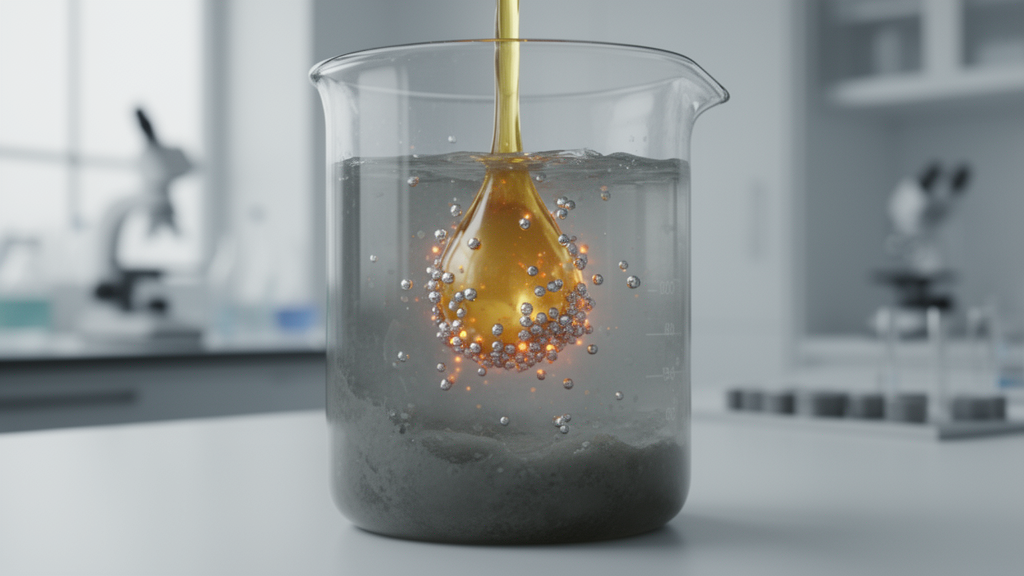
Industrial wastewater from electroplating shops is a strange kind of treasure. It is toxic enough that regulators will not let it be discharged or reused, yet it carries dissolved chromium and nickel that are worth recovering if someone can pluck them out selectively. A research team in Tamil Nadu, India, now reports that a single ionic liquid can do exactly that, using a miniaturized liquid-liquid extraction trick that turns a cloudy vial of wastewater into a metal-enriched droplet in minutes. The study, published in Frontiers in Chemical Engineering, recovered roughly 89 percent of chromium from a real metal-plating effluent and depleted nearly all dissolved nickel from an alkaline feed under the right conditions.
The solvent at the heart of the work is 1-butyl-1-methylpyrrolidinium bis(trifluoromethylsulfonyl)imide, abbreviated [BMPyrr][TFSI]. Ionic liquids are salts that stay liquid near room temperature, and their properties can be tuned by swapping either the cation or the anion. This particular pyrrolidinium salt is hydrophobic, chemically stable and dense, at about 1.40 grams per cubic centimeter, which matters enormously for the extraction scheme the team used. In dispersive liquid-liquid microextraction, or DLLME, the ionic liquid is first dissolved in a water-miscible disperser and then rapidly injected into the aqueous sample. The sample instantly turns cloudy as countless microscopic ionic-liquid droplets form, creating a vast interfacial area across which metal species can migrate. A spin in the centrifuge then coalesces the droplets into a dense, sedimented receiving phase that can be collected with a pipette.
What makes this study unusual is that it applied the technique not to trace analysis in clean laboratory water, the usual domain of DLLME, but to genuinely dirty industrial matrices. The researchers sampled five real wastewater streams at an effluent treatment facility in Malumichampatti, Coimbatore District, drawing from pharmaceutical manufacturing, industrial sewage, leather tanning, paint and coating operations, and metal electroplating. Flame atomic absorption spectroscopy revealed chromium in every single stream, from 0.28 parts per million in pharmaceutical wastewater to 21.42 parts per million in the composite industrial sewage sample. The plating wastewater, at 10.31 parts per million chromium, was selected for the recovery experiments because it combined a comparatively high metal loading with a traceable process origin.
The chemistry of these effluents is punishing. The chromium-bearing stream measured a pH of 10.0, total dissolved solids of 9742 milligrams per liter and suspended solids of 3471 milligrams per liter, with a total hardness of 568 milligrams per liter as calcium carbonate. Such a background can interfere with dispersion, sedimentation and phase disengagement, which is precisely why conventional treatments like precipitation, ion exchange and membrane filtration often lose selectivity or become economically prohibitive when target metals occur at trace-to-intermediate concentrations. Hexavalent chromium, meanwhile, is classified as a confirmed human carcinogen, and both metals are regulated as environmental priority substances owing to their persistence and bioaccumulation potential.
Because the response of a DLLME system depends on interacting variables, the team screened each parameter one factor at a time for each metal. For chromium, extractant volume produced a bell-shaped response: raising the ionic liquid from 100 to 400 microliters lifted recovery from about 35 percent to approximately 89 percent, but pushing further to 500 and 600 microliters dragged it back down to 73 and 61 percent. Too much solvent apparently disrupts the delicate phase ratio that lets droplets coalesce cleanly. Feed concentration told a similar story of finite capacity, with recovery falling from 86 percent at 10 parts per million to just 13 percent at 60 parts per million under fixed solvent conditions.
Centrifugation and salt addition each showed their own optima. Recovery peaked at 83 percent at 2000 revolutions per minute, dropping at both gentler and harsher spins, and climbed from 49 percent at 3 minutes of centrifugation to 93 percent at 15 minutes before declining again at 18 minutes. Sodium chloride, added to exploit salting-out effects, raised recovery from 47 percent at 0.1 grams to 86 percent at 0.4 grams, then reversed to 59 percent at 0.6 grams as ionic strength began to alter solvation, viscosity and interfacial transfer. Combining the best values, 400 microliters of ionic liquid at pH 6, 2000 rpm, 15 minutes and 0.4 grams of NaCl, delivered approximately 89 percent chromium recovery in a combined-condition experiment.
Nickel behaved differently. In a separate alkaline feed held at pH 10, aqueous-phase removal peaked at 96.1 percent at 80 parts per million initial nickel and then declined to 56.9 percent at 240 parts per million. Removal rose to a plateau of about 95 percent with 5 to 6 milliliters of ionic liquid, and centrifugation speed pushed removal from 55.9 percent at 500 rpm to 87.6 percent at 2500 rpm. The most dramatic effect came from salt: removal climbed monotonically from 70.7 percent at 0.4 grams of NaCl to 98.2 percent at 2.4 grams. The authors are careful to note, however, that at pH 10 nickel hydroxo-speciation and precipitation of nickel hydroxide can contribute to the measured depletion alongside genuine ionic-liquid partitioning, so the 98.2 percent figure represents overall aqueous-phase removal rather than an isolated extraction coefficient.
Two characterization techniques probed what actually happened to the solvent and the recovered metal. Fourier-transform infrared spectra recorded before and after extraction retained the diagnostic TFSI-anion bands, including asymmetric SO2 stretching near 1201 wavenumbers, CF3 stretching near 1059 and S-N-S bending near 619, along with the pyrrolidinium cation signatures, indicating no major structural decomposition was detectable. Scanning electron microscopy coupled with energy-dispersive X-ray spectroscopy of the recovered material showed an irregular, aggregated particulate morphology enriched in chromium at approximately 12.9 weight percent, with chromium K-alpha and K-beta peaks at 5.41 and 5.95 kiloelectronvolts. Notably, iron appeared at 8.6 weight percent alongside sodium, chlorine and other matrix elements, revealing that the recovery was a co-enrichment of competing species rather than a phase-pure chromium separation.
Recyclability exposed the practical challenge ahead. Reused over three consecutive cycles without regeneration, the ionic liquid’s performance fell from 96.1 percent in the first cycle to 81.8 percent in the second and 65.6 percent in the third. FTIR alone cannot resolve whether the decline stems from solvent loss, water carry-over or matrix fouling, and the authors emphasize that phase mass-balance, washing and regeneration measurements are needed separately. The team also stresses that the single-factor design yields local maxima rather than a statistically derived global optimum, and that no comparative screening against imidazolium, ammonium or phosphonium ionic liquids was performed, so intrinsic selectivity among ionic-liquid families remains undetermined.
Even so, the study marks a meaningful step toward viewing metal-bearing wastewater as a resource rather than a burden. Compared with published benchmarks, the chromium recovery of roughly 89 percent sits below the 95.40 percent overall recovery of multistage amide solvent extraction and the 98.6 percent precipitation recovery of an integrated ion-exchange process, while the nickel removal of 98.2 percent numerically exceeds the 95.6 percent electrodeposition recovery achieved after fixed-bed ion exchange, though such comparisons cannot establish process equivalence given different feeds and endpoints. The authors point to phase-specific metal mass balances, quantitative selectivity in multicomponent systems, ionic-liquid regeneration and back-extraction, and reduction of the solvent-to-feed ratio for nickel treatment as the priorities for scaling the process. If those hurdles fall, the humble cloudy vial could become a compact tool for closing the loop on two of industry’s most problematic metals.
Subject of Research: Near-quantitative nickel recovery and selective chromium preconcentration from complex industrial wastewaters by pyrrolidinium ionic-liquid dispersive liquid–liquid microextraction
Article Title: Near-quantitative nickel recovery and selective chromium preconcentration from complex industrial wastewaters by pyrrolidinium ionic-liquid dispersive liquid–liquid microextraction
Article References: Mariappan, D., Janani, V. A., Ganesan, S. K., & Raj, A. S. (2026). Near-quantitative nickel recovery and selective chromium preconcentration from complex industrial wastewaters by pyrrolidinium ionic-liquid dispersive liquid–liquid microextraction. Frontiers in Chemical Engineering, 8, Article 1896238. https://doi.org/10.3389/fceng.2026.1896238
Image Credits: AI Generated
DOI: 10.3389/fceng.2026.1896238
Keywords: ionic liquids, chromium recovery, nickel removal, industrial wastewater, dispersive liquid-liquid microextraction, heavy metals, circular economy, electroplating, water treatment, Frontiers in Chemical Engineering, Near-quantitative, nickel
News Source: Denise Maddox. (October 15, 2026). Ionic liquid pulls chromium and nickel out of industrial wastewater in minutes. Scienmag.