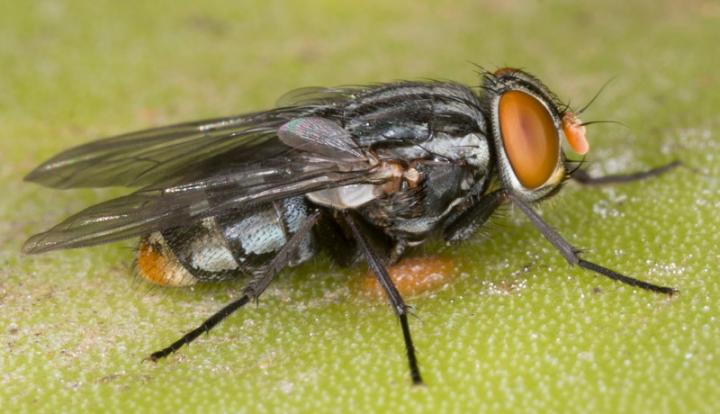
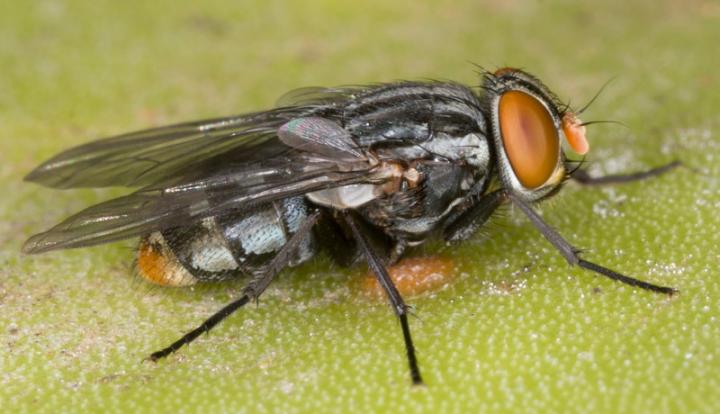
Credit: University of Huddersfield
AN insect that was once found mainly in China and in South America has begun to appear in Europe. Forensic entomologists – who gain vital crime scene information such as time of death by studying the infestation of human cadavers – need to learn as much as they can about the newcomer. The University of Huddersfield's Dr Stefano Vanin, assisted by some of his students, is leading the way.
His researches have led him to show that climate change and the globalisation of trade are key factors in the migration of the fly that has the scientific name Synthesiomyia nudiseta. In recent years, the insect has been found in Spain, Portugal and southern Italy. Now, it has been detected in corpses in the Genoa district of North West Italy.
A new article co-authored by Dr Vanin – who is the University of Huddersfield's Reader in Forensic Biology – includes five case studies of dead bodies found in houses in Genoa. Their ages ranged from 51 to 89, and the deaths were deemed to be natural. Larvae and pupae of S. nudiseta were discovered in each cadaver.
So how did a tropical insect migrate to Northern Italy?
Dr Vanin and his University of Huddersfield team obtained samples of the Genoese flies and conducted DNA analysis, comparing the genealogy of the Italian insects with that of Chinese specimens. This led to a conclusion that S. nudiseta had arrived not via Spain and Portugal but directly from China. The DNA findings are reinforced by the fact that Genoa is a large port and most of its trade is conducted with China.
The extent to which globalisation can disperse insect species is an issue that Dr Vanin has explored previously, and he also says that global warming plays a role.
"If the insects had arrived 20 years ago, they would have died. But the average temperature in Genoa, as in the whole Europe, has increased by about two degrees and is now a good temperature for this species," he said.
In addition to the forensic significance of the spread of S. nudiseta, there could also be a public health dimension, according to Dr Vanin. "This species does not have any competitor in Europe, so it could spread and increase the risk of transmission of disease," he explained.
There is a need for more work on the distribution of the insect within Europe, says Dr Vanin, and he stressed the importance of this at the most recent meeting of the European Association for Forensic Entomology. He aims to carry out new research.
###
The co-authors of the article on S. nudiseta in Italy include collaborators from the Institute of Legal Medicine and Forensic Pathology, University of Genova, and two of Dr Vanin's University of Huddersfield PhD students, Giorgia Giordani and Fabiola Tuccia. They belong to the cohort of doctoral candidates funded by a £1 million award from the Leverhulme Trust, creating a Centre for Evolutionary Genomics. Under Dr Vanin's supervision they have also been analysing samples of S. nudiseta that have been found in mummified South Peruvian bodies.
* The article, First records of Synthesiomyia nudiseta (Diptera: Muscidae) from forensic cases in Italy, by Stefano Vanin, Sara Lo Pinto, Giorgia Giordani, Fabiola Tuccia and Francesco Ventura is in the July 2017 edition of Forensic Science International.
Media Contact
Nicola Werritt
[email protected]
01-484-473-315
@HudUniPR
http://www.hud.ac.uk/
Original Source
https://www.hud.ac.uk/news/2017/july/forensicentomologistunearthschinesemigrantflyineurope/