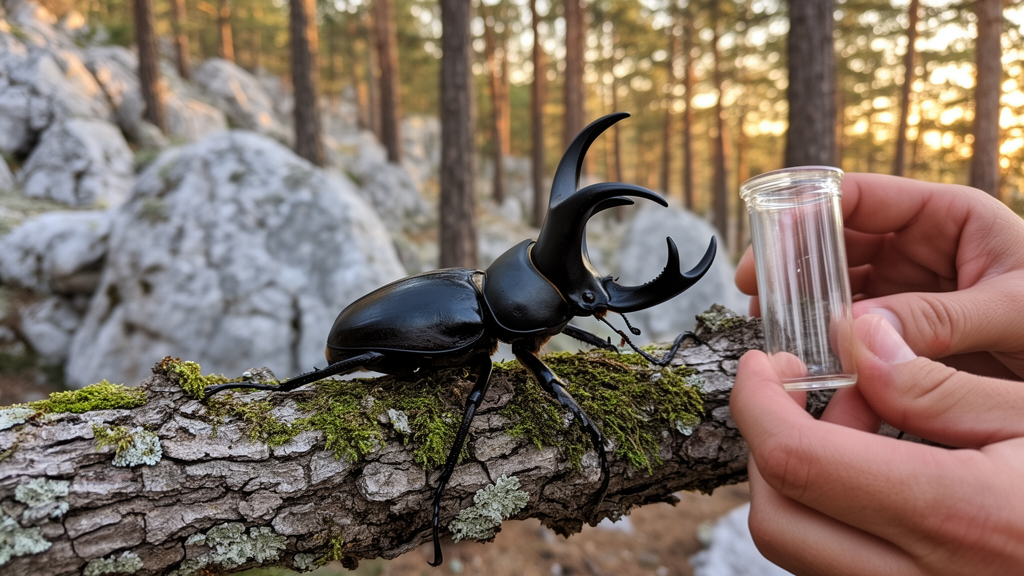
Deep in the pine forests of the Geraneia Mountains in Corinthia, Greece, a large and glossy stag beetle has been hiding in plain sight. A team of field entomologists working at nightfall in July 2025 captured 56 male specimens of an animal that turned out to belong to an entirely undescribed species. The insect has now been formally named Lucanus apollon, in honour of the ancient Greek god of light, music, and the arts, and the discovery is published in the Deutsche Entomologische Zeitschrift. The finding is remarkable because Lucanus is one of the most intensively studied beetle genera in Europe, and yet a species large enough to reach nearly five centimetres in length had gone unnoticed on the Greek mainland until citizen scientists and researchers finally brought it to light.
The genus Lucanus, the type genus of the stag beetle family Lucanidae, comprises approximately 132 described species distributed across the Palaearctic, Oriental, and Nearctic regions. Most of its diversity lies in eastern Asia, while Europe hosts only five species. Prior to this study, three of those had been cited from Greece: the famous European stag beetle Lucanus cervus, along with L. ibericus and L. tetraodon, although the presence of the latter two in Greece had long been considered doubtful. Molecular evidence based on COI sequences suggests that the western Palaearctic Lucanus species form a monophyletic group distinct from their eastern Asian relatives, but the phylogenetic relationships among the European members of the genus remain incompletely resolved. Against this backdrop, the discovery of a morphologically distinct new species in the Peloponnese region is a significant addition to European biodiversity knowledge.
The road to the discovery began not in a museum storeroom but on the citizen-science platform iNaturalist. Observations uploaded from southern Greece prompted targeted field surveys in the Peloponnese during July 2025. The researchers, Jonas Kristl of Vienna and Gaëtan Flocon of Rennes, focused their efforts on the forest of Pisia in the Geraneia Mountains, at elevations between 540 and 580 metres. Fieldwork was conducted under a research permit issued by the Greek Ministry of Environment and Energy, and all specimens were captured at nightfall between 21:00 and 23:00 hours using insect nets with two-metre telescopic handles and by hand. The team collected during two periods, 4 to 8 July and 13 to 17 July 2025, accumulating a total of 56 male specimens that would form the basis of the new species description.
Once back in the laboratory, the specimens underwent detailed morphological preparation. The insects were relaxed for approximately 48 hours in a sealed box containing moistened paper towels, after which the abdominal terminalia and aedeagus were carefully dissected. To remove remaining tissues from the sclerotised structures, the terminalia were macerated in a 10 percent potassium hydroxide solution for 24 hours and washed with distilled water. High-resolution photographs of the habitus and genital structures were captured using focus stacking with Helicon Focus software, producing the detailed image plates that accompany the publication. The holotype, a male measuring 43.5 millimetres in body length, has been deposited in the Naturhistorisches Museum Wien in Vienna, with paratypes distributed among personal and institutional collections in Austria, France, and Greece.
Lucanus apollon is a striking insect. The body is reddish-brown, dorsally glossy and without pubescence, with dark reddish femora and tibiae. The head is transverse, bearing mandibles approximately as long as the head itself, semicircular and incurved, with a bifid apex in which the distal tine is longer than the proximal one. The inner margin of each mandible carries a prominent median tooth located at midlength, along with two unequally sized denticles below it and two more between the median tooth and the apical fork. The antennal club is hexamerous, with antennomeres five to ten prominently elongated. The pronotum is transverse, 1.8 times wider than long, and the elytra are elongate, 1.4 times longer than wide. Among the paratypes, body length ranges from 30.6 to 47.0 millimetres, with variation in mandibular dentition, protibial teeth, and overall colour intensity.
Distinguishing the new species from its closest relatives required a careful comparative analysis. Lucanus apollon is most similar to L. busignyi from southwestern Anatolia in its glossy dorsal surface but differs in having a bifid mandibular apex, which is simple in L. busignyi. It differs from L. ibericus and L. macrophyllus by its glossy dorsal surface, whereas those two species possess a dull surface. Critically, the aedeagus of L. apollon bears stout parameres with upcurved apices, while all three compared species have more slender parameres. The penis-to-parameres length ratio is 0.7, matching L. ibericus but exceeding the ratios found in L. busignyi and L. macrophyllus. Additional diagnostic characters include the shape of abdominal tergite VIII, which is trapezoidal in the new species, and the ovate form of abdominal segment IX. The authors also compared the species against material of L. ibericus from Georgia, Russia, and Turkey, L. busignyi from southwestern Anatolia, and L. macrophyllus from southern Anatolia, confirming that the Greek population represents a distinct taxon.
The ecology of the new species is as intriguing as its morphology. Adults were active between 21:00 and 23:00 hours, with most activity occurring after nightfall, and some specimens were attracted to streetlights, suggesting positive phototaxis. The beetles were observed in flight, on the ground, on the trunks of holm oak Quercus ilex, oriental plane Platanus orientalis, and Aleppo pine Pinus halepensis, and within cavities in rock walls and Quercus coccifera. The habitat consists of a Mediterranean lowland to submontane pine forest dominated by Pinus halepensis, Quercus ilex, Quercus coccifera, Platanus orientalis, and Arbutus andrachne. The beginning of July appears to mark the onset of adult activity, with 12 specimens observed in the first survey period, while the highest number of active adults, 44 specimens, was recorded in mid-July. Despite the presence of potential predators such as the hooded crow, red fox, and domestic cat, no damaged specimens were observed, and the only evidence of predation was a single damaged elytron.
The species coexists with Dorcus parallelipipedus and other saproxylic Coleoptera, including Mesoprionus besikanus and Oryctes nasicornis, but no other Lucanus species were found at the type locality. Beyond the Geraneia Mountains, two additional localities of L. apollon were documented through verified citizen-science observations: a male photographed on Mount Parnitha, 30 kilometres north-northeast of Athens, at 650 metres elevation in July 2025, and another on Mount Messapio in Euboea, at 760 metres elevation in June 2022. These records expand the known distribution of the species across three mountain systems in Attica, Corinthia, and Euboea, all within a relatively small area of central Greece. The female of the species remains unknown, leaving open questions about sexual dimorphism and reproductive biology.
In addition to describing the new species, the authors compiled a comprehensive checklist and distribution map of the Greek Lucanus fauna, drawing on museum specimens and verified observations from iNaturalist and Observation.org. A total of 178 iNaturalist observations were reviewed, of which 150 could be confidently identified to species or subspecies level, comprising two observations of L. apollon, 74 of L. cervus cervus, 62 of L. cervus turcicus, six intermediate specimens of L. cervus, and six of L. laticornis. From Observation.org, 41 photographic observations were reviewed, of which 25 could be confidently identified, including 14 of L. cervus cervus, three of L. cervus turcicus, seven of L. laticornis, and one of L. ibericus. The verification process revealed that all Greek specimens previously identified as either L. tetraodon or L. ibericus proved to be minor males of L. cervus turcicus, resolving a long-standing taxonomic confusion in the Greek fauna.
The checklist confirms the presence of five Lucanus taxa in Greece: L. cervus cervus, L. cervus turcicus, L. apollon, L. ibericus, and L. laticornis. Notably, L. ibericus is documented for the first time from Greece, on the island of Lesbos, and L. laticornis is confirmed from Lesbos and Samos, representing first documented records of that species from the country as well. On Samos, L. laticornis was observed in habitats near human settlements dominated by Quercus, Platanus, and Pinus, with adults active shortly after dusk during June and attracted to ultraviolet light. Lucanus cervus cervus occurs in western Greece and the Peloponnese, whereas L. cervus turcicus is distributed across the eastern Greek mainland, Euboea, and Samothraki, with intermediate populations between the ranges of the two subspecies. The authors provide a diagnostic key to the males of the Greek Lucanus species and allied species of L. apollon, based on mandible length, antennal club composition, dorsal surface texture, mandibular apex structure, and femoral colouration, offering a practical tool for future surveys of the Greek stag beetle fauna.
Subject of Research: Biodiversity
Article Title: A surprising discovery of a new Lucanus species from Corinthia, Greece ( Coleoptera , Lucanidae , Lucaninae )
Article References: Kristl, J., & Flocon, G. (2026). A surprising discovery of a new Lucanus species from Corinthia, Greece (Coleoptera, Lucanidae, Lucaninae). Deutsche Entomologische Zeitschrift, 73(2), 531-541. https://doi.org/10.3897/dez.73.210225
Image Credits: AI Generated
Keywords: surprising, discovery, Lucanus, species, Corinthia, Greece, Coleoptera, Lucanidae, Lucaninae, scientific research
News Source: Drew Townsend. (October 15, 2026). New Stag Beetle Species Surprises Entomologists in the Mountains of Corinthia, Greece. Scienmag.