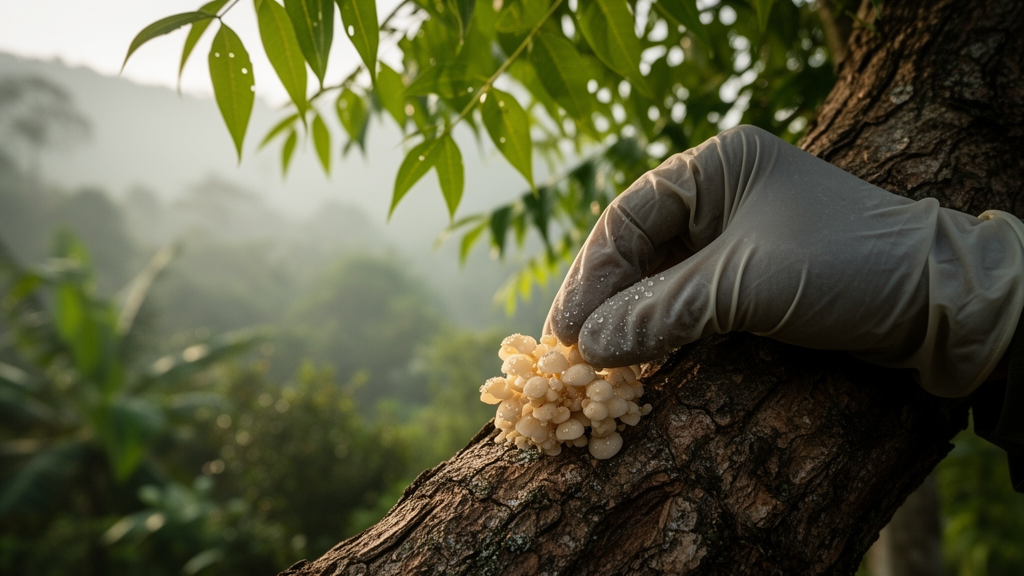
Deep in the forests of Chiang Rai Province in northern Thailand, dead neem branches have been quietly hosting organisms new to science. Researchers collecting decaying stems of Azadirachta indica, the celebrated neem tree of traditional medicine and natural pest control, have uncovered five saprobic microfungi, among them two species entirely unknown to mycology. The study, published in MycoKeys, not only names Neomassaria azadirachtae and Nigrograna azadirachtae as new species but also documents three additional fungi as new host records for neem and compiles the first comprehensive global checklist of microfungi associated with this economically vital tree genus.
Neem has long fascinated scientists for reasons far removed from fungi. Its fruits, leaves, and wood extracts are packed with secondary metabolites boasting antimicrobial activity, and the tree is cultivated across tropical Asia and beyond for natural pesticides, cosmetics, and pharmaceutical products. Yet while the plant’s chemistry has been dissected in hundreds of studies, the fungi that colonize its dead woody tissue, the saprobes that break it down and recycle its nutrients, have remained largely invisible. Most previous work on neem’s fungal partners focused instead on endophytes, the microorganisms living symptomlessly inside healthy leaves, stems, bark, and roots. The new study deliberately targets this blind spot, examining the fungi that emerge on dead stems bearing visible fruiting bodies.
Between June and October 2024, the team collected dead neem stems in Chiang Rai and brought them to the laboratory for detailed examination. Using stereomicroscopes and compound light microscopy, they documented the tell-tale reproductive structures of the fungi, from flask-shaped ascomata packed with sac-like asci to pycnidia producing chains of asexual spores. Pure cultures were established through single-spore isolation on potato dextrose agar, incubated at 25 to 30 degrees Celsius, and eventually deposited in the Mae Fah Luang University Culture Collection. This dual approach, pairing painstaking morphology with living cultures, remains the gold standard in fungal taxonomy, because neither appearance nor DNA alone can reliably settle a species’ identity.
The molecular backbone of the study came from sequencing five genetic loci: the internal transcribed spacer region (ITS), the large and small ribosomal subunits (LSU and SSU), and the protein-coding genes tef1-alpha and rpb2. These five markers were amplified by polymerase chain reaction and sequenced, then aligned with reference sequences from international databases. The researchers built separate phylogenetic trees using two independent statistical frameworks, maximum likelihood and Bayesian inference, and treated a species as new only when its strains formed a distinct, well-supported branch on both. Genetic distances between the new species and their closest relatives were calculated using the Kimura 2-parameter method, providing quantitative evidence to complement the morphological comparisons.
The first novelty, Neomassaria azadirachtae, announces itself on the host surface as semi-immersed, dark brown to black fruiting bodies, each 220 to 250 micrometres across, containing eight-spored, bitunicate asci and hyaline, single-septate ascospores. In a combined dataset of 5,256 characters across four loci, strains of the new species formed a distinct sister clade to four known Neomassaria species, supported by 83 percent maximum likelihood bootstrap and a Bayesian posterior probability of 99. Crucially, the species differs from its relatives not only genetically, with nucleotide differences reaching more than 14 percent in the rpb2 gene when compared with Neomassaria khayae, but also anatomically: its asci and ascospores are larger than those of N. sinensis and N. alstoniae, while its peridium architecture distinguishes it from N. khayae.
The second new species tells a different life-history story. Nigrograna azadirachtae was found only in its asexual, coelomycetous form, producing immersed pycnidia up to 485 micrometres long that release minute, single-celled, guttulate conidia just under four micrometres in length. Its conidiophores carry a diagnostic combination of terminal phialides and short peg-like lateral extensions, a signature feature of the genus. Multi-locus analysis placed the new species in a distinct clade sister to Nigrograna guttulata and N. peruviensis, with striking molecular divergence: differences of 7.7 to 7.8 percent in ITS and roughly 16 percent in rpb2 against N. guttulata. The genus Nigrograna is a genuinely eclectic group, encompassing wood-decaying saprobes, plant endophytes, and even human pathogens responsible for eumycetomas, which makes placing a new species within it ecologically significant.
Alongside the two novelties, the study extended the known ranges of three existing species. Aquadictyospora yunnanensis, previously recorded only on decaying coffee branches in Yunnan Province, China, was confirmed on neem in Thailand through a phylogeny in which the Thai strains clustered with the ex-type strain with 100 percent support, making this both a new host and a new geographical record. Neoaquastroma bauhiniae, originally described from dead twigs of Bauhinia variegata in Phrae Province, Thailand, was recovered on neem with larger ascomata, a thicker peridium, and longer asci than its type collection, yet its DNA placed it firmly within the species. Pararoussoella lincangensis, known from China and Thailand on unrelated hosts and even from forest soil, completed the set of new host records, clustering with its ex-type strain with maximum statistical support.
Beyond the species descriptions, the most consequential contribution may be the global checklist. Sifting through published literature, books, and authoritative databases such as Index Fungorum and the USDA fungal database, the authors assembled a list of 212 microfungal taxa and fungus-like Oomycota reported from Azadirachta species worldwide, excluding Basidiomycota. The numbers reveal a lopsided picture: 210 of those species come from neem itself, Azadirachta indica, while its only congener, A. excelsa, has yielded just a single fungal record. Taxonomically, the Pleosporales dominate with 43 species on neem, followed by Hypocreales with 24, and the most species-rich family is Pleosporaceae with 18 species. Geographically, India leads with 105 recorded species, followed by China with 45 and Pakistan with 25, while Thailand previously had no documented neem microfungi at all until the five species reported in this study.
The checklist also exposes how research bias shapes what we think we know about fungal ecology. Among species with documented lifestyles, endophytes dominate with 124 species, followed by 31 pathogens, only nine saprobes, and three arbuscular mycorrhizal fungi, while more than 50 species have no reported life mode at all. The authors attribute this skew to decades of bioprospecting: endophytes of neem are hunted for bioactive compounds with medicinal potential, so they receive disproportionate attention. Saprobes, despite performing the essential ecological work of litter decomposition and nutrient cycling, have been nearly ignored, and the new species described here, all collected from dead stems, directly begin to redress that imbalance. The neem tree’s rich antimicrobial chemistry may itself shape which saprobes can colonize its woody litter, a question the authors flag for future work.
Northern Thailand sits within the Greater Mekong Subregion, a recognized global biodiversity hotspot where previous surveys have estimated species novelty rates for fungi ranging from 55 to 96 percent. That even a host as intensively studied as neem can yield two new species from a single province underscores how incomplete the global fungal census remains, with recent estimates suggesting the vast majority of fungal species are still undescribed. The study’s framework, combining morphological scrutiny, multi-locus phylogenetics, and cumulative checklists, offers a template for closing these gaps. The authors argue that targeted sampling of Azadirachta across different regions and substrates, together with integrative taxonomic approaches, is essential to correct the current sampling biases, illuminate host-jumping patterns and host-shift speciation, and ultimately achieve a realistic estimate of the fungal diversity sheltered by this remarkable tree genus.
Subject of Research: Saprobic microfungi associated with the neem tree genus Azadirachta, including new species and a global checklist
Article Title: Microfungi associated with Azadirachta ( Meliaceae , Sapindales ): New species, new records, and a global checklist
Article References: Madagammana, A. D., Bhunjun, C. S., Phukhamsakda, C., Dai, D.-Q., Ali, S., Karunarathna, S. C., Hyde, K. D., & Wang, H. (2026). Microfungi associated with Azadirachta (Meliaceae, Sapindales): New species, new records, and a global checklist. MycoKeys, 142, 1-41. https://doi.org/10.3897/mycokeys.142.208876
Image Credits: AI Generated
DOI: 10.3897/mycokeys.142.208876
Keywords: mycology, Azadirachta indica, neem, Pleosporales, new species, Thailand, phylogenetics, fungal diversity, endophytes, saprobes, Dothideomycetes, biodiversity
News Source: Roger Howard. (October 15, 2026). Two New Fungal Species Discovered on Neem Trees in Northern Thailand. Scienmag.