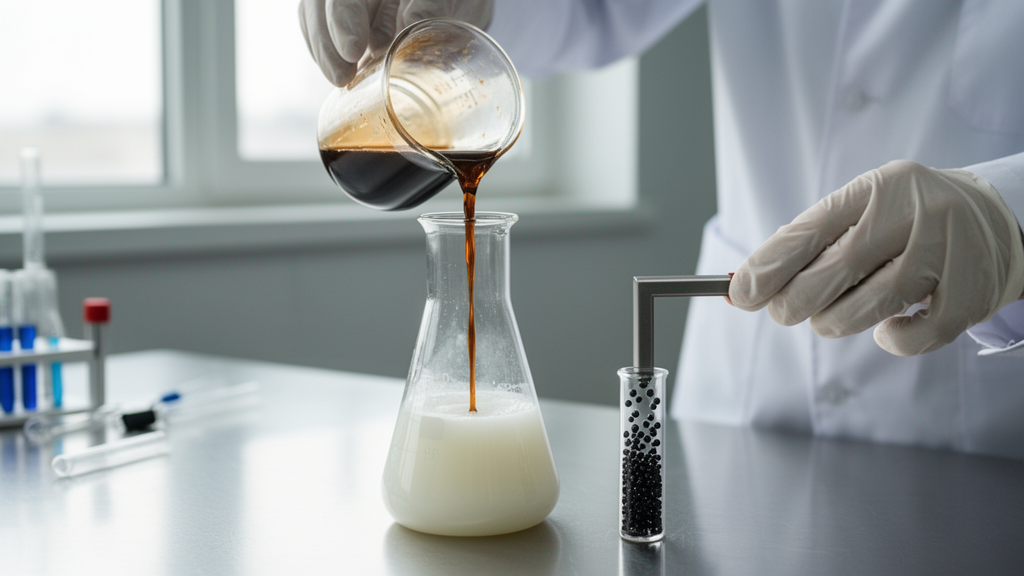
A team of materials scientists in Xi’an, China, has found a way to turn one of the humblest substances in soil—humic acid—into a powerful performance booster for waterborne polyurethane, one of the most widely used environmentally friendly coatings and adhesives in modern industry. By combining humic acid with magnetic iron oxide nanoparticles, researchers at Xijing University and Northwestern Polytechnical University created a nanocomposite emulsion whose films are dramatically stronger, more thermally stable, electrically conductive, and magnetically responsive than conventional waterborne polyurethane. The work, published in Polymer Bulletin, points toward a new generation of multifunctional coatings that could serve in electromagnetic shielding, flexible sensors, and smart functional surfaces.
Waterborne polyurethane has long been celebrated as the greener alternative to solvent-based polyurethane systems. Instead of releasing volatile organic compounds as it cures, it disperses in water, making it attractive for coatings, leather finishing, textiles, adhesives, and packaging. The catch has always been performance: neat waterborne polyurethane films typically lag behind their solvent-borne cousins in mechanical strength, thermal resistance, and functional properties. Closing that gap without sacrificing environmental credentials has become one of the central challenges in polymer science, and it is precisely the problem the Chinese team set out to solve.
The researchers built their material through what they describe as a dual-modification strategy, attacking the problem from two directions at once. The backbone of the polyurethane was synthesized from three workhorse reactants: isophorone diisocyanate, a cyclic diisocyanate prized for its weatherability and light stability; polycaprolactone diol with a molecular weight of 1000, a soft polyester segment that lends flexibility and toughness; and 2,2-bis(hydroxymethyl) propionic acid, a dimethylol carboxylic acid that acts as an internal emulsifier, providing the ionic groups that allow the polymer to disperse stably in water without external surfactants.
Into this polyurethane framework the team introduced two functional modifiers. The first was humic acid, a complex, heterogeneous organic macromolecule derived from the decomposition of plant and microbial matter, abundant in soil and peat and rich in carboxyl, phenolic, and quinone functional groups. Those oxygen-containing groups give humic acid a remarkable ability to interact with both inorganic surfaces and polymer backbones, acting as a natural bridge between the two worlds. The second modifier was nano-iron oxide, specifically magnetite, Fe3O4, chosen for its intrinsic magnetism and its capacity to confer electrical conductivity and electromagnetic functionality on an otherwise inert polymer.
Raw magnetite nanoparticles are notoriously difficult to work with. Bare Fe3O4 particles tend to agglomerate because of strong magnetic dipole-dipole attractions and high surface energy, and they bond poorly to organic polymer matrices, leading to defects that weaken rather than strengthen a composite. The researchers solved this by surface-functionalizing the nanoparticles with (3-isocyanatopropyl)triethoxysilane, or IPTS, a silane coupling agent whose isocyanate end can react with hydroxyl groups on the magnetite surface while the triethoxysilane end offers reactive handles compatible with the polyurethane chemistry. This molecular grafting dramatically improved the compatibility and dispersibility of the nanoparticles within the polyurethane matrix, ensuring that the filler actually reinforced the material instead of undermining it.
The characterization data told a striking story. Humic acid modification significantly reduced the average particle size of the emulsion droplets and improved colloidal stability—critical parameters for any waterborne dispersion, since smaller, more stable particles translate into smoother, more uniform films and longer shelf life. The team systematically varied the modifier content to identify the optimal formulation, a careful optimization that paid off in the final film properties.
The headline result came at an iron oxide loading of 2.0 weight percent. The resulting film, designated HA-FWPU3, exhibited a tensile strength of 23.01 megapascals, a 67.7 percent increase over the unmodified waterborne polyurethane counterpart. That magnitude of improvement from such a modest filler loading is notable, and it reflects the synergy between the two modifiers: the silane-grafted nanoparticles anchor firmly into the polymer network, while humic acid’s multifunctional groups promote stronger interfacial interactions and finer dispersion, so stress can be transferred efficiently from the soft polymer matrix to the hard inorganic phase.
Mechanical reinforcement was only part of the package. The nanocomposite films also showed improved thermal stability, meaning they can withstand higher processing and service temperatures without degrading—a key requirement for coatings and electronic applications. More intriguingly, the incorporation of magnetite imparted electrical conductivity and magnetic responsiveness to the films. The optimal formulation displayed a saturation magnetization of 6.01 emu per gram, confirming that the composite retains genuine magnetic character even within a polymer matrix that is itself completely nonmagnetic. That combination of conductivity and magnetism in a flexible, waterborne, environmentally benign film is precisely the profile sought for electromagnetic interference shielding materials and wearable sensor platforms.
The broader context makes the advance timely. Electromagnetic interference has become a pressing engineering problem as 5G communications, high-frequency electronics, and dense wearable devices proliferate, and much of the current research focuses on exotic fillers such as MXenes, graphene aerogels, carbon nanotubes, and silver nanowires. Those materials deliver impressive shielding performance but often carry high costs, complex processing requirements, or sustainability concerns. Humic acid, by contrast, is inexpensive, abundant, and biomass-derived. Pairing it with low-cost magnetite in a water-based polymer system offers a route to functional composites that are simultaneously high-performing and comparatively green—a combination that has proved elusive.
The authors suggest that the approach opens a feasible pathway for designing multifunctional waterborne polyurethane composites for electromagnetic shielding, sensors, and functional coatings. Because the chemistry builds on standard polyurethane emulsion synthesis—using conventional diisocyanates, polyols, and ionic emulsifiers—the dual-modification strategy could in principle be adopted by existing coating manufacturers without wholesale changes to production infrastructure. If scaled successfully, coatings based on this chemistry could one day shield electronics from interference, respond to magnetic fields, sense strain or touch, and do so with a formulation whose key modifier comes straight from the earth. For a material class built around environmental responsibility, adding magnetic muscle and electrical sensitivity without compromising that ethos may prove to be the advance that brings smart waterborne polyurethanes out of the laboratory and into everyday products.
Subject of Research: Humic acid-modified Fe3O4/waterborne polyurethane nanocomposite emulsions with enhanced mechanical, thermal, electrical and magnetic properties
Article Title: Fabrication and characterization of humic acid-modified Fe3O4/waterborne polyurethane nanocomposite emulsions
Article References: Fabrication and characterization of humic acid-modified Fe3O4/waterborne polyurethane nanocomposite emulsions. (n.d.). https://doi.org/10.1007/s00289-026-06733-7
Image Credits: AI Generated
DOI: 10.1007/s00289-026-06733-7
Keywords: waterborne polyurethane, humic acid, Fe3O4 nanoparticles, nanocomposite, silane coupling agent, magnetic properties, electrical conductivity, tensile strength, electromagnetic shielding, functional coatings, colloidal stability, polymer Bulletin
News Source: Bethany Barker. (October 15, 2026). Soil-Derived Humic Acid and Magnetic Nanoparticles Supercharge Waterborne Polyurethane. Scienmag.