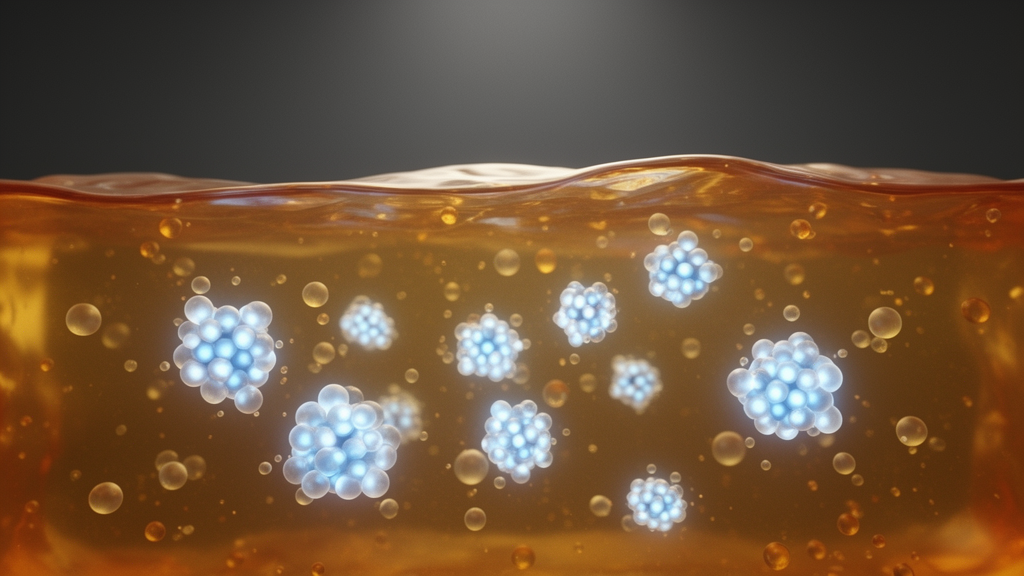
For more than three decades, the lithium-ion battery has been the workhorse of modern electronics and electric transport, yet the liquid heart of these devices has remained surprisingly opaque. The electrolyte, typically a lithium salt dissolved in organic carbonate solvents, governs nearly everything that matters in a cell: how fast ions move, how viscous the liquid is, how the solid electrolyte interphase forms on the anode, and ultimately how long and how safely the battery operates. Now a team of researchers from Columbia University, Schrödinger and the New York Structural Biology Center reports in Nature that this familiar liquid is far stranger than textbooks suggest. Using machine-learning-enabled molecular simulations validated against nuclear magnetic resonance spectroscopy and quantum-chemical calculations, they found that lithium ions do not simply drift through the solvent as isolated, individually solvated cations. Instead, at working concentrations, substantial fractions of lithium ions gather into multi-ion clusters wrapped in ethylene carbonate molecules, with no anions bound to them at all.
The discovery emerged from a high-dimensional, charge-recursive neural network force field, or QRNN, trained exclusively on quantum-chemical gas-phase cluster calculations. Traditional molecular mechanics force fields, the kind that have served protein simulation so well, struggle with the peculiar physics of concentrated polar organic electrolytes, while ab initio molecular dynamics is limited to tiny systems and short timescales. Machine-learning force fields promise the accuracy of quantum chemistry at a cost many orders of magnitude lower, and the team’s refined model delivered a picture that conventional force fields simply cannot see. In simulations of lithium hexafluorophosphate in ethylene carbonate, the QRNN trajectories showed a sharp peak in the lithium-lithium radial distribution function near three angstroms, a signature of cations sitting in close proximity. The widely used OPLS4 force field, run on the same systems, produced no such peak and placed more than ninety-nine percent of lithium ions in single-ion clusters.
The statistics are striking. At 1.2 molar salt concentration, roughly forty percent of lithium ions were found in multi-lithium clusters during the QRNN trajectories, corresponding to an average of about 1.3 lithium ions per complex. At 2 molar, that proportion climbed above sixty-eight percent, while at 0.5 molar it fell to around twenty-three percent, showing that clustering scales strongly with concentration. Some clusters contained two or three lithium ions, and at the highest concentrations a smaller number contained four or even five. Crucially, these aggregates consisted of lithium cations bridged by ethylene carbonate molecules through their carbonyl oxygens, with the hexafluorophosphate anions pushed away. The ethylene carbonate molecules act as molecular glue, their high dielectric constant and polarizability stabilizing the otherwise repulsive approach of multiple positive charges, something that would be impossible in the gas phase or in an ordinary organic solvent.
Because such a radical departure from accepted solvation pictures demands extraordinary evidence, the team subjected their model to a battery of validation tests. Association energies computed with the QRNN force field agreed with density functional theory calculations at the ωB97X-D3BJ/def2-TZVPD level to within chemical accuracy, meaning errors below one kilocalorie per mole, for structures drawn from both QRNN and OPLS4 trajectories. The OPLS4 force field, by contrast, erred by ten to one hundred times more, and performed especially poorly on the multi-lithium clusters. Lithium-lithium distance scans in the presence of solvent molecules revealed a clear energy minimum between 2.4 and 3.0 angstroms, which the QRNN model reproduced faithfully, and an ab initio molecular dynamics simulation of a nearly five-hundred-atom system confirmed that a di-lithium cluster remains stable in that minimum region over the course of the simulation.
The model also passed demanding condensed-phase tests without ever having seen experimental data during training. Predicted densities for seven common electrolyte solvents, including ethylene carbonate, propylene carbonate, vinylene carbonate, fluoroethylene carbonate and three linear carbonates, matched measured values closely, and viscosity predictions for lithium hexafluorophosphate in a three-to-seven ethylene carbonate and dimethyl carbonate mixture were accurate up to the highest practical salt concentrations, a marked improvement over the team’s earlier work. Ionic conductivities from the simulations agreed strongly with experimental values at working temperatures. Because the potential energy surface was parameterized purely against quantum-chemical calculations, these comparisons constitute a fully independent test, and the results make a compelling case that first-principles machine-learning force fields can represent a complex chemical system to atomic resolution.
Experimental corroboration came from solid-state nuclear magnetic resonance spectroscopy performed on flash-frozen electrolyte samples. Freezing the liquid preserves the local solvation structures that fast molecular exchange would otherwise blur at room temperature. Direct-polarization lithium-7 spectra captured the full lithium population, while proton-to-lithium cross-polarization experiments showed attenuated signal consistent with lithium binding to carbonyl oxygens with protons facing away. Most tellingly, fluorine-to-lithium cross-polarization produced almost no signal, even after fivefold amplification. Both contact ion pairs and anion-containing aggregates would place lithium and fluorine atoms close enough to generate strong dipolar couplings and enhance such transfer. The absence of that spectroscopic signature indicates that the frozen samples contain predominantly solvent-separated species, exactly the single- and multi-lithium clusters the simulations predicted.
Simulated carbon-13 spectra built from clusters extracted from the QRNN trajectories matched the experimental line shapes across three salt concentrations, reproducing both the spread in chemical shifts of ethylene carbonate molecules bound in lithium clusters and the gradual growth of a shoulder on the carbonyl peak as concentration increased. When the identical protocol was applied to OPLS4 trajectories, the simulation adequately predicted spectra for dilute samples dominated by single-lithium structures but deviated from experiment once multi-lithium clusters became prevalent, particularly at carbon sites closest to the lithium ions. The agreement between a purely computational prediction and cryogenic solid-state NMR measurements provides some of the strongest evidence yet that these unusual cation aggregates are real features of the working electrolyte, not artifacts of a neural network’s imagination.
Why does this matter for the battery itself? The reduction potentials of electrolyte species determine what happens when the cell is first charged, when the anode draws electrons and the solid electrolyte interphase begins to form. Quantum-chemical calculations of one-electron reduction potentials, referenced to the lithium/lithium-ion couple through the ferrocenium/ferrocene standard, showed that the most common single-lithium complex, LiEC4, reduces at a much lower voltage than the family of di-lithium complexes such as Li2EC7. Experimentally, interphase formation begins at approximately 0.8 volts versus lithium/lithium-ion on both graphite and silicon anodes. The single-lithium clusters would not be spontaneously reduced at that voltage, but the di-lithium species fall within a tenth of a volt of it, and they appear to undergo even more favorable second one-electron reductions afterward. In other words, the multi-lithium clusters may not merely participate in the initial formation of the interphase; they may govern it, with the excess electron localizing on a carbonate moiety of an ethylene carbonate ligand shared between two lithium centers.
The finding finally offers a mechanistic explanation for one of battery chemistry’s oldest empirical choices: why ethylene carbonate has been indispensable in commercial electrolytes since the 1990s. Its unusual combination of high dielectric constant and polarizability in an aprotic solvent appears to be exactly what enables multiple lithium ions to co-complex around bridging carbonyl oxygens, creating the species that reduce at the right voltage to build a protective interphase. Beyond the specific chemistry, the work is a proof of concept that machine-learning force fields trained without any experimental input can uncover surprising phenomena in systems far more complex than liquid water, spanning elements across the periodic table. The team now plans to extend the platform to other solvents, salts and additives, and to add electrode models, reactive chemistry and applied voltage, aiming for an atomic-level picture of interphase formation. If successful, large-scale graphics-processing-unit-based simulation could become a genuine engineering tool, allowing electrolytes to be designed computationally rather than discovered by trial and error, with consequences for battery efficiency, cost and the broader electrification of transport and grid storage.
Subject of Research: Multi-lithium-ion clustering in lithium-ion battery electrolytes revealed by machine-learning molecular simulations and solid-state NMR spectroscopy
Article Title: Evidence for multi-Li+ clustering in lithium-ion battery electrolytes
Article References: Evidence for multi-Li+ clustering in lithium-ion battery electrolytes. (n.d.). https://doi.org/10.1038/s41586-026-11138-7
Image Credits: AI Generated
DOI: 10.1038/s41586-026-11138-7
Keywords: lithium-ion batteries, electrolytes, machine-learning force fields, molecular dynamics, solid-state NMR, solvation structure, solid electrolyte interphase, ethylene carbonate, quantum chemistry, reduction potentials, computational chemistry, energy storage
News Source: Faith Mcneil. (October 15, 2026). Hidden lithium clusters revealed inside battery electrolytes. Scienmag.