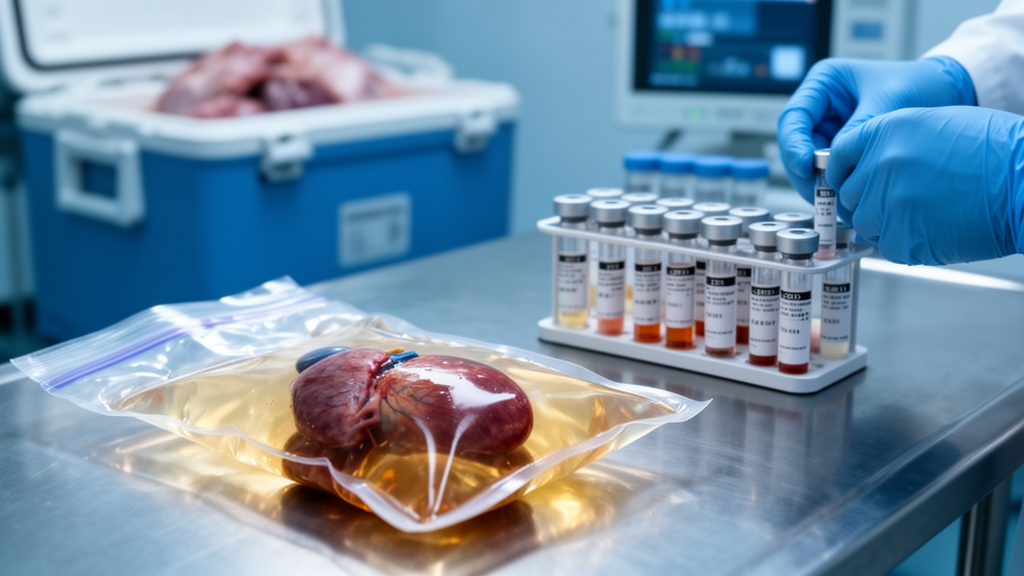
Every donated organ travels to its new owner bathed in a cold preservation fluid, and every so often, that fluid turns out to be positive when the transplant team cultures it in the laboratory. For decades, this has been one of the most frustrating gray zones in transplantation medicine: a positive culture might mean nothing more than harmless contamination picked up during the procurement operation, or it might be the first warning that a dangerous microbe is riding along with the graft. A new retrospective donor-recipient cohort study from the Affiliated Hospital of Qingdao University, published in BMC Infectious Diseases, now offers transplant physicians a sharper way to read that signal, and its findings could change how organ procurement teams interpret microbiology results in the critical first week after surgery.
The research team, led by Shuai Feng and Chuanshen Xu of the hospital’s Organ Transplantation Center, together with critical care specialist Xiaoyan Zhu, set out to disentangle two very different phenomena that hide behind a single laboratory report. When preservation fluid grows bacteria or fungi, clinicians currently have little guidance on whether the finding deserves aggressive antibiotic therapy in the recipient or can be safely watched. Overtreating every positive culture fuels antimicrobial resistance and exposes vulnerable patients to unnecessary drug toxicity, while undertreating a genuine donor-derived infection can be catastrophic in a patient whose immune system is deliberately suppressed to protect the new organ.
To address this dilemma, the investigators analyzed 2024 transplant data from their single center, carefully deduplicating donor records so that each deceased donor was counted only once. The final cohort comprised 135 deceased donors contributing 354 graft-level observations of liver or kidney transplantation, of which 352 could be evaluated for the primary endpoint. That endpoint was deliberately broad: a composite early donor-derived infectious event occurring within seven days of transplantation, encompassing confirmed donor-derived infection, suspected or probable donor-derived infection, and treated-potential donor-derived infectious events where clinicians acted on a potential threat without full diagnostic confirmation.
The central innovation of the study lies in how it classified preservation-fluid results. Rather than treating any positive culture as equivalent, the team developed an adjudication framework for what they termed clinically relevant preservation-fluid positivity, abbreviated PF_CP. This recipient-specific measure distinguished microbiologically high-risk findings from low-risk contaminants by considering the organism involved, its virulence, and the clinical context. The researchers also examined whether the same organisms appeared in both the donor’s respiratory tract and the preservation fluid, a pattern called respiratory-preservation fluid concordance that might indicate a true donor-origin microbial signal rather than a procurement artifact.
The results were striking. Seventy-one composite early donor-derived infectious events occurred across the cohort: fifteen confirmed, twenty-two suspected or probable, and thirty-four treated-potential events. When the researchers split recipients by their preservation-fluid status, the difference was dramatic. Among the 113 recipients whose fluid met the clinically relevant positivity criteria, 46 percent experienced a composite event, compared with just 7.9 percent of the 239 recipients whose fluid did not. In statistical terms, after adjusting for other factors using donor-clustered generalized estimating equations, clinically relevant preservation-fluid positivity carried an adjusted odds ratio of 10.28, meaning these recipients faced roughly ten times the odds of an early donor-derived infectious event.
The analysis grew more informative when respiratory concordance entered the model. Even with that additional variable included, clinically relevant fluid positivity remained strongly associated with the composite endpoint, with an adjusted odds ratio of 6.11. Independently, donor respiratory-preservation fluid concordance was also associated with the endpoint, at an adjusted odds ratio of 2.78. This suggests that when the same organism is recovered from the donor’s airways and the organ preservation fluid, it may genuinely reflect organisms circulating in or colonizing the donor, providing transplant teams with a second, independent microbiological clue about donor-derived risk.
Recognizing that their broad composite endpoint included events treated on suspicion alone, the researchers performed a sensitivity analysis restricted to confirmed or suspected and probable donor-derived infections, excluding the treated-potential category. Clinically relevant fluid positivity remained firmly associated with this stricter endpoint, with an adjusted odds ratio of 6.44. A post hoc review of organism-level data added further biological plausibility: among 109 organism-evaluable observations of clinically relevant positivity, fifteen showed genus or species concordance between the preservation fluid and the recipient’s own cultures. Notably, these matched pairs included three involving Candida species and four involving carbapenem-resistant Klebsiella pneumoniae, one of the most feared multidrug-resistant organisms in modern hospitals.
The study also touched on a surgical question that has long divided procurement teams: whether organs should be removed through abdominal-only procurement or through thoracoabdominal procurement, in which the chest is opened as well. In exploratory interaction analyses, the researchers found a possible effect modification by thoracoabdominal procurement, with an interaction adjusted odds ratio of 4.60. In other words, the strength of the association between clinically relevant fluid positivity and infectious events might differ depending on which procurement technique was used, perhaps because opening the thorax alters the microbial exposure of the organs or the composition of the fluid. The authors are careful, however, to label this finding hypothesis-generating: the confidence interval was wide, spanning 1.29 to 16.41, and the imprecision means the interaction requires confirmation in larger, independent cohorts before it should influence surgical practice.
What emerges from the study is a clear argument for risk-stratified interpretation of preservation-fluid cultures rather than reflexive treatment of every positive result. Under the framework proposed by the Qingdao team, a transplant infectious disease physician would weigh whether the organism recovered from the fluid is a recognized pathogen, whether it matches organisms found in the donor’s respiratory tract, and whether the recipient’s subsequent cultures show concordant organisms. Only findings meeting clinically relevant criteria would trigger targeted antimicrobial escalation, while low-risk contaminants could be observed, conserving antibiotics and reducing the selective pressure that drives multidrug-resistant organisms. In an era when carbapenem-resistant Klebsiella pneumoniae and Candida infections threaten transplant programs worldwide, such stewardship is not merely an efficiency measure but a safety imperative.
The study’s limitations are those inherent to its design. It was conducted at a single center over a single year, its retrospective nature means treatment decisions were not standardized, and the composite endpoint blends events of varying diagnostic certainty, even though the sensitivity analyses partially address this concern. The adjudication framework for clinically relevant positivity, detailed in the supplementary materials, will need external validation before other centers adopt it wholesale. Nevertheless, the magnitude and consistency of the associations, the biological plausibility provided by organism-level concordance, and the independence of the respiratory concordance signal together make a compelling case that preservation fluid is not just a transport medium but a diagnostic specimen in its own right. For the thousands of patients each year who receive liver and kidney grafts from deceased donors, the fluid surrounding their new organ may soon speak more clearly than ever before, guiding clinicians toward precisely the protection they need and away from the antibiotics they do not.
Subject of Research: Preservation-fluid contamination and donor-derived infection risk after liver and kidney transplantation
Article Title: Recipient-specific preservation-fluid contamination, thoracoabdominal procurement and early donor-derived infectious events after liver and kidney transplantation: a retrospective donor-recipient cohort study
Article References: Feng, S., Liu, J., Zhao, S., Zhang, L., Cai, J., Zhu, X., & Xu, C. (2026). Recipient-specific preservation-fluid contamination, thoracoabdominal procurement and early donor-derived infectious events after liver and kidney transplantation: a retrospective donor-recipient cohort study. BMC Infectious Diseases. https://doi.org/10.1186/s12879-026-14510-0
Image Credits: AI Generated
DOI: 10.1186/s12879-026-14510-0
Keywords: organ transplantation, preservation fluid, donor-derived infection, liver transplantation, kidney transplantation, thoracoabdominal procurement, antimicrobial stewardship, multidrug-resistant organisms, Klebsiella pneumoniae, Candida, deceased donors, BMC Infectious Diseases
News Source: Kristina Jarvis. (October 15, 2026). Contaminated Preservation Fluid May Signal Real Infection Risk in Transplant Recipients. Scienmag.