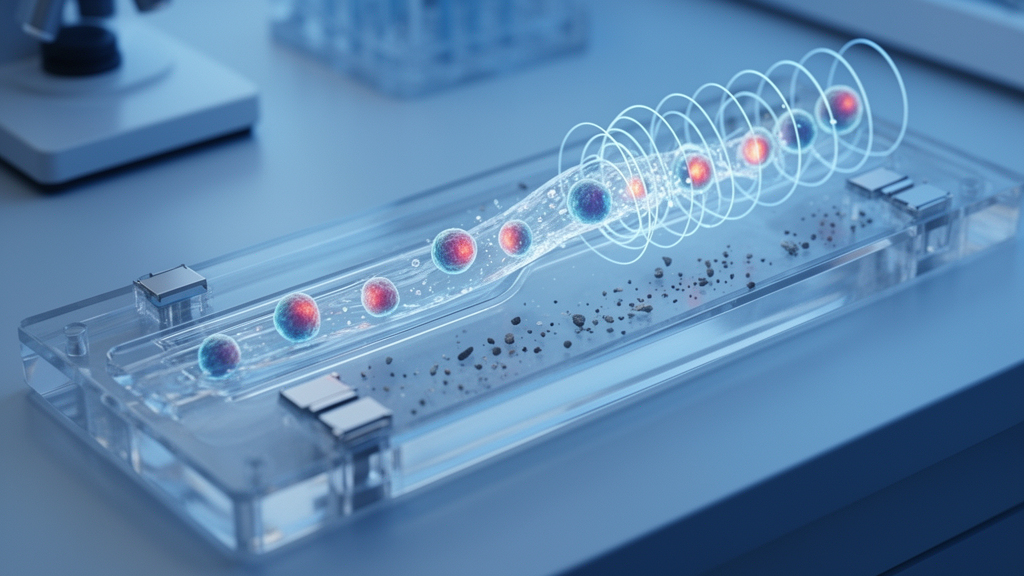
A tiny chip that uses nothing but sound waves to steer living cancer cells away from a cloud of nanoscale fibers has demonstrated recovery rates approaching 100 percent in a new study published in Results in Engineering. The device, developed by Mahdi Moghimi, Naeim Jalali, and Fereshteh Abbasvandi, tackles one of the most stubborn problems in liquid biopsy: how to pull rare, micrometer-scale tumor cells out of a suspension that is teeming with material thousands of times smaller, without labels, filters, or the clogging that plagues conventional approaches.
The technology belongs to a field called acoustofluidics, which exploits the fact that sound waves traveling through a fluid exert forces on suspended particles. When two surface acoustic waves, generated by interdigital transducers etched onto a piezoelectric lithium niobate substrate, meet inside a microchannel, they create a standing pressure field. Particles suspended in that field experience an acoustic radiation force that pushes them toward or away from pressure nodes. Crucially, this force scales strongly with particle volume, so a 15-micrometer cancer cell feels a vastly stronger push than an 80-nanometer particle. The research team exploited exactly this size asymmetry to split their two-component streams into different outlets.
Designing the chip was a careful balancing act. The researchers compared two frequency-scaled geometries numerically before committing to fabrication: one operating at 3.75 megahertz with a 200-micrometer-wide main channel, and a rescaled 5.4-megahertz design with a narrower 137-micrometer channel. Using COMSOL Multiphysics simulations that coupled laminar flow, acoustic fields, and particle tracing, they found that the 3.75-megahertz geometry reached stable outlet assignment at a substantially lower forcing threshold. At the higher frequency, the required boundary velocity jumped roughly sevenfold. The team stresses that this is a system-level result reflecting the coupled influence of channel width, acoustic node placement, interaction length, and residence time, not a simple frequency effect. The lower-threshold 3.75-megahertz design was therefore the one that went to the cleanroom.
The channel geometry itself was dictated by the physics. At 3.75 megahertz, the acoustic half-wavelength in water is approximately 200 micrometers, so the main channel was sized to match, allowing a single transverse pressure node to form at 70 percent of the channel width. The interdigital transducers were defined from the surface acoustic wavelength of 1.0368 millimeters, with finger widths of about 259 micrometers and 35 finger pairs. Inlets and outlets branch off at 15 degrees to preserve smooth hydrodynamic focusing, and the acoustic interaction zone stretches 9 millimeters along the channel, giving cells enough residence time to migrate laterally before the flow splits.
Fabrication combined two independent processes. A silicon wafer was patterned with a 40-micrometer-tall SU-8 master, from which a PDMS microchannel was replica-molded. Meanwhile, titanium and gold electrodes were sputtered and wet-etched onto the lithium niobate substrate. The two layers were aligned so the channel sat squarely within the acoustic aperture, then bonded with oxygen plasma and mounted on a glass support to protect the fragile piezoelectric substrate. The result was a sealed, reusable microchip in which a 1-microliter-per-minute sample stream, hydrodynamically focused by a 10-microliter-per-minute sheath flow, passes through the standing-wave region in single file.
For biological validation, the team used MCF-7 human breast adenocarcinoma cells as tumor-cell models, deliberately switching from their standard DMEM culture medium to RPMI-1640 supplemented with serum and EDTA to suppress the adhesion and aggregation that had caused clogging in preliminary tests. As the nanoscale counterpart, they used cellulose nanofibers of 20 to 50 nanometers, a non-biological model material chosen to represent the size range of extracellular vesicles without claiming to characterize the vesicles themselves. The authors are explicit about this distinction: the experiments establish physical outlet assignment in a controlled model system, not clinical extracellular-vesicle isolation.
The experimental results are striking. At 20 volts peak-to-peak, target-outlet recovery was 152 of 153 cells for a 51-cell input, 316 of 318 for 106 cells, and 735 of 756 for 252 cells, corresponding to run-level means between 97.2 and 99.4 percent with coefficients of variation no greater than 1.63 percent. Post-processing viability, measured by trypan blue staining, ranged from about 82 to 89 percent. Paired no-acoustic controls at zero voltage confirmed that the redirection was genuinely actuation-dependent: without sound, every single cell followed the carrier-flow outlet, while passage through the chip alone preserved viability above 98 percent. Voltage screening at 18 volts showed incomplete migration, mapping out the lower edge of the operating window.
The cellulose nanofibers behaved exactly as the size-scaling argument predicted. Across nine runs at 250, 500, and 1000 micrograms per milliliter, the nanofiber suspension consistently exited through the carrier-flow-directed outlet, verified by visual turbidity and centrifugation-based pellet assessment, while the target outlet stayed clear. Mixed-sample testing then revealed an important boundary. At 250 micrograms per milliliter, cell recovery and viability matched the cell-only results. But at 1000 micrograms per milliliter, although recovery remained high at 95 percent, post-processing viability collapsed to roughly 36 percent, a nearly 49-percentage-point drop that the authors report as a descriptive effect without assigning a mechanism, since no nanofiber-only cell-exposure control was included.
Thermal management, a known concern for living-cell acoustofluidics, was addressed with contact thermometry at the glass surface adjacent to the channel. The maximum recorded temperature across the actuation range was 38.5 degrees Celsius, comfortably below levels typically considered harmful to cells, although the authors note this characterizes local surface response rather than the full intrachannel temperature field. Notably, all 38 experimental runs were completed on a single reusable device using a standardized cleaning protocol of PBS and ethanol flushes, with no observed clogging, leakage, or delamination, demonstrating operational stability that is often absent from single-use microfluidic demonstrations.
The study is candid about its limits. All results come from one fabricated chip, so device-to-device reproducibility remains untested; the nanofiber endpoint is qualitative rather than a quantitative recovery measurement; and MCF-7 cells do not reproduce the rarity and heterogeneity of patient-derived circulating tumor cells. The authors position the platform as a downstream model-system module with a clearly defined operating window, a deliberate contrast to claims of whole-blood processing in a single device. Within that scope, the work delivers something the field has lacked: a single experimentally validated regime linking frequency-scaled geometry selection, hydrodynamic controls, low-count recovery, viability, thermal screening, and nanoscale loading boundaries. If future iterations can transfer this operating logic to biologically characterized extracellular vesicles and clinical samples, sound-driven chips of this kind could become a label-free workhorse for the sample-preparation bottleneck that currently constrains liquid biopsy.
Subject of Research: Size-selective surface acoustic wave acoustofluidic separation of MCF-7 tumor-cell models from cellulose-nanofiber suspensions in a reusable microchip
Article Title: Size-selective SAW acoustofluidic microchip for separating MCF-7 tumor-cell models from cellulose-nanofiber suspensions
Article References: Moghimi, M., Jalali, N., & Abbasvandi, F. (2026). Size-selective SAW acoustofluidic microchip for separating MCF-7 tumor-cell models from cellulose-nanofiber suspensions. Results in Engineering, 32, Article 113494. https://doi.org/10.1016/j.rineng.2026.113494
Image Credits: AI Generated
DOI: 10.1016/j.rineng.2026.113494
Keywords: acoustofluidics, surface acoustic waves, liquid biopsy, circulating tumor cells, MCF-7 cells, cellulose nanofibers, microfluidics, label-free separation, extracellular vesicles, piezoelectric transducers, cell viability, lab-on-a-chip
News Source: Nathaniel Bowman. (October 15, 2026). Sound-Powered Microchip Sorts Tumor Cells From Nanoscale Debris With Near-Perfect Recovery. Scienmag.