For decades, the safety case for plastics has rested on a single, reassuring assumption: that plastic is chemically inert. That inertness is why the material wraps our food, bottles our water, and fills our children’s toy boxes without raising alarms. A new study from Columbia University and the University of California, Berkeley, published in the journal Nature, now upends that assumption at the scale where it matters most. When bulk plastic breaks down into micro- and nanoparticles, the researchers report, its surfaces become chemically active in water, spontaneously generating reactive molecules that are textbook causes of biological damage.
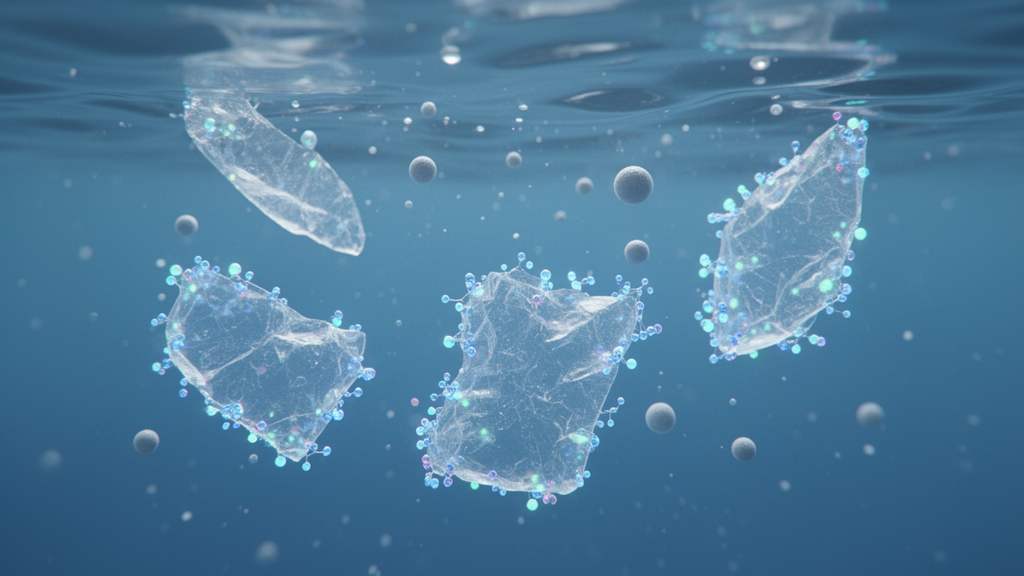
The central insight of the study is deceptively simple. As a piece of plastic fragments into ever smaller particles, the ratio of its surface area to its volume increases dramatically. A vast proportion of the material’s mass suddenly sits at an interface, in direct contact with its surroundings. In the environments where microplastics end up, that surrounding medium is almost always water, whether in a bottle, a river, or the interior of a living cell. The Columbia team found that this contact is anything but passive. The plastic-water interface becomes a site of chemical reactivity, producing reactive oxygen species, or ROS, a family of highly reactive radicals well known to biologists for their capacity to damage tissue.
Wei Min, a professor of Chemistry and Biomedical Engineering at Columbia, described the phenomenon in stark terms. As plastic fragments into smaller and smaller particles, he explained, its surface area increases enormously, and the microplastics then change the water that surrounds them, generating high-energy reactive radicals that very likely contribute to the biological damage observed in animals and potentially in humans as a result of microplastic exposure. The finding challenges the prevailing view of microplastics as largely passive shards of inert material and offers a chemical explanation for a growing body of epidemiological concern.
The mechanism itself is subtle and, until now, overlooked. Water, the researchers found, is not a mere spectator in this process but a key active player. Water molecules become chemically active when they come into contact with plastic, which is hydrophobic and repels them. That contact creates an environment that facilitates electron transfer and the formation of reactive radicals. The theoretical side of the work, led by Professor Teresa Head-Gordon’s laboratory at UC Berkeley, used calculations and dynamical simulations to pin down the details: hydroxide ions promoted into the immediate water layers near the hydrophobic microplastic interface can more easily lose an electron, creating hydroxide radicals. The more hydrophobic the plastic, the more pronounced the effect, meaning the very property that makes many commodity plastics useful may also make them chemically troublesome at the nanoscale.
Naixin Qian, a postdoctoral researcher in Min’s laboratory who helped lead the research, emphasized the biological stakes. When microplastics interact with water, as they do in bottled water or after being absorbed into the bloodstream, they spontaneously generate reactive oxygen species, she said, and ROS are textbook examples of the kinds of molecules that can damage animal and human tissue. Because human blood is roughly 50 percent water and individual human cells are generally 60 to 80 percent water, microplastics that enter the bloodstream or cells would find themselves in precisely the water-rich environment in which this reactivity flourishes.
The new study builds directly on a striking 2024 finding from the same Columbia group. That earlier work developed a laser-based microscope technology capable of visualizing nanoplastics and discovered that, on average, a liter of bottled water contained some 240,000 detectable plastic fragments, most of them nanometer-sized. That figure was 10 to 100 times higher than previous estimates, and it forced a broad recognition that micro- and nanoplastics permeate the food system at levels far beyond what conventional measurement had captured. The 2024 study attracted widespread media attention and helped push microplastics onto the public health agenda.
That agenda is now moving quickly. This year, the United States federal government launched a 144 million dollar program to combat toxic microplastics in the human body, and the U.S. Environmental Protection Agency recently added microplastics to a federal list of contaminants that may pose a concern for drinking water, the first time the material has appeared on the list. Meanwhile, research published in prominent journals including the New England Journal of Medicine, Nature Medicine, and Nature Health has reported links between micro- and nanoplastic exposure and heart attack, stroke, dementia, and brain tumor. What had been missing was a mechanism. Given the supposed inertness of plastic, it was unclear how passive fragments could contribute to such illnesses. The new study specifies a previously overlooked pathway that might help bridge that gap.
The implications extend beyond the human body. Beizhan Yan of Columbia’s Lamont-Doherty Earth Observatory, a co-author of the study, noted that microplastics form and enter aquatic environments in settings such as discharges from plastic manufacturers and laundromats. If radicals can form on hydrophobic plastic surfaces in water, as the study indicates, then ecosystems exposed to these particles may face chemical stress that has gone entirely unmeasured. Yan also pointed out that everyday activities and processes generate microplastics, including microwave heating and sunlight exposure of bottled water during storage, meaning that the conditions for interfacial reactivity may arise in ordinary consumer situations, not just in industrial or environmental settings.
For Head-Gordon, the fundamental discovery opens a door to engineering solutions. If the most hydrophobic microplastics interacting with water can drive chemical reactivity, then redesigning the chemistry of commodity plastics to reduce that reactivity could ultimately lessen toxic outcomes for health and the environment. Such an approach would treat the problem at its source, rather than attempting to scrub particles from water supplies after the fact, and it reframes plastic formulation as a question of interfacial chemistry rather than bulk material properties alone.
The study, titled Intrinsic physicochemical activity at microplastic-water interfaces, was published on 14 October 2026 in Nature and is described as an experimental study, with the authors declaring no competing interests. Its significance lies less in any single measurement than in a conceptual shift: microplastics are not merely physical irritants or vectors for attached pollutants, but chemically active participants in their environment. If the formation of reactive oxygen species at plastic-water interfaces is confirmed across particle types and biological settings, it would supply the long-sought mechanistic link between the particles now found everywhere in the environment and the cellular damage increasingly associated with them, and it would give regulators, manufacturers, and public health agencies a concrete chemical target in the effort to make plastics safer.
Subject of Research: Chemical reactivity at microplastic-water interfaces generating reactive oxygen species
Article Title: Microplastics are chemically active, and could cause biological harm
Article References: Microplastics are chemically active, and could cause biological harm. (n.d.). Original publication
Image Credits: AI Generated
DOI: Not provided
Keywords: microplastics, nanoplastics, reactive oxygen species, water chemistry, human health, Nature journal, Columbia University, UC Berkeley, hydrophobic interfaces, radicals, bottled water, public health
News Source: Bethany Barker. (October 15, 2026). Microplastics Turn Chemically Reactive in Water, Raising New Health Concerns. Scienmag.