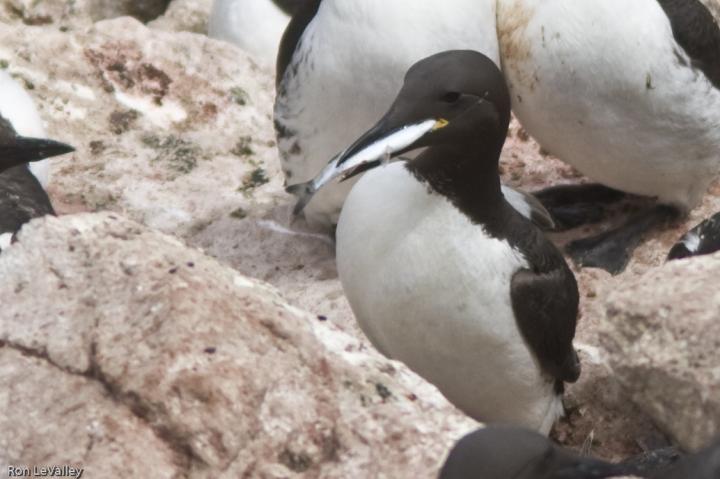
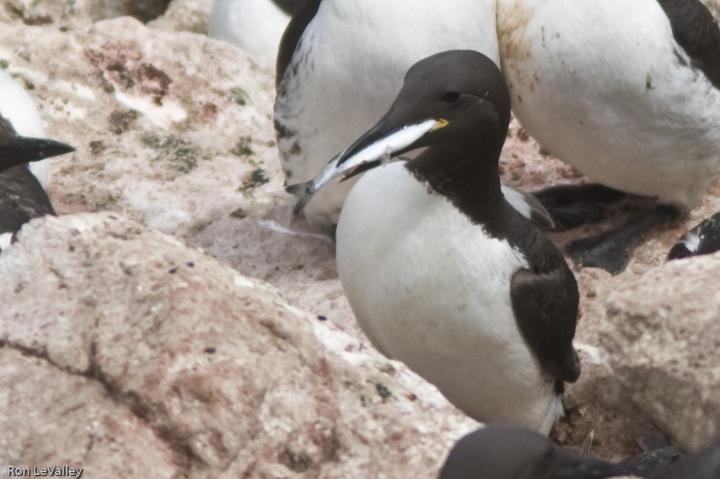
Credit: Point Blue Conservation Science
Interpreting relationships between species and their environments is crucial to inform ecosystem-based management (EBM), a priority for NOAA Fisheries. EBM recognizes the diverse interactions within an ecosystem — including human impacts — so NOAA Fisheries can consider resource tradeoffs that help protect and sustain productive ecosystems and the services they provide.
In the coastal ocean of California — seabird predators, forage fish on which they feed, and the survival of salmon out-migrating to sea are each of particular interest, and an improved understanding of their interactions could in turn improve the management of the ocean ecosystem.
For example, in the California Current, understanding the interactions between predator seabirds, forage fish in the coastal ocean and out-migrating salmon from San Francisco Bay could improve the understanding of salmon early survival in the ocean and a measure of the possible strength of the year class return.
In the Gulf of the Farallones, new research by scientists from NOAA Fisheries' Southwest Fisheries Science Center, Point Blue Conservation Science, H.T. Harvey and Associates, University of California Santa Cruz, U.S. Geological Survey and the U.S. Fish and Wildlife Service found that the common murre, a small ocean seabird, can make a difference in the number of salmon that survive to return as adults. This is especially true when ocean conditions cause the murres to feed primarily on salmon and anchovy. The research has been published online in the Journal of Marine Systems, and will be included in the journal's October print issue.
Large colonies of more than 500,000 common murres nest throughout the Gulf of the Farallones, offshore of San Francisco. In typical years, with nutrient-rich water welling up from the depths, the murres prey primarily on young rockfish around their offshore breeding sites.
When ocean conditions change, and the upwelling falters, young rockfish that are the typical prey for the murres become scarce. Then the murres switch, feeding instead on adult northern anchovies found closer to shore. That's a problem for the young salmon entering the ocean at these near-shore locations, because the murres eat them too.
The finding documents one of the first examples of what biologists call "bottom-up" influences — changes at the base of the food web — causing "top-down" effects on West Coast salmon, such as an increase in predation by a species higher in the chain, in this case the common murres.
"This is the first example we've found involving salmon where bottom-up drivers are causing top-down impacts," said NOAA Fisheries research biologist Brian Wells, lead author of the research. "The lack of upwelling affects salmon in a top-down way."
The new research shows that salmon survival drops sharply in the years when ocean conditions lead the murres to prey on anchovy and salmon. Even in years when the murres are preying on anchovy, salmon comprise less than 10 percent of the diet of the murres; but the impact can be a significant factor in the survival of salmon. The research concludes that predation by the seabirds can make a difference in the number of salmon that survive to return as adults.
The salmon affected are primarily fall-run Chinook, which are the primary species supporting salmon fisheries off the California Coast. The research helps reveal the complex relationships between species and their environment, which in turn helps NOAA Fisheries anticipate and respond to changes that affect fish, birds and people.
For example, the murres preyed heavily on anchovy and salmon in 2005, which likely contributed to the collapse of the California salmon fishery in 2007 and 2008, the researchers found. Congress appropriated $170 million in disaster relief for fishermen affected by the collapse.
NOAA Fisheries managers can use the details to make better decisions about how best to protect and manage marine species.
"Understanding the dynamics behind these connections can help us anticipate impacts to salmon, which are very important both economically and environmentally," said John Field, a research fisheries biologist at the SWFSC in Santa Cruz. "That can help fisheries managers make smart and informed decisions about how to manage these species into the future."
###
Media Contact
Michael Milstein
[email protected]
503-231-6268
@NOAAFish_WCRO
http://www.westcoast.fisheries.noaa.gov/index.html
Original Source
https://swfsc.noaa.gov/news.aspx?ParentMenuId=54&id=22643 http://dx.doi.org/10.1016/j.jmarsys.2017.05.008