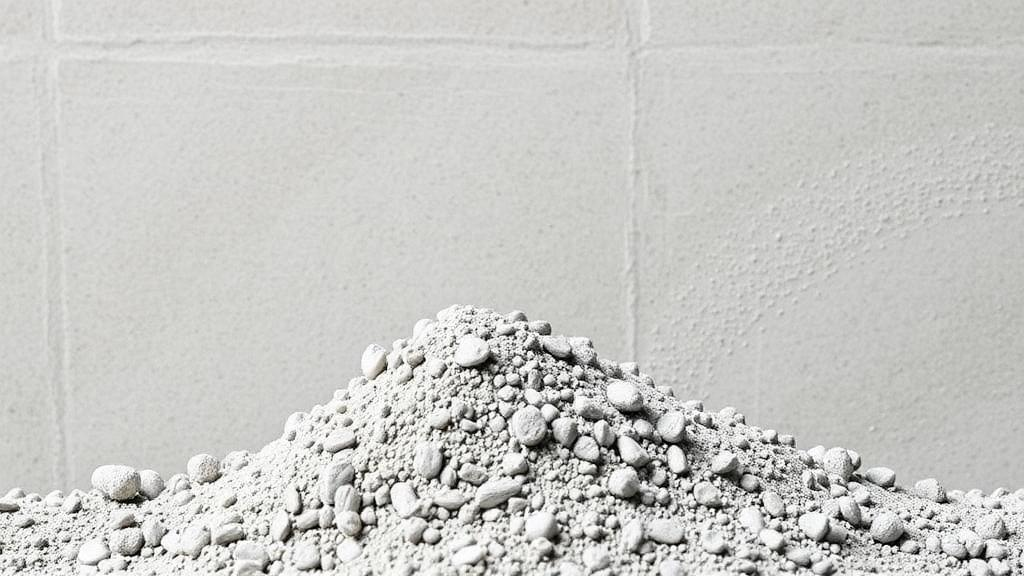
Cement is the quiet giant of the climate crisis. Producing it accounts for roughly eight percent of global carbon dioxide emissions, and the world’s appetite for concrete shows no sign of slowing. Yet every demolished building contains a largely overlooked resource: the hardened cement paste that once glued sand and gravel together. A new comparative analysis published in Case Studies in Construction Materials takes the most systematic look yet at how this recycled cement paste can be reactivated into a useful cement substitute, and the verdict is more nuanced than either camp of researchers might have hoped.
The study, led by Maureen Denu of the Karlsruhe Institute of Technology with colleagues from KIT, TU Munich, and Heidelberg Materials, sifted through 200 published studies and distilled 57 that met strict criteria into a single quantitative dataset. The team focused on laboratory-prepared recycled cement paste, the reactive heart of construction and demolition waste, and compared the two most prominent activation routes: heating the material to drive off water and rebuild reactive minerals, or treating it with carbon dioxide to lock the gas away and create pozzolanic gel. To make the comparison fair, the authors introduced two indices. The Activity Index measures a property such as strength or heat release against ordinary Portland cement, while the Impact Index measures the same property against unactivated recycled paste, isolating what the activation itself actually contributes.
Thermal activation is the older and better-mapped of the two techniques, with roots stretching back to work on hardened cement paste in the early 1980s. The chemistry unfolds in stages. Around 110 degrees Celsius, free and chemically bound water begin to escape from calcium silicate hydrate, ettringite, and related phases. Between 400 and 500 degrees, portlandite, or calcium hydroxide, dehydrates into reactive calcium oxide. From roughly 600 degrees onward, calcium carbonate decomposes and releases carbon dioxide. Crucially, between about 390 and 490 degrees the dehydrated silicate gel reorganizes into belite-like phases, and depending on the thermal regime these can form reactive polymorphs similar to alpha-prime C2S. Above roughly 800 degrees, however, those reactive forms collapse into the stable but sluggish beta-C2S, and rapid cooling can trigger the same loss of reactivity. The sweet spot, the analysis confirms, sits near 600 degrees.
Carbonation activation works in the opposite chemical direction. In wet carbonation, the most efficient variant, carbon dioxide is bubbled as fine bubbles through an aqueous suspension of the paste, dissolving and reacting with portlandite, calcium silicate hydrate, and aluminate phases within hours, even at ambient temperature and pressure. The products are calcium carbonate in its various forms and an amorphous alumina-silica gel. That gel is the star of the show: it has a high specific surface area and reacts with portlandite in cement to form additional binding hydrates, behaving like a fast-acting pozzolan. The calcium carbonate, while not reactive on its own, acts as a filler and nucleation surface, and can react with aluminate phases to stabilize ettringite, nudging early strength upward in a manner familiar from limestone-blended cements.
The spectroscopic fingerprints of the two routes could hardly be more different. Silicon-29 nuclear magnetic resonance spectroscopy classifies silicate units by their connectivity, from isolated Q0 species in unreacted clinker through chain-ending Q1 and middle-chain Q2 units in C-S-H gel to the branching Q3 and fully polymerized Q4 networks. In thermally activated paste, the Q1 and Q2 signals collapse toward zero as the C-S-H chains break apart, while Q0 rises dramatically, reaching an impact index of about 10 at 750 degrees, reflecting the birth of modified belite. In carbonated paste, the opposite happens: Q3 and Q4 populations soar, with a combined impact index of 16.1, marking the growth of a highly polymerized silica network as C-S-H decalcifies into gel. Thermal activation depolymerizes; carbonation polymerizes.
Microstructure tells a similar story of divergence. Heating narrows the pore distribution of the paste, concentrating pores between 50 and 300 nanometers, and raises the BET surface area, apparently because the modified C2S phase carries an intrinsic microporosity. Carbonation, by contrast, floods the material with fine calcium carbonate particles between 0.1 and 2 micrometers and generates extensive gel pores from the silica gel, pushing the BET surface area impact index to roughly 5, five times that of untreated paste, while leaving overall density essentially unchanged. Particle size responds differently too: heating at 550 to 650 degrees typically coarsens the median particle size by about half again, whereas carbonation can either refine the powder dramatically or agglomerate it, a scatter the authors flag as a genuine research gap.
When it comes to performance, both routes beat doing nothing, but neither beats Portland cement outright. Thermally activated paste releases more heat in the first hours of hydration than untreated material, with cumulative heat impact indices reaching 1.2 and up to 3.0 at favorable water-to-binder ratios, though still below pure cement. In mortar, the strength activity index peaks near 600 degrees: reported values of 0.88 and 0.86 at around 30 percent replacement approach parity with cement, and one study reports a k-value of 1.0, effectively full credit as a cement constituent. Carbonated paste delivers rapid early strength thanks to its pozzolanic gel, but the gel is consumed within about a week, after which strength gains plateau, and the strength activity index generally stays between 0.6 and 1.0. The relative impact against untreated paste is around 1.1 for carbonation versus 1.3 for thermal treatment.
The analysis is candid about the elephant in the laboratory: real demolition waste is not pure cement paste. Recycled concrete waste carries quartz, calcite, dolomite, and other largely inert aggregate phases that dilute reactivity, and its silica content can run far higher than laboratory pastes. Pilot-scale carbonation facilities already exist, including an industrial-scale enforced carbonation plant, but thermal activation has so far been validated mainly at laboratory scale, even though the underlying calcination technology is proven for calcined clays. Early life-cycle modeling offers an encouraging signal: at 10 percent substitution, thermally activated waste fines could cut carbon dioxide emissions by nearly 10 percent compared with ordinary Portland cement, outperforming limestone powder or fly ash largely because the raw material is available locally. Still, the authors stress this is a first indication, not a transferable result, and no full life-cycle assessment of carbonation activation yet exists.
The paper’s most valuable contribution may be its roadmap. The authors call for side-by-side experiments on identical starting materials, studies combining activated recycled paste with other supplementary cementitious materials such as calcined clay, systematic testing on real demolition fines rather than laboratory pastes, a larger database to capture the scatter caused by feedstock variability, comprehensive durability investigations, and full techno-economic and life-cycle assessments of both activation plants. Their bottom line is measured: thermal activation currently delivers the stronger mechanical gains, carbonation offers the unique bonus of sequestering carbon dioxide, and only standardized, comparative research will reveal which route, or which hybrid of the two, can genuinely turn the rubble of demolished cities into the low-carbon concrete of the next one.
Subject of Research: Comparative analysis of thermal and carbonation activation of recycled cement paste as a supplementary cementitious material
Article Title: Thermal and carbonation activation of recycled cement paste: A comparative data analysis and future research directions
Article References: Denu, M., Höffgen, J. P., Niewöhner, F., Zajac, M., Patel, R. A., Machner, A., & Dehn, F. (2026). Thermal and carbonation activation of recycled cement paste: A comparative data analysis and future research directions. Case Studies in Construction Materials, 25, Article e06611. https://doi.org/10.1016/j.cscm.2026.e06611
Image Credits: AI Generated
DOI: 10.1016/j.cscm.2026.e06611
Keywords: recycled cement paste, thermal activation, carbonation activation, supplementary cementitious materials, concrete recycling, CO2 sequestration, construction and demolition waste, cement chemistry, C-S-H, belite, pozzolanic reactivity, life-cycle assessment
News Source: Denise Maddox. (October 14, 2026). Baking and CO2-Curing Old Cement: Scientists Rank Two Ways to Recycle Concrete’s Hidden Glue. Scienmag.