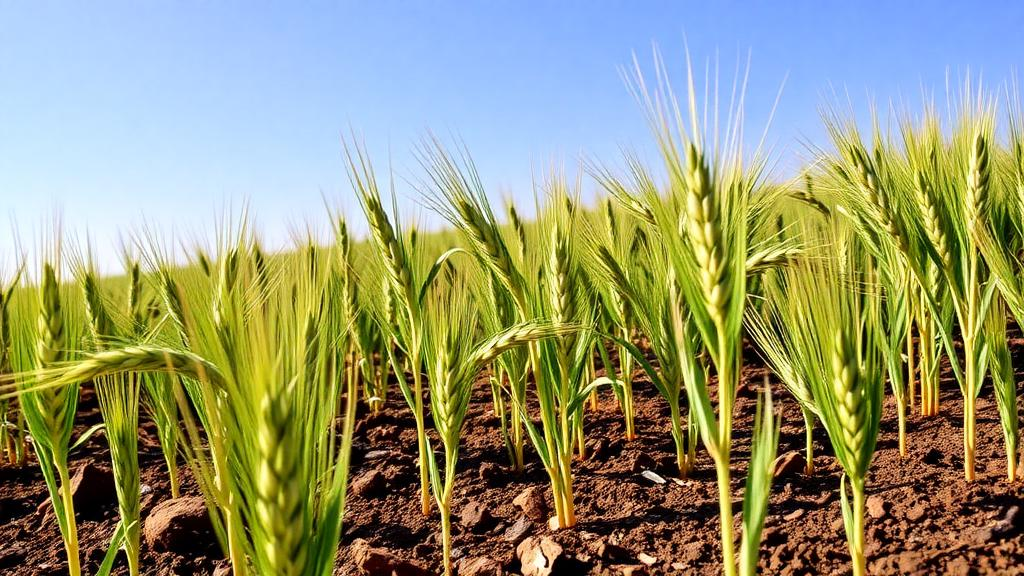
Three of the world’s most common farm practices—adding nitrogen fertilizer, mixing crop straw back into the soil, and covering fields with plastic film—can all raise wheat harvests and increase the amount of organic carbon stored in soil. But a seven-year field experiment published in Plant and Soil suggests that these gains come with a hidden cost: the extra carbon that accumulates is disproportionately stored in forms that are far less stable, potentially undermining the long-term climate benefits that farmers and policymakers hope to secure. The study, led by Qingling Zhao of Northwest Agriculture and Forestry University in Yangling, China, together with colleagues including soil scientist Yakov Kuzyakov of the University of Göttingen, tracked not just how much carbon entered the soil but where that carbon ended up—and the answer reveals a trade-off that could reshape how agricultural carbon sequestration is evaluated worldwide.
Soil is one of the planet’s largest carbon reservoirs, holding more carbon than the atmosphere and all vegetation combined. But not all soil carbon is created equal. Scientists now distinguish between two fundamentally different pools. Particulate organic carbon, or POC, consists of partially decomposed plant fragments—bits of straw, root debris, and leaf litter—that are physically visible but chemically vulnerable. Microbes can digest this material relatively easily, releasing carbon dioxide back into the atmosphere within years to decades. Mineral-associated organic carbon, or MAOC, by contrast, consists of small organic molecules that bind tightly to clay and silt particles, forming complexes that can persist in soil for centuries or even millennia. Because MAOC is the more durable reservoir, the ratio between these two fractions is a critical indicator of how stable a soil’s carbon stock really is.
To determine which pool different farming practices actually build, the research team ran a seven-year field experiment comparing straw incorporation, plastic film mulching, and nitrogen fertilization, alone and in combination, against conventional tillage. What makes the study unusual is its forensic approach to carbon sources. Rather than simply measuring total soil organic carbon, the researchers deployed three molecular biomarkers, each tracing a different pathway of carbon entry. Phospholipid fatty acids, or PLFAs, revealed the size and composition of living microbial communities. Amino sugars served as fingerprints of microbial necromass—the accumulated remains of dead bacteria and fungi. And lignin phenols, compounds that plants produce in their cell walls but microbes do not, marked carbon that arrived directly from crop residues.
The yield results were striking. Nitrogen fertilization proved the most powerful productivity lever, increasing annual wheat grain yield by 45 percent. Straw incorporation raised yields by 23 percent per year, while plastic film mulching delivered a 14 percent boost. These numbers alone would encourage any farmer to adopt all three practices simultaneously. All three treatments also increased soil organic carbon contents relative to conventional tillage, seemingly confirming the widely held assumption that intensive management simultaneously improves productivity and sequesters carbon. But when the researchers decomposed that carbon into its particulate and mineral-associated fractions, a more complicated picture emerged.
Straw incorporation emerged as the most carbon-friendly of the three practices. By returning crop residues to the soil, it substantially increased plant carbon inputs and stimulated the proliferation of bacteria and saprotrophic fungi—the decomposer organisms that break down organic matter. This microbial surge was accompanied by higher enzyme activities, and the combined effect raised the accumulation of both lignin phenols and microbial necromass carbon in the soil. As a result, particulate organic carbon contents increased by 1.5-fold compared with conventional tillage, and total soil organic carbon rose by 17 percent. Crucially, straw incorporation enriched both the POC and MAOC fractions with plant-derived and microbial-derived carbon, meaning it fed both the fast and slow carbon pools at once.
Plastic film mulching told a different story. The practice, which involves covering soil with thin polyethylene sheets to conserve moisture and warm the seedbed, did increase both POC and total SOC contents. Yet beneath the surface, the mineral-associated fraction was being eroded. Mulched soils showed reduced contents of amino sugars and lignin phenols within the MAOC fraction, along with lower concentrations of microbial PLFAs there—evidence that the living microbial community and its necromass contributions to the stable carbon pool had declined. Consequently, MAOC content itself decreased under mulching. The film appears to alter the soil microclimate in ways that shift carbon cycling away from the microbial pathways that build durable, mineral-bound carbon, even as it boosts the total stock through particulate accumulation.
Nitrogen fertilization produced perhaps the most consequential trade-off of all. While it increased POC content, it decreased MAOC content and reduced the contribution of mineral-associated carbon to total SOC under both straw incorporation and film mulching. The mechanism, according to the biomarker evidence, runs through the microbial community: nitrogen addition reduced amino sugar content and microbial PLFA concentration, weakening the microbial carbon pump that converts plant carbon into necromass and ultimately into mineral-stabilized forms. In other words, the fertilizer that delivers the biggest yield gains also suppresses the very organisms and biochemical processes responsible for locking carbon into soil’s most stable reservoir.
The broader implication is that the two most celebrated pathways for building soil carbon—straw incorporation and film mulching—achieve their gains primarily through POC accumulation while simultaneously weakening the mineral-associated stabilization pathways that make carbon persistence possible. Nitrogen fertilization amplifies this effect. Particulate carbon is not worthless; it feeds soil food webs, improves aggregation, and can eventually be processed into more stable forms. But it is inherently transient, vulnerable to changes in temperature, moisture, and tillage. Recent global research has underscored this vulnerability, with studies showing that mineral-associated organic carbon across the world’s drylands is itself sensitive to climate warming—raising the stakes for management decisions that determine how much carbon sits in each pool.
For the rapidly expanding practice of agricultural carbon crediting, the findings carry a warning. Many carbon markets and national inventories currently reward measured increases in total soil organic carbon without distinguishing between its fractions. A field that gains carbon through straw incorporation and mulching may look like a sequestration success on paper, while the added carbon sits in a labile pool that could be released within a decade. The study’s authors suggest that quantifying the contributions of POC and MAOC to SOC—ideally with the biomarker toolkit they employed—reduces uncertainty in predicting how soil carbon will respond to management and should inform which practices are genuinely climate-positive. As wheat systems across China’s Loess Plateau and similar dryland regions worldwide face intensifying pressure to raise yields while storing carbon, this seven-year experiment makes clear that the two goals can pull in opposite directions, and that the stability of soil carbon, not just its quantity, must become the yardstick of success.
Subject of Research: Effects of nitrogen fertilization, straw incorporation, and plastic film mulching on wheat yield and the stability of soil organic carbon fractions
Article Title: Nitrogen fertilization, straw incorporation, and plastic film mulching increase wheat yield and soil organic carbon but reveal trade-offs in carbon stability
Article References: Zhao, Q., Abdo, A. I., Zhang, K., Li, H., Zhou, C., Chen, J., Wang, L., & Kuzyakov, Y. (2026). Nitrogen fertilization, straw incorporation, and plastic film mulching increase wheat yield and soil organic carbon but reveal trade-offs in carbon stability. Plant and Soil. https://doi.org/10.1007/s11104-026-09044-y
Image Credits: AI Generated
DOI: 10.1007/s11104-026-09044-y
Keywords: soil organic carbon, wheat yield, nitrogen fertilization, straw incorporation, plastic film mulching, particulate organic carbon, mineral-associated organic carbon, microbial necromass, lignin phenols, phospholipid fatty acids, carbon sequestration, soil microbiology
News Source: Alan Morgan. (October 14, 2026). Farming Practices That Boost Wheat Yields May Leave Soil Carbon Less Stable, Seven-Year Study Finds. Scienmag.