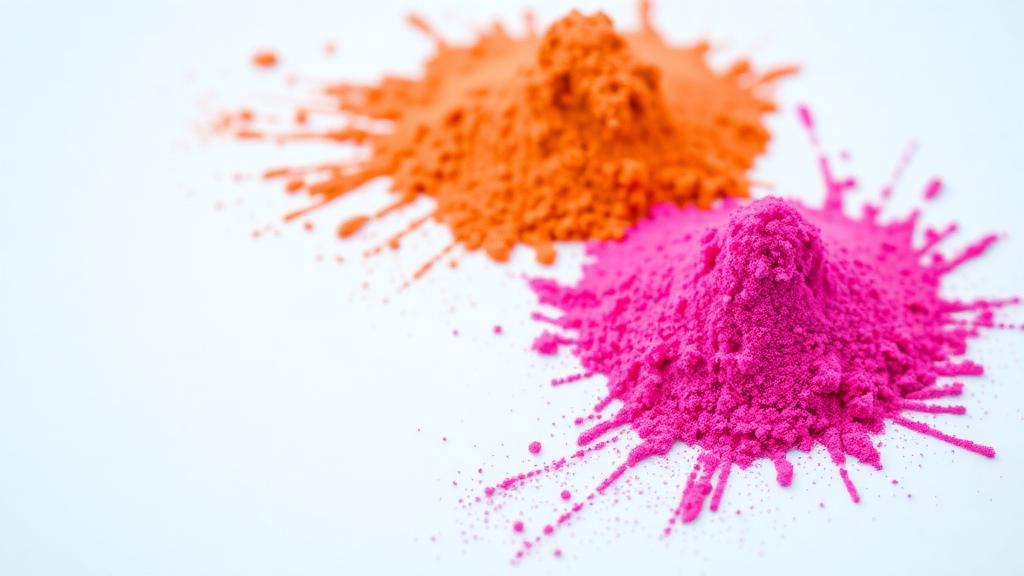
A pinch of pink powder may hold the answer to a stubborn water pollution problem. An international team of researchers spanning Brazil, Ukraine, Poland and Spain has shown that manganese-doped zinc oxide nanoparticles grown on fumed silica can destroy an antiviral drug lingering in wastewater under nothing more exotic than visible light. Better still, the team demonstrated that a simple camera photograph of the powder, fed through machine-learning models, can reveal exactly what is inside the material — no laboratory chemistry required. The study, published in the Journal of Materials Science, weaves together classical materials characterization, artificial intelligence and environmental chemistry into a single, unusually complete portrait of a photocatalytic material.
The researchers, led by M. A. Nazarkovsky of the Pontifical Catholic University of Rio de Janeiro, synthesized a series of nanocomposites containing 3, 6, and 9 millimoles of manganese-doped ZnO per gram of silica. The recipe was deliberately low-tech: zinc and manganese acetates were dissolved together with urea, spread onto fumed silica, dried, and calcined at 600 degrees Celsius. The result was a family of pale pink powders whose color deepened as the loading of the doped semiconductor increased. X-ray diffraction confirmed that the zinc oxide adopted its usual hexagonal wurtzite structure, with crystallite sizes refined between 27.7 and 31.0 nanometers for the two highest loadings. At the lowest loading, the crystallites were simply too few and too small to produce detectable diffraction peaks — a detection threshold effect rather than a sign of amorphous disorder.
Raman spectroscopy supplied the chemical fingerprints of manganese substitution. Alongside the standard ZnO vibrational modes, the spectra showed a distinct local mode at 502 per centimeter that appears neither in pure zinc oxide nor in any common manganese oxide. That peak, the authors argue, is a hallmark of manganese ions sitting on zinc sites in the wurtzite lattice, breaking the crystal symmetry and turning a normally silent vibration Raman-active. The main longitudinal optical mode also shifted compared with undoped ZnO, consistent with lattice distortion from oxygen vacancies and interstitial zinc — the very defects that give the material its visible-light appetite.
The textural story was equally detailed. Nitrogen adsorption measurements revealed predominantly mesoporous solids with specific surface areas ranging from 159 square meters per gram at the lowest loading down to 111 at the highest, reflecting progressive particle aggregation and pore blocking as the oxide content grew. Atomic force microscopy added a nanoscale twist: the roughest and most morphologically complex surface belonged to the intermediate, 6 millimole sample, whose fractal dimension reached 2.21, while the highest-loading powder paradoxically smoothed out as particles consolidated into dense agglomerates. Scanning electron microscopy, processed with an AI-assisted segmentation model called Tiny SAM, quantified this transition — the particle size distribution of the 6 millimole sample was nearly monodisperse, while the 9 millimole sample was strongly polydisperse, with nearly three times as many particles exceeding 100 nanometers.
Optical measurements explained why these powders work under sunlight. UV-visible spectroscopy showed a broad absorption band near 500 nanometers that intensified steadily with Mn–ZnO loading, arising from spin-forbidden d–d transitions of Mn2+ ions and defect states inside the band gap. Photoluminescence spectra, excited at 473 nanometers, emitted broad green-yellow light associated with oxygen-vacancy recombination centers — and that emission was quenched by roughly 38 percent as loading increased, a hint that charge carriers were being separated and consumed non-radiatively rather than recombining into wasted photons. The authors are careful to note that the band gap itself shifted slightly upward, while visible absorption rose; the two effects stem from different electronic origins and are not contradictory.
The truly novel contribution lies in how the team turned color into a quality-control tool. Standardized photographs taken with a digital SLR camera were chopped into 64 fragments each, and descriptors such as RGB channels, hue, saturation and lightness were extracted. A support vector machine trained on just two of these — saturation and hue — classified the three compositions with 100 percent accuracy on both training and validation sets, using only 12 support vectors. Even more striking, image fragments were converted into 2048-dimensional feature vectors by the Inception v3 convolutional neural network; an SVM built on those embeddings reached 99.3 percent training and 100 percent validation accuracy. In parallel, infrared spectra processed through principal component analysis and NIPALS regression predicted the silica content of the powders with Q2 values above 0.9997, with surface-sensitive ATR spectra outperforming conventional transmission FTIR by 36 percent in prediction error.
Why does all this analytical machinery matter? Because photocatalysts are notoriously difficult to check on a production line. Traditional characterization — diffraction, electron microscopy, gas sorption — is slow, destructive or expensive. The new workflow suggests that a factory could photograph a batch of pink powder, run the image through a trained classifier, and know within seconds whether the active phase hit its target concentration. The same logic extends to infrared spectroscopy coupled with chemometrics, giving manufacturers two independent, nondestructive windows onto composition. The authors frame this as a transferable framework for any doped metal oxide supported on a substrate, not just the manganese–zinc oxide system studied here.
Then came the environmental test. The model pollutant was lopinavir, the HIV protease inhibitor that saw heavy, largely ineffective use during the early COVID-19 pandemic and now turns up in surface waters at concentrations spanning from tens of nanograms to as much as 130 micrograms per liter near some wastewater plants. Photolysis alone removed less than 20 percent of the drug in an hour, but the best composite, 9-Mn–ZnO/SiO2, eliminated 96 percent of lopinavir within 60 minutes under a 550-nanometer lamp, with a pseudo-first-order rate constant of 0.0465 per minute — more than an order of magnitude faster than photolysis alone. Radical scavenger experiments implicated hydroxyl radicals and superoxide anions as the dominant reactive species, generated through a Haber-Weiss-type cascade, while direct hole oxidation played a negligible role. The catalyst retained its performance across four reuse cycles with no measurable deactivation.
Real-world waters told a more sobering but instructive story. Nitrate ions, dissolved organic matter and river water all slowed degradation by competing for photons and scavenging radicals, though at environmentally typical organic matter concentrations of around 10 milligrams per liter the catalyst still performed nearly as well as in distilled water. Even in treated wastewater, substantial removal persisted. The team also noted a satisfying convergence between their AI-assisted microscopy and the photocatalytic trends: the highest activity of the 9 millimole sample was attributed not to its reduced surface area but to the greater absolute mass of photoactive phase and evidence of improved charge-carrier separation. The optimum, in other words, depends on what you are optimizing — texture favors the intermediate loading, while photocatalysis favors the densest one. Together, the study makes the case that the future of photocatalyst manufacturing may be judged, quite literally, by the color of the powder.
Subject of Research: Manganese-doped ZnO/silica nanocomposites for machine-learning-assisted quality control and visible-light photocatalytic removal of pharmaceuticals from water
Article Title: Comprehensive study on the Mn–ZnO/SiO2 nanocomposites: from the digital colorimetry to the visible-light photocatalysis
Article References: Nazarkovsky, M. A., Galaburda, M. V., Sokołowski, A., Czech, B., Dionisio, E. R. C., Chaves, J. F., Artiushenko, O., Dugato, D. A., Caraballo-Vivas, R. J., de Paula, N. F. L., Archanjo, B. S., Pimenta, A. M. G., Costa, R. G., Chacón-Rosales, G., Diaz, E. C. M., Navarro, R. C. S., & Marinkovic, B. A. (2026). Comprehensive study on the Mn–ZnO/SiO2 nanocomposites: from the digital colorimetry to the visible-light photocatalysis. Journal of Materials Science. https://doi.org/10.1007/s10853-026-13831-4
Image Credits: AI Generated
DOI: 10.1007/s10853-026-13831-4
Keywords: photocatalysis, Mn-doped ZnO, nanocomposites, digital colorimetry, machine learning, Inception v3, chemometrics, lopinavir, water treatment, silica support, oxygen vacancies, visible light
News Source: Denise Maddox. (October 14, 2026). AI Reads the Color of Photocatalyst Powders to Purify Drug-Polluted Water. Scienmag.