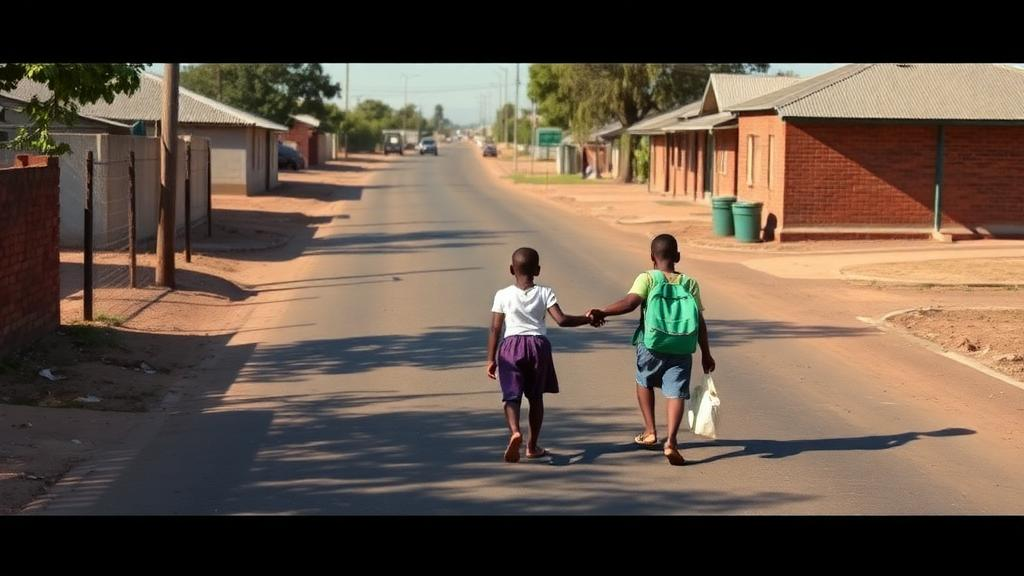
Every weekday morning across South Africa’s townships, thousands of children set out on foot for school, navigating roads that were rarely designed with them in mind. A new study published in BMC Public Health by Samuel Ntsanwisi of Durban University of Technology takes a close, systematic look at this everyday journey in Nkowankowa Township, in Limpopo Province, and arrives at an uncomfortable conclusion: the dangers facing child pedestrians are not the product of a single failing but of an entire system in which infrastructure, institutions, communities, and policy all fall short at once. The research, published as an open-access article on 14 October 2026, uses a qualitative case study approach to dissect how multiple layers of influence combine to leave young walkers dangerously exposed to traffic.
The scale of the problem provides the study’s starting point. Road safety has long been recognized as a significant public health concern in South African townships, where walking is the primary mode of transport for most schoolchildren. Despite a steady stream of road-safety initiatives over the years, pedestrian fatalities remain stubbornly high, a pattern that suggests conventional interventions are not reaching the environments where children are most at risk. School zones, the very places that should concentrate protection around the most vulnerable road users, have instead emerged as persistent trouble spots. Ntsanwisi set out to understand why, asking what infrastructural, institutional, and governance factors shape safety outcomes in these zones and why existing measures have failed to reduce the toll.
Methodologically, the study is deliberately grounded in the specifics of place. The researcher employed an exploratory qualitative case study design, combining structured observational audits across eight school zones in Nkowankowa with semi-structured key-informant interviews. This dual approach matters because it captures both what can be seen on the ground, such as the presence or absence of road markings, signage, and crossings, and what the people responsible for managing these environments understand about their own roles and responsibilities. Observational audits provide an objective record of physical conditions, while interviews reveal the institutional knowledge, assumptions, and gaps that shape how those conditions arise and persist. Together, they offer a layered picture that a purely statistical study of accident counts could never supply.
To interpret the evidence, the study draws on two complementary analytical frameworks: a systems perspective and the Social Ecological Model. The systems perspective treats road safety not as a collection of isolated problems but as an interacting whole, in which a missing sign, an unclear mandate, an absent speed-calming measure, and an unengaged community reinforce one another. The Social Ecological Model, widely used in public health research, organizes influences into nested levels ranging from individual behavior through interpersonal relationships, community settings, and institutional arrangements, up to broader policy environments. Applying both frameworks to township school zones allows the analysis to show how factors operating at very different scales, from a child’s daily walking route to national road-safety policy, converge on the same stretch of pavement outside a school gate.
The findings that emerge from this analysis are stark in their consistency. The study identifies unclear school-zone governance arrangements as a central problem: responsibility for safety in and around school zones is distributed in ways that leave no single actor clearly accountable. When it is uncertain whether a road authority, a school, a provincial department, or a municipal body should act, inaction becomes the default. Compounding this, the research documents limited implementation of formal safety initiatives, meaning that programs that exist on paper have not translated into visible changes on the streets where children walk. Safety interventions, in other words, are failing not only in design but in delivery.
Infrastructure tells a similar story of inconsistency. The observational audits across the eight school zones revealed uneven and unreliable provision of the basic elements that traffic engineers consider essential for protecting pedestrians: consistent road-safety infrastructure, clear signage, and appropriate traffic-calming measures. In an environment where such features appear in some locations but not others, children and drivers alike receive mixed signals about how to behave, undermining the predictability that road safety depends upon. The study also documents high levels of pedestrian exposure to traffic-related risks, reflecting the reality that children in townships walk long distances along busy roads, often at exactly the times of day when traffic volumes peak. Exposure of this kind multiplies the consequences of every other weakness in the system.
What makes the study distinctive is its insistence that these problems cannot be fixed one at a time. Because the findings were interpreted through a systems lens, the analysis points toward coordinated interventions across four levels simultaneously: infrastructure, institutions, community, and policy. Building a pedestrian crossing accomplishes little if no institution is responsible for maintaining it or for educating children in its use; a road-safety curriculum achieves less if the route to school lacks any safe infrastructure to teach children to navigate. The study’s conclusion, stated plainly, is that improving road safety in township school zones requires interventions that operate across all of these levels together, rather than the fragmented, single-point measures that have characterized past efforts.
The title’s reference to visual communication hints at a further dimension of the work. In environments where formal signage and road markings are inconsistent or absent, the visual cues that normally regulate traffic behavior break down, and the burden of interpretation falls on the most vulnerable users, children, whose cognitive and perceptual capacities for judging traffic are still developing. The study’s attention to these implications suggests that the design of visual communication in school zones, from signage to road markings to broader environmental cues, deserves treatment as a safety-critical system component rather than an afterthought. How a school zone looks, in the most literal sense, shapes how drivers and children behave within it.
The broader significance of the research extends well beyond a single township. Nkowankowa’s school zones are, in essential respects, representative of conditions across South African townships and in many low- and middle-income settings worldwide, where rapid urbanization, limited municipal budgets, and historical patterns of infrastructure neglect intersect with high rates of walking as the default mode of school transport. By demonstrating how a systems analysis can expose the web of governance ambiguity, institutional underperformance, and infrastructural deficit behind persistently high pedestrian fatality figures, the study offers a template for diagnosis that other municipalities could adapt. It also implicitly challenges the assumption that road-safety campaigns aimed at individual behavior change can succeed in environments where the surrounding system provides neither the infrastructure nor the institutional support for safe behavior.
The research was conducted with formal ethical oversight, with clearance obtained from the University of the Witwatersrand Human Research Ethics Committee (Non-Medical) under protocol HRECNM 19–09-057, and carried out in accordance with the Declaration of Helsinki, with informed consent obtained from all participants. It received no external funding, and the author declares no competing interests. Published open access under a Creative Commons Attribution 4.0 license, the study invites the scrutiny and reuse that public-facing safety research demands. For the children of Nkowankowa and townships like it, the message of the work is ultimately one of reframing: the walk to school is not merely a personal risk taken by individual families, but the visible output of a system that can, with coordinated reform across infrastructure, institutions, community, and policy, be redesigned to protect them.
Subject of Research: Child pedestrian road safety and school-zone governance in South African townships
Article Title: Rethinking school zone safety in South African townships: a systems analysis of Nkowankowa with implications for visual communication
Article References: Rethinking school zone safety in South African townships: a systems analysis of Nkowankowa with implications for visual communication. (n.d.). https://doi.org/10.1186/s12889-026-29821-9
Image Credits: AI Generated
DOI: 10.1186/s12889-026-29821-9
Keywords: road safety, school zones, child pedestrians, South Africa, townships, systems analysis, Social Ecological Model, public health, traffic infrastructure, governance, visual communication, BMC Public Health
News Source: Ophelia Keating. (October 14, 2026). Why Children Walking to School in South African Townships Face Unseen Road Dangers. Scienmag.