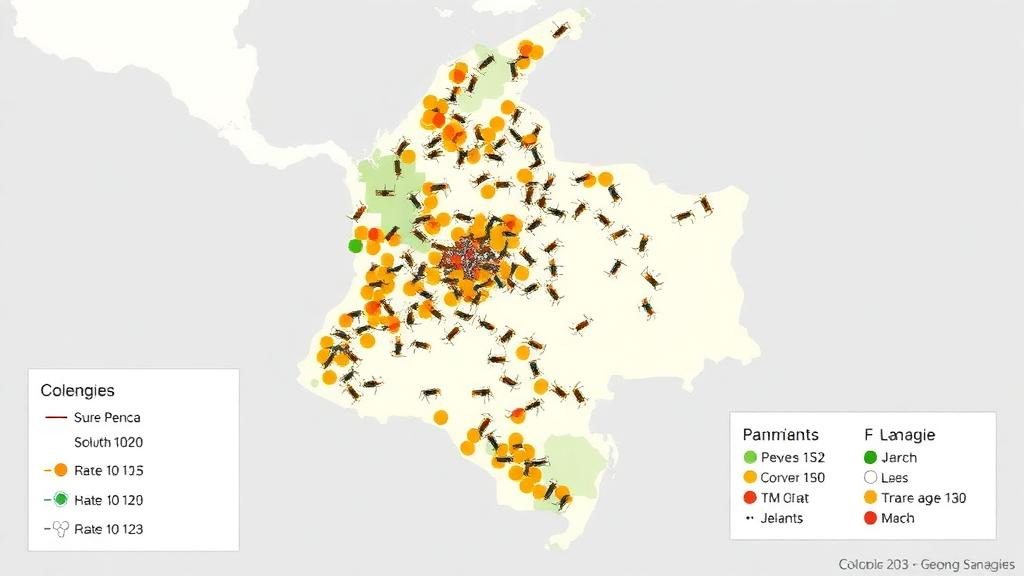
The yellow fever mosquito, Aedes aegypti, is arguably the most consequential insect in Latin American public health. As the primary urban vector of dengue, Zika, chikungunya, and yellow fever viruses, its movements and population dynamics directly shape where and how badly arboviral outbreaks strike. Yet for a country like Colombia, whose territory spans Caribbean coastlines, Andean highlands, Orinoco savannas, and Amazonian rainforest, the genetic architecture of this mosquito’s populations has remained surprisingly opaque. A new country-scale study published in PLOS Neglected Tropical Diseases now offers the most detailed mitochondrial portrait to date of Colombian Aedes aegypti, revealing a genetic landscape organized less by geography than by history, urbanization, and climate.
A research team led by Andrés Gómez-Palacio and colleagues set out to answer a deceptively simple question: how are Colombian populations of this vector genetically structured across space and time? To do so, they assembled a mitochondrial dataset centered on the cytochrome c oxidase subunit I gene, or COX1, a workhorse marker in animal population genetics. The team generated 394 new COX1 sequences from Colombian mosquito specimens and combined them with publicly available records, producing a final dataset of 717 entries. Crucially, the sampling covered a broad geographic and temporal range, spanning the Caribbean, Andean, Orinoco, and Amazonian regions of the country, which allowed the researchers to ask whether genetic patterns were stable through time or shifted across collection years.
Mitochondrial DNA is inherited only through the maternal line, which makes it a sensitive recorder of female population history. Because Aedes aegypti females lay eggs in water-holding containers close to where they themselves developed, and because the species thrives in human-made environments, maternal lineages can persist in cities for generations while also being shuffled around by human activity. Vehicles, shipping, and commerce move eggs, larvae, and adults across administrative boundaries with ease, and this human-mediated dispersal is widely recognized as a dominant force in the species’ population genetics. The Colombian study was designed to test how these competing forces of persistence and mixing have shaped the country’s mosquito populations.
The headline finding is that Colombian COX1 diversity is organized mainly into two broad mitochondrial genetic clusters, rather than being partitioned by sampling locality, department, or collection year. In other words, a mosquito from the Caribbean coast may be genetically more similar, at this mitochondrial marker, to one from an Andean city than to a neighbor from a nearby town. This pattern suggests the persistence of deep maternal lineages across the country, combined with substantial spatial mixing that erodes fine-scale geographic structure. Such mixing is consistent with the movement of mosquitoes along human transportation networks and with the species’ strong adaptation to urban habitats, where continuous breeding sites connect populations that geographic distance alone would separate.
To probe what environmental and demographic factors might underlie this structure, the researchers applied a battery of analytical approaches, including population genetic statistics, ordination methods, constrained spatial analyses, and demographic inference. One of the more striking results concerned urbanization. Human population density and the intensity of built-up land partially explained the mitochondrial genetic structure of Colombian mosquito populations, but the strength of this association varied through time. That temporal variation is biologically telling: it indicates that urbanization does not act as a uniform filter on mosquito genetics, but instead interacts with regional demographic heterogeneity and the local configuration of habitats. A densely built district with abundant water storage containers may sustain distinct maternal lineages, while neighboring areas with different urban forms may exchange mosquitoes more freely.
The study also reconstructed the mitochondrial demographic history of the populations, asking how effective population size, the number of breeding females contributing to the next generation, has changed over time. Rather than showing a simple story of continuous expansion, as might be expected for a vector that has spread so successfully through the tropics, the analyses suggested temporal variation in mitochondrial effective population size. The data pointed to an older increase in female effective population size, followed by a reduction and relative stabilization toward recent generations. This kind of trajectory can arise from a combination of factors, including historical colonization events, changes in available habitat, vector control interventions, and the statistical behavior of mitochondrial markers, which can lag behind changes in census numbers.
Climate emerged as another candidate influence. Analyses associating demographic parameters with climatic variables suggested that temperature, particularly minimum temperature, may contribute to mitochondrial demographic variation in Colombian Aedes aegypti. The relationship is biologically plausible: mosquito development rates, survival, and breeding-site dynamics are all temperature dependent, and cooler minimum temperatures can constrain the species’ activity and reproduction, especially at Andean elevations. The authors are careful, however, to frame this association as correlative. Temperature co-varies with altitude, urbanization, and ecology across Colombia, and mitochondrial demographic inference is sensitive to a range of assumptions, so the climatic signal should be read as a hypothesis for further testing rather than a demonstrated causal driver.
What makes these results more than an academic exercise is their direct relevance to vector control. Genetic structure is the currency of surveillance: it tells program managers which populations are effectively isolated, which are connected, and therefore where control measures must be applied independently and where they can reinforce one another. The finding that Colombian mosquito populations are shaped by historical maternal-lineage structure, urbanization-associated spatial heterogeneity, eco-regional demographic variation, and climatic context implies that a one-size-fits-all control strategy is unlikely to succeed everywhere. Regions belonging to different mitochondrial clusters may require separate monitoring, while corridors of human-mediated dispersal may demand coordinated interventions across departmental boundaries.
The study also provides something Colombia has lacked: a country-scale mitochondrial baseline. By documenting haplotype diversity and its distribution across four major biogeographic regions and multiple collection years, the dataset establishes a reference against which future samples can be compared. New invasions, range expansions into higher elevations as temperatures warm, or the success or failure of control campaigns should all leave detectable signatures in this baseline. The authors explicitly position the work as a foundation for prioritizing regions for genomic, entomological, and epidemiological surveillance, and for guiding future investigations of mosquito dispersal and population connectivity relevant to vector management.
There are, of course, limits to what a single mitochondrial marker can reveal. COX1 captures only maternal history, and patterns at one locus may not reflect the genome-wide structure that determines how traits such as insecticide resistance or vector competence move through populations. The authors note that the mitochondrial baseline is intended to help prioritize regions for future genomic work, which will be needed to resolve population structure at finer scales and to connect genetics with epidemiological outcomes. Still, the study’s core message is clear and actionable: Colombia’s Aedes aegypti populations are not a uniform mass but a mosaic of persistent lineages, urban filters, and climatic gradients, and understanding that mosaic is a prerequisite for outsmarting one of humanity’s most dangerous animal neighbors.
Subject of Research: Mitochondrial genetic diversity and demographic history of Aedes aegypti mosquito populations across Colombia
Article Title: Country-scale diversity, spatial genetic structure, and mitochondrial demographic history of Aedes aegypti populations in Colombia
Article References: Gómez-Palacio, A., Marín-Suarez, J., Beltran-Rodriguez, L., Gomez, M., Briñez-Zabaleta, W., Sanchez, A., Patiño, L. H., Uribe-Soto, S., & Ramirez, J. D. (2026). Country-scale diversity, spatial genetic structure, and mitochondrial demographic history of Aedes aegypti populations in Colombia. PLOS Neglected Tropical Diseases, 20(10), e0014808. https://doi.org/10.1371/journal.pntd.0014808
Image Credits: AI Generated
DOI: 10.1371/journal.pntd.0014808
Keywords: Aedes aegypti, Colombia, mitochondrial DNA, COX1, population genetics, vector control, arboviruses, urbanization, demographic history, genetic structure, dengue, surveillance
News Source: Juliet Wilcox. (October 13, 2026). Mosquito Genes Map Colombia’s Hidden Aedes aegypti Lineages. Scienmag.