A new study from George Mason University has found that the everyday routines of family life, from the meals children eat at school to the languages spoken at home and the immigration journeys of their parents, are closely tied to the levels of per- and polyfluoroalkyl substances, or PFAS, circulating in the blood of Hispanic children in Northern Virginia. The research, led by Rooshna Mohsin, a recent PhD graduate of the university’s College of Public Health, together with her mentor Professor Michael S. Bloom of the Department of Global and Community Health, was published in the Journal of Exposure Science & Environmental Epidemiology. It stands among the first investigations anywhere to examine potential sources of PFAS exposure in children from primarily Central American households, a population that has been largely invisible in environmental health research despite growing national concern over these persistent pollutants.
PFAS are a large family of manufactured chemicals that have been used for decades in consumer and industrial products because of their remarkable resistance to heat, water, and grease. Nonstick cookware, stain-resistant carpets and fabrics, water-repellent clothing, and grease-resistant food packaging all rely on these compounds, and the same properties that make them useful in manufacturing also make them extraordinarily persistent in the environment and in the human body. Because certain PFAS break down extremely slowly, they can accumulate over years of repeated exposure, entering the body through contaminated drinking water, food, household dust, and air. This persistence has earned them the popular nickname of forever chemicals, and biomonitoring surveys have detected them in the blood of nearly all residents of industrialized countries.
The health stakes of early-life exposure are considerable. Previous research has linked certain PFAS in childhood with weaker responses to routine vaccines, an increased risk of asthma, and measurable changes in metabolism and thyroid function, both of which play central roles in growth and development. Some members of the chemical family are also considered carcinogens, meaning that reducing exposure during childhood, when the body is still developing, is widely regarded by public health researchers as a priority. The George Mason study did not set out to measure health effects in the children themselves. Instead, its value lies in identifying where the exposure may be coming from and, crucially, which everyday circumstances appear to protect against it, information that can guide practical interventions for families and communities.
To pursue those questions, the research team analyzed blood samples from 106 Hispanic children between the ages of four and eleven, all living in Prince William County, Virginia. Most of the children had obesity and were taking part in a family lifestyle program, which provided the opportunity to collect both biological samples and detailed information about diet, language use, and family history. Among the mothers who reported their birthplace, roughly two-thirds had been born in El Salvador, reflecting the distinctive demographic profile of the local Central American community. This combination of blood measurements and richly detailed household data allowed the researchers to look for patterns linking specific foods, school meal participation, and immigration-related factors to the concentrations of individual PFAS compounds detected in the children’s blood.
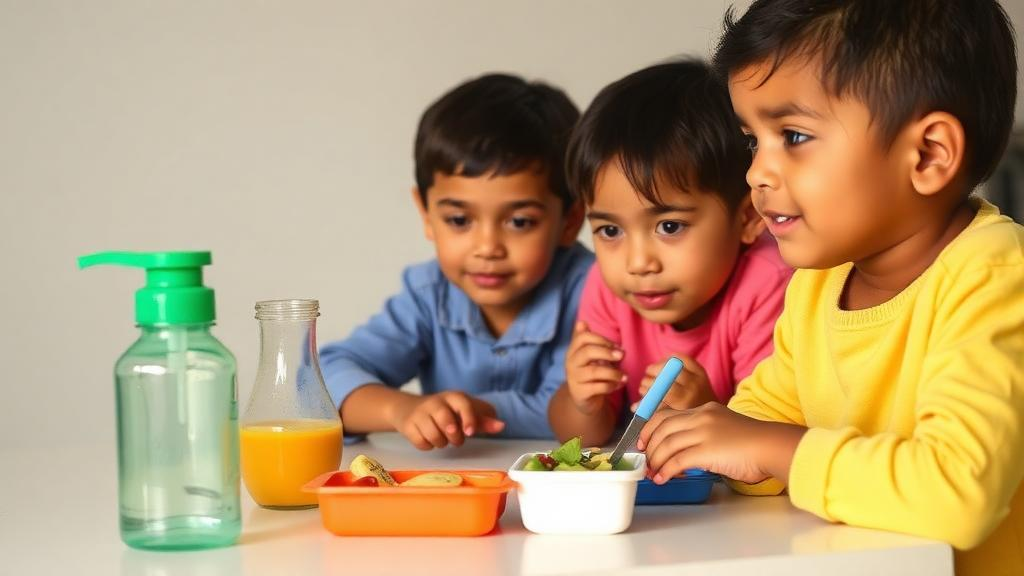
One of the most striking and consistent findings concerned school meals. Children who received free or reduced-price lunches had lower blood concentrations of five different PFAS compounds, and participation in school breakfast programs was associated with lower levels of another. The authors suggest that the meals provided through these federal programs may reduce families’ reliance on individually packaged foods, which are a recognized potential route of PFAS exposure because grease-resistant packaging can transfer chemicals into food. The researchers are careful to note that they did not directly test that explanation, so it remains a plausible hypothesis rather than a demonstrated mechanism. Even so, the consistency of the association across multiple compounds suggests that school meal programs, which serve tens of millions of American children every day, may play an unappreciated protective role in limiting exposure to environmental contaminants.
Dietary patterns beyond the school cafeteria also left their mark on the children’s chemical profiles, although the relationships varied depending on the specific compound. Greater consumption of cheese was linked to higher levels of one PFAS, while eating more fish was associated with a higher likelihood of detecting another, a pattern consistent with the broader scientific literature, since fish and other animal-based foods can accumulate certain PFAS from contaminated water and feed. Greater consumption of burritos was associated with higher total PFAS, an intriguing result that the authors suggest could reflect the packaging and preparation methods associated with such foods, although the study design cannot pin down the exact pathway. Overall, eating more animal-based foods was associated with higher levels of some PFAS, reinforcing the idea that dietary composition is a meaningful determinant of body burden in children.
Perhaps the most novel dimension of the study concerns the social and immigration-related factors that shaped exposure. Children with stronger English skills had lower levels of one PFAS compound, and for another chemical known as PFBS, the differences were even more pronounced. Hispanic children born in the United States had 75 percent lower odds of PFBS being detected in their blood compared with Hispanic children born elsewhere. Moreover, each additional year that a child’s mother had lived in the United States was associated with an 8 percent lower odds of detecting PFBS. These findings suggest that the circumstances surrounding immigration, including the foods available to families before and after arrival, the neighborhoods they live in, and the resources they can access, may all influence how much of these chemicals children absorb. The researchers emphasize that understanding what families eat and the resources available to them is essential if interventions are to work, and Mohsin argues that the study highlights the necessity of community-informed approaches, such as those targeting dietary habits, to mitigate exposure.
Like all cross-sectional research, the study offers a snapshot rather than a moving picture, and the authors are explicit about its limits. Because the measurements were taken at a single point in time, the analysis cannot show whether particular foods or family circumstances actually caused the differences in PFAS levels, only that they were associated. The sample was also small and drawn from a single county, so the findings may not generalize to Hispanic communities elsewhere in the country or to children of other backgrounds. The dietary questionnaire, like most such instruments, may not have captured culturally specific foods that are important in Central American households, potentially leaving some exposure sources unmeasured. The researchers call for larger studies that follow children over time, and for future work to examine drinking water, household products, and the culturally specific foods missing from the current questionnaire.
Even with those caveats, the study opens an important window onto a population that environmental health research has rarely examined in detail. It suggests that the same institutions designed to support low-income families, such as school meal programs, may simultaneously be shielding children from chemical exposure, and that the health of immigrant children may be shaped in part by the environmental conditions of their countries of birth and the length of their families’ residence in the United States. For public health practitioners, the message is that reducing PFAS exposure is not simply a matter of individual choices but of understanding the full context of family life, from the grocery aisle to the classroom cafeteria. As regulators continue to tighten limits on PFAS in drinking water and consumer products, studies like this one demonstrate that exposure is woven into the fabric of daily routines, and that culturally informed, community-based strategies will be essential to untangle it.
The research was a collaborative effort involving multiple departments at George Mason University and beyond. Mohsin and Bloom’s coauthors include faculty members Jenna R. Krall and alum Lameck Chiwaka of the Department of Global and Community Health, Allison J. McKay of the Department of Nutrition and Food Studies, Margaret T. Jones of the College of Education and Human Development, and Robyn Mehlenbeck of the Department of Psychology, along with Virginia Espina and Veronica G. Sanchez of the Center for Applied Proteomics and Molecular Medicine. Additional researchers included Roy R. Gerona and Daniel Tomer of the University of California, San Francisco, and Sina Gallo of the University of Georgia. Mohsin, who earned her PhD in public health with a concentration in epidemiology, is now a postdoctoral research associate at Washington University in St. Louis, where she continues to build on the kind of community-centered exposure science that this study exemplifies. As forever chemicals remain a fixture of the modern environment, work like this makes clear that the path to safer childhoods runs through kitchens, classrooms, and communities alike.
Subject of Research: Dietary and social predictors of PFAS exposure in Hispanic children
Article Title: Study finds diet and culture influences Hispanic children’s exposure to 'forever chemicals'
Article References: Study finds diet and culture influences Hispanic children’s exposure to 'forever chemicals'. (n.d.). Original publication
Image Credits: AI Generated
DOI: Not provided
Keywords: PFAS, forever chemicals, Hispanic children, school meals, diet, environmental epidemiology, Central American families, immigration, PFBS, George Mason University, exposure science, public health
News Source: Phoebe Ingram. (October 13, 2026). School lunches and family history shape forever chemical exposure in Hispanic children. Scienmag.