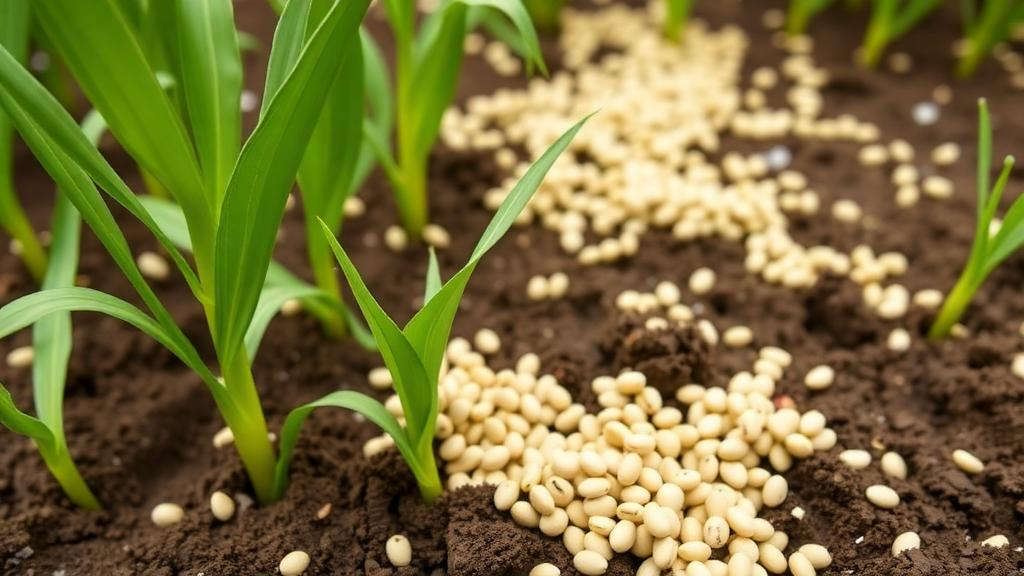
A handful of soil-dwelling bacteria may accomplish what decades of synthetic fertilizer application have struggled to deliver efficiently: bigger harvests with less chemical input. New research from Sriwijaya University in Indonesia suggests that Rhizobium inoculation, a technique that harnesses the natural partnership between legumes and nitrogen-fixing microbes, outperformed increasing doses of urea fertilizer in boosting the growth and yield of mung bean, one of the tropics’ most important protein crops. The findings, published in Discover Plants, arrive at a moment when farmers and scientists worldwide are searching for ways to reconcile rising food demand with the environmental costs of nitrogen fertilizer, from water pollution to greenhouse gas emissions.
Nitrogen is the engine of plant productivity. It sits at the heart of chlorophyll molecules, amino acids, and nucleic acids, and without an ample supply, photosynthesis stalls and biomass accumulation grinds to a halt. Yet despite its centrality, nitrogen use efficiency in agriculture remains stubbornly low. Much of the urea spread on fields is lost before crops can absorb it, escaping into the atmosphere through volatilization and denitrification or leaching into groundwater. These losses inflate production costs for farmers and contribute to environmental degradation, including emissions of potent nitrogen-based greenhouse gases. Improving nitrogen use efficiency has therefore become a central priority in sustainable nutrient management frameworks that seek to balance crop productivity with environmental protection.
Leguminous crops hold a unique ecological advantage in this struggle. Through symbiosis with Rhizobium bacteria, they can tap an essentially unlimited reservoir: the nitrogen gas that makes up roughly 78 percent of the atmosphere. Inside specialized root nodules, the bacteria convert atmospheric nitrogen into forms the plant can use, a process known as biological nitrogen fixation. This partnership enriches both the plant and the soil, reducing dependence on synthetic inputs. However, biological nitrogen fixation alone is often insufficient to meet the full nitrogen demands of a crop, particularly during early growth stages or in soils where native rhizobial populations are sparse. This has led researchers to explore integrated strategies that combine Rhizobium inoculation with measured doses of mineral nitrogen fertilizer.
Mung bean (Vigna radiata L.) is an ideal test case. The crop is an economically and nutritionally vital legume across tropical and subtropical Asia, serving as a major source of plant-based protein and contributing to food security and sustainable cropping systems. In Indonesia, mung bean is cultivated under diverse agro-ecological conditions, particularly in regions characterized by high rainfall, intensive soil weathering, and variable fertility, all of which strongly influence nitrogen availability and the success of biological nitrogen fixation. Managing nitrogen in mung bean involves a delicate trade-off: excessive mineral nitrogen suppresses nodulation and the activity of nitrogen-fixing bacteria, while insufficient nitrogen limits early growth and ultimately yield. Identifying the right balance between fertilizer and biology is essential for maximizing productivity.
The research team, led by Risna Rusdan and Risa Emelia Ramatha Sianipar of Sriwijaya University’s Faculty of Agriculture, conducted their experiment at the Agro Techno Center research station in South Sumatra. They grew the Vima-1 mung bean variety in polybags filled with a mixture of topsoil and cow manure at a 4:1 ratio by weight. The soil was an Ultisol, a highly weathered, acidic soil type that dominates much of the region and typically presents fertility challenges. The experiment followed a factorial randomized complete block design with two factors: Rhizobium inoculation dosage applied as a seed coating at 0, 5, 15, and 25 grams per kilogram of seed, and urea dosage at 25, 50, and 75 kilograms per hectare, equivalent to 11.5, 23, and 34.5 kilograms of nitrogen per hectare. The combination produced twelve treatment groups across three replications, with urea applied in three split doses timed to key growth stages to synchronize nitrogen supply with crop demand and minimize losses.
The results revealed a striking asymmetry between the two nitrogen sources. During the early vegetative phase, from two to six weeks after planting, plant height, leaf number, and branch number increased steadily with plant age but showed no statistically significant differences across any of the treatments. This uniformity suggests that nitrogen was not a limiting factor during early growth, likely because nutrients from the soil-manure medium were sufficient, and that mineral nitrogen applied at these rates may have been partially lost to leaching and volatilization before the plants needed it. In legumes, symbiotic fixation can also compensate once the partnership establishes, further buffering plants against variation in applied fertilizer.
Where the treatments diverged was in biomass and yield. Rhizobium inoculation had a significant to highly significant effect on shoot fresh weight, shoot dry weight, root fresh weight, and, critically, the number of root nodules, the structural foundation of biological nitrogen fixation. The number of nodules responded clearly to inoculation, while urea dosage and the interaction between the two factors had no significant effect on nodulation, indicating that the range of mineral nitrogen tested did not interfere with the symbiosis. The most pronounced yield responses appeared at medium to high Rhizobium doses of 15 to 25 grams per kilogram of seed, which increased productivity by approximately 12 percent compared with uninoculated controls and enhanced the number of seeds per pod and seed weight per plant, the two traits most strongly tied to final harvest.
Urea told a more inconsistent story. Although it significantly affected pod fresh weight, pod dry weight, seed weight, and productivity, its effects were not proportional to the applied rate and failed to reach significance across most vegetative and root parameters. This pattern suggests that nitrogen was not the sole factor limiting yield under the experimental conditions, and that increasing mineral nitrogen availability in legumes can actually reduce the relative contribution of symbiotic fixation, undermining the very mechanism that makes legumes valuable in low-input systems. Multivariate analysis reinforced this interpretation: principal component analysis showed that medium to high Rhizobium treatments clustered with productivity-related variables, while correlation analysis revealed strong positive relationships between productivity and seed weight, seeds per pod, pod weight, shoot biomass, and nodule number.
The authors are candid about the study’s limitations. Baseline soil chemical properties were not characterized before the experiment, the commercial inoculant’s Rhizobium strain identity, carrier composition, and bacterial density were unspecified, and plant tissue nitrogen content and nodule dry weight were not measured, all of which constrain direct interpretation of nitrogen dynamics. The polybag setup, while offering tight control over growing conditions, cannot fully reproduce field conditions, particularly root expansion and soil-plant interactions. The urea rates tested were also relatively low, leaving open the question of whether higher doses might produce different outcomes. These caveats mean the findings should be read as evidence from a controlled tropical context rather than a universal prescription.
Even with those qualifications, the implications are compelling. If a modest seed coating of bacteria can deliver yield gains that escalating urea applications could not match, the economics and ecology of mung bean production could shift meaningfully, particularly for smallholder farmers in the tropics who face both fertilizer costs and increasingly erratic rainfall. The study adds to a growing body of evidence that integrated nitrogen management, pairing biological nitrogen fixation with carefully calibrated mineral fertilization rather than defaulting to synthetic inputs alone, offers a viable path toward sustainable legume production. The research team calls for field-based trials across a wider range of nitrogen rates to determine the optimal balance, but the central message is already clear: sometimes the most powerful fertilizer is the one that has been living in the soil all along.
Subject of Research: Effects of Rhizobium inoculation and urea dosage on mung bean growth, nodulation, and yield
Article Title: Effect of Rhizobium inoculation and urea dosage on the growth and yield of mung bean (Vigna radiata L.)
Article References: Effect of Rhizobium inoculation and urea dosage on the growth and yield of mung bean (Vigna radiata L.). (n.d.). https://doi.org/10.1007/s44372-026-00943-z
Image Credits: AI Generated
DOI: 10.1007/s44372-026-00943-z
Keywords: Rhizobium, mung bean, biological nitrogen fixation, urea, nitrogen use efficiency, Vigna radiata, sustainable agriculture, nodulation, legume yield, Indonesia, soil microbiology, fertilizer management
News Source: Alan Morgan. (October 13, 2026). Tiny Soil Bacteria Beat Urea in Boosting Mung Bean Yields, Study Finds. Scienmag.