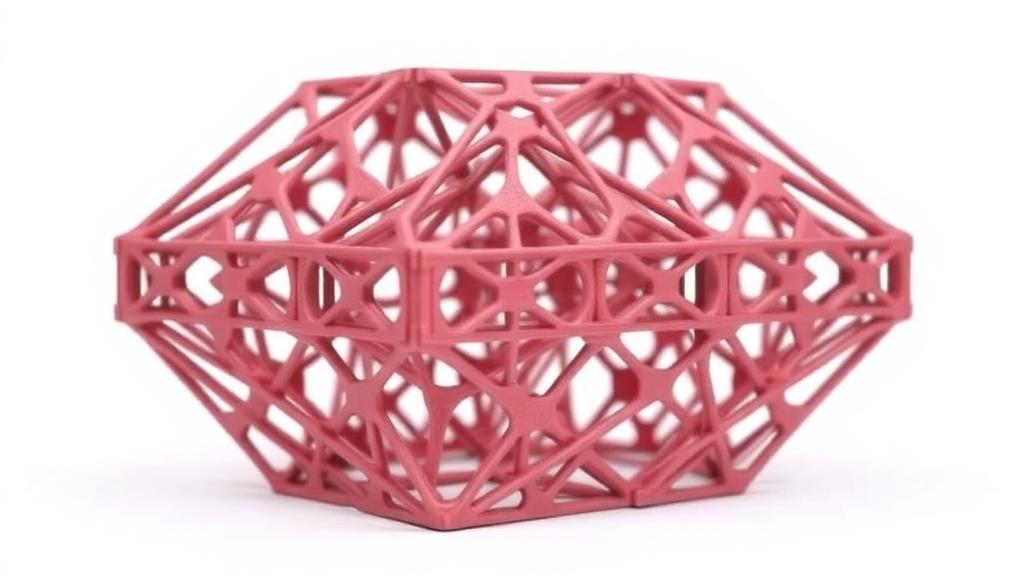
Materials that get fatter when you squeeze them sound like a physics prank, but they are real, and a new study shows just how much their behavior depends on the shape of their internal architecture. Researchers at Vellore Institute of Technology in India have designed and 3D-printed two different auxetic lattice structures and put them head to head in compression tests, revealing that one geometry is best suited to soft, cushioning roles while the other delivers the kind of strength and impact resistance demanded by aerospace and automotive engineers. The work, published in Scientific Reports, offers a practical roadmap for anyone hoping to turn these counterintuitive materials into real-world components.
Auxetic structures are defined by their negative Poisson’s ratio. In an ordinary material, stretching it makes it thinner and compressing it makes it bulge outward sideways. Auxetic materials do the opposite: when compressed, they contract inward, and when stretched, they expand laterally. This peculiar behavior arises not from the chemistry of the material itself but from its geometry, specifically from carefully engineered repeating unit cells that rotate and fold inward under load. The most iconic example is the re-entrant hexagon, a honeycomb whose cell walls are angled inward like an hourglass, so that compression causes the angled ribs to hinge and the whole structure to densify rather than spread.
Because the effect is purely geometric, engineers can dial in mechanical properties by changing the shape of the unit cell rather than searching for exotic new alloys or polymers. That flexibility has made auxetic lattices attractive for a striking range of applications, from energy-absorbing panels and protective armor to biomedical implants, ergonomic seating, and even shoe insoles. The catch is that different auxetic geometries behave very differently under load, and until now designers have lacked clear, experimentally grounded guidance on which architecture to choose for which job. The new comparative study was designed to fill exactly that gap.
The team, led by Pranjal Rukmangad with co-authors Benedict Thomas and Gunji Bala Murali from the School of Mechanical Engineering, selected two candidate architectures for their investigation. The first, labeled structure A, was a classic re-entrant hexagonal lattice, the workhorse of auxetic design. The second, labeled structure B, was a re-entrant star triangular configuration, a more intricate geometry in which star-shaped cells with triangular reinforcements replace the simple hexagonal motif. Both designs were created as three-dimensional models and then fabricated using stereolithography, or SLA, an additive manufacturing technique that builds parts layer by layer by curing a liquid photopolymer resin with a precisely directed light source.
SLA was a deliberate choice for this kind of study. Unlike extrusion-based 3D printing methods, which squeeze molten filament through a nozzle and can leave visible layer lines and voids, stereolithography produces parts with smooth surfaces and fine geometric detail. That fidelity matters enormously for lattices, where thin struts and sharp internal angles carry the load, and small printing defects can dramatically change how a structure fails. The researchers used a standard photopolymer resin for both geometries, ensuring that any differences in mechanical performance could be attributed to the architecture rather than to variations in the base material.
With the specimens printed, the team turned to standardized mechanical testing. Compression tests were carried out on a universal testing machine following the ASTM D695 standard, the widely used protocol for determining the compressive properties of rigid plastics. Standardization is more than bureaucratic box-ticking here: because auxetic structures deform through complex internal rotation and collapse, comparing results across studies requires a common loading geometry, strain rate, and measurement procedure. By adhering to ASTM D695, the researchers produced data that other labs can replicate and extend, building toward a shared evidence base for auxetic design.
The results confirmed what theorists have long suspected but designers have rarely had quantified side by side: geometry is destiny for these lattices. The re-entrant hexagonal structure, structure A, exhibited a more compliant, energy-absorbing response under compression, deforming gradually and cushioning the applied load. That behavior makes it a natural fit for applications where comfort and controlled deformation are the priorities, such as biomedical implants that must match the mechanical environment of surrounding tissue, ergonomic materials that conform to the body, shoe soles that absorb each footfall, and soft protective padding that cushions impacts without transmitting them.
The re-entrant star triangular structure, structure B, told a different story. Its reinforced geometry gave it markedly higher strength and impact resistance, holding its shape under loads that drove the hexagonal lattice into progressive collapse. The triangular elements within the star cells act like internal bracing, resisting the rotation of the cell walls and forcing the structure to carry load through its struts rather than simply folding. That makes structure B the stronger candidate for demanding structural roles, including aerospace sandwich structures where lightweight cores must resist crushing, automotive crash absorbers that must absorb enormous energies in milliseconds, and protective equipment where failure is not an option.
The practical significance of the comparison lies in its simplicity. Rather than treating auxetic materials as a single category, the study shows that designers should think of them as a family of architectures with distinct mechanical personalities, and it provides experimental evidence to guide that selection. A biomedical engineer designing an implant scaffold now has data supporting a hexagonal re-entrant lattice for tissue-friendly compliance, while an aerospace engineer sizing a crash-absorbing core can point to the star triangular geometry as the more robust choice, both fabricated from the same resin on the same machine.
The work also underscores how far additive manufacturing has come in making metamaterials accessible. A decade ago, fabricating intricate auxetic lattices with consistent quality was a laboratory curiosity; today, a desktop SLA printer and a standard testing machine are enough to characterize competing designs end to end. As the authors note, auxetic structures have gained significant attention for aerospace and automotive applications because of their superior mechanical performance, and studies like this one, grounded in standardized testing and open-access publication, help move that attention toward engineering practice. The next step for the field will likely be exploring how these geometries perform across repeated loading cycles, at larger scales, and in tougher material systems, but the central lesson already stands: when it comes to auxetic lattices, the shape of the void matters as much as the strength of the solid.
Subject of Research: Mechanical performance of SLA 3D-printed re-entrant auxetic lattice structures under compression
Article Title: Design and mechanical performance analysis of re-entrant auxetic structures fabricated using SLA 3D printing: a comparative study
Article References: Rukmangad, P., Thomas, B., & Murali, G. B. (2026). Design and mechanical performance analysis of re-entrant auxetic structures fabricated using SLA 3D printing: a comparative study. Scientific Reports. https://doi.org/10.1038/s41598-026-73142-1
Image Credits: AI Generated
DOI: 10.1038/s41598-026-73142-1
Keywords: auxetic structures, negative Poisson's ratio, re-entrant hexagon, stereolithography, SLA 3D printing, compression testing, ASTM D695, photopolymer resin, additive manufacturing, impact resistance, aerospace sandwich structures, biomedical implants
News Source: Denise Maddox. (October 13, 2026). Auxetic 3D-Printed Lattices Show Geometry Is Destiny Under Compression. Scienmag.