Engineers at Johns Hopkins University have built a pair of wireless, magnetically steered robots small enough to rest on a pencil tip, designed to travel through the bloodstream and deliver antibiotics directly to infected tissue inside a beating heart. The devices, described in the journal Advanced Materials Technologies, are intended to replace two grim alternatives that doctors currently face when treating life-threatening heart infections: weeks of intravenous drug therapy that often fails, or open-heart surgery that carries enormous risk. Because the robots concentrate medicine exactly where it is needed, the researchers say the same approach could eventually be adapted to treat other hard-to-reach diseases, including cancers that have spread through the body.
The clinical problem the team set out to solve is both common and stubborn. Roughly 50,000 people in the United States develop endocarditis each year, an infection of the heart’s inner tissue that can destroy valves and seed dangerous clots throughout the circulation. The standard treatment is a course of intravenous antibiotics lasting four to six weeks, but the therapy frequently falls short because the drugs become heavily diluted as they circulate through the entire body before reaching the heart. By the time the medication arrives at the infected tissue, the concentration may be too low to clear the bacteria effectively.
When intravenous therapy fails, physicians are left with two unattractive options. One is to escalate to higher and higher doses of antibiotics, which risks toxicity to organs such as the kidneys and can still fail to reach therapeutic levels inside the heart. The other is open-heart surgery, a highly invasive procedure in which the chest is opened and the heart may be stopped and placed on bypass, exposing the patient to blood loss, infection, and long recovery. The Johns Hopkins team, led by senior author Axel Krieger, a medical roboticist previously known for developing robots that performed a realistic surgical procedure without human assistance, wanted a way to sidestep both paths entirely.
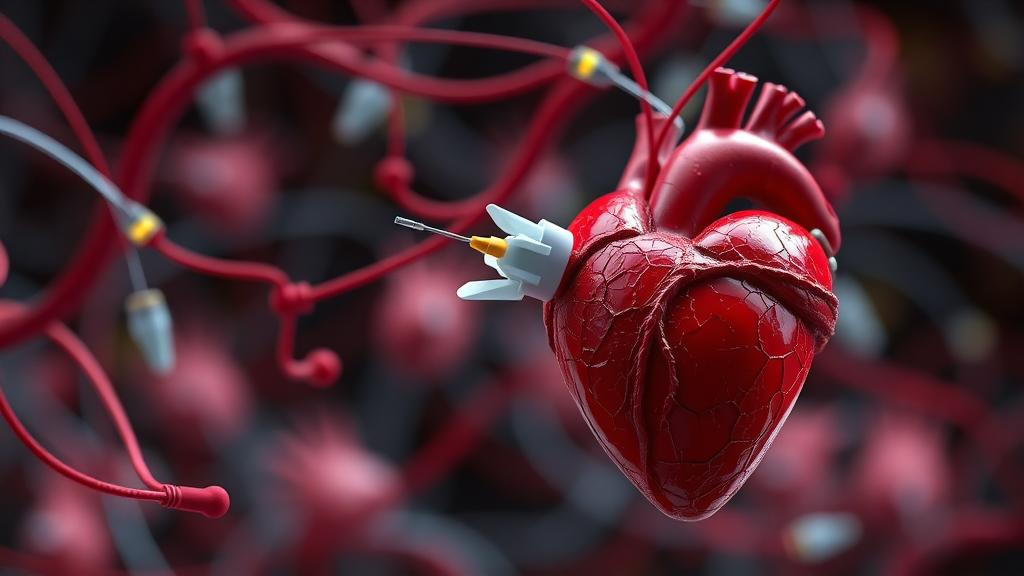
Their answer is a pair of magnetically powered devices the researchers call millirobots, named for their scale: each is about as wide as a pencil tip or the head of a matchstick and roughly as long as a grain of rice. Rather than a single larger robot, the system uses two specialized modules that work in tandem. The first, called the needle module, is guided to the infected site, where it gently latches onto the heart tissue and remains in place. Anchored to the moving muscle, it serves as a docking station on the surface of the beating heart, waiting for its partner to arrive.
The second device, the drug module, carries the medication payload. It navigates through the body to the waiting needle module and magnetically docks with it, then slowly releases antibiotics at the precise location where they are most needed. The two-robot architecture solves several problems at once. Because the modules are small, the system can reach tight anatomical spaces that a single larger device could not. And because the needle module stays docked while the drug module can detach and be replaced, clinicians can administer repeat doses of medicine without re-navigating the entire system, a feature that could prove essential when a single round of treatment is not enough.
Both robots contain no batteries, no motors, and no onboard power source of any kind. Instead, they are made of magnetic materials and steered wirelessly by an external electromagnetic coil system that operates on principles similar to those of an MRI machine. The coils generate controlled magnetic fields and gradients that pull and rotate the robots through the vasculature and hold them steady against the motion of the beating heart. Magnetic guidance is exciting, Krieger explained, because the robot itself carries nothing that can fail or harm the patient; the same field technology used for imaging in hospitals becomes the engine that drives the millirobots to their target.
The team tested the system on phantom heart models engineered to closely mimic human cardiac anatomy, as well as on real porcine heart tissue. In these experiments the robots traveled smoothly and autonomously, even when moving against simulated blood flow, demonstrating that the magnetic control scheme can overcome the hemodynamic forces that would sweep a passive object away. The success in both synthetic and biological tissue is an important early milestone, though the researchers emphasize that more realistic testing lies ahead before the technology approaches the clinic.
The potential payoff in treatment time is dramatic. Anuruddha Bhattacharjee, first author of the study and a former Johns Hopkins postdoctoral researcher who is now an assistant professor at the University of Alabama at Birmingham, described a future in which a patient receives a tiny robot through a simple injection into a vein, after which it travels to the infection site with minimal invasiveness. Where conventional intravenous therapy demands four to six weeks of hospital or at-home drug administration, the robotic procedure might take as little as ten minutes, or perhaps an hour if several rounds of dosing are required. If everything works as designed, Bhattacharjee noted, the treatment timeline collapses from weeks to a single day or less, delivered through what amounts to a pinprick rather than a sawn-open chest.
Krieger frames the work as the frontier of surgical robotics, and the implications extend well beyond cardiology. Because the platform delivers concentrated drugs to a precisely chosen location, the researchers believe it could be adapted to fight cancer where it is spreading, saturating tumors with chemotherapy while sparing healthy tissue the toxic systemic exposure that limits conventional dosing. Any disease that is difficult to reach with oral or intravenous drugs, from deep-seated infections to localized malignancies, is a candidate for the same docking-and-release strategy, and the steerable robots could play a major role across those applications.
Significant engineering and clinical hurdles remain before pencil-tip robots are injected into patients. The researchers’ next step is to test the devices in more realistic phantom hearts that reproduce the muscular contraction and beating movement of a living heart, conditions that will stress the docking mechanism and the magnetic control algorithms far more than the current models did. Human trials, regulatory review, and manufacturing at clinical scale all lie further down the road. But the demonstration that two untethered, battery-free robots can navigate simulated blood flow, latch onto moving cardiac tissue, dock magnetically, and release medication on target marks a striking proof of concept, one that hints at a future in which the most dangerous heart surgery is performed by machines smaller than a grain of rice, guided from outside the body and removed without a scar.
Subject of Research: Magnetically steered millirobots for targeted drug delivery to infected heart tissue
Article Title: Tiny robots speed medicine through body to the heart
Article References: Tiny robots speed medicine through body to the heart. (n.d.). Original publication
Image Credits: AI Generated
DOI: Not provided
Keywords: millirobots, medical robotics, endocarditis, targeted drug delivery, magnetic steering, Johns Hopkins University, Advanced Materials Technologies, minimally invasive surgery, antibiotics, heart infection, electromagnetic coils, cancer therapy
News Source: Denise Maddox. (October 12, 2026). Pencil-Tip Robots Ride the Bloodstream to Deliver Drugs to a Beating Heart. Scienmag.