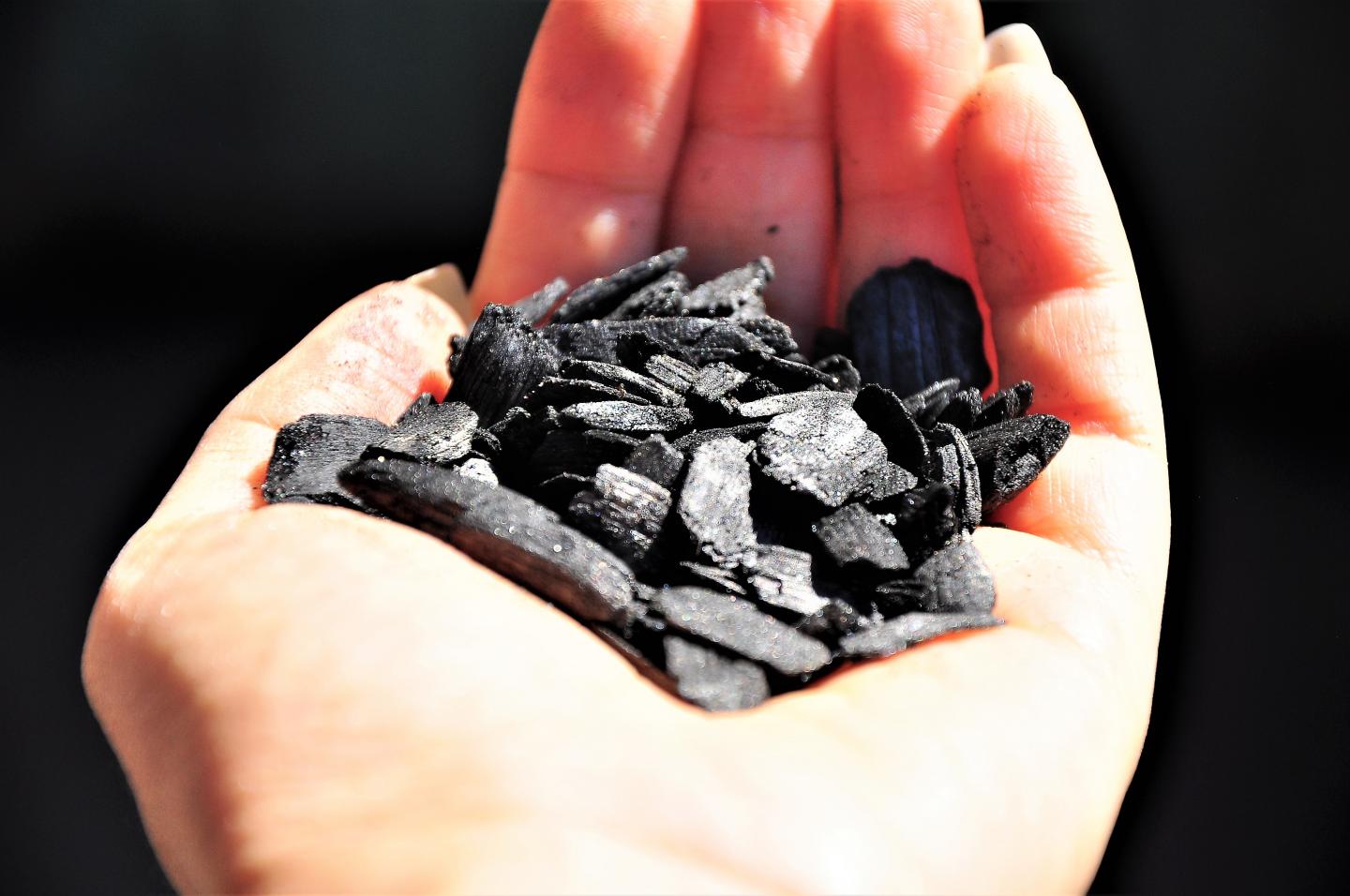
Credit: Ghasideh Pourhashem/Rice University
Biochar from recycled waste may both enhance crop growth and save health costs by helping clear the air of pollutants, according to Rice University researchers.
Rice researchers in Earth science, economics and environmental engineering have determined that widespread use of biochar in agriculture could reduce health care costs, especially for those who live in urban areas close to farmland.
Biochar is ground charcoal produced from waste wood, manure or leaves. Added to soil, the porous carbon has been shown to boost crop yields, lessen the need for fertilizer and reduce pollutants by storing nitrogen that would otherwise be released to the atmosphere.
The study led by Ghasideh Pourhashem, a postdoctoral fellow at Rice's Baker Institute for Public Policy, appears in the American Chemical Society journal Environmental Science and Technology.
Pourhashem worked with environmental engineering graduate student Quazi Rasool and postdoc Rui Zhang, Rice Earth scientist Caroline Masiello, energy economist Ken Medlock and environmental scientist Daniel Cohan to show that urban dwellers in the American Midwest and Southwest would gain the greatest benefits in air quality and health from greater use of biochar.
They said the U.S. counties that would stand to save the most in health care costs from reduced smog are Will, La Salle and Livingston counties in Illinois; San Joaquin, San Diego, Fresno and Riverside counties in California; Weld County in Colorado; Maricopa County in Arizona; and Fort Bend County in Texas.
"Our model projections show health care cost savings could be on the order of millions of dollars per year for some urban counties next to farmland," Pourhashem said. "These results are now ready to be tested by measuring changes in air pollutants from specific agricultural regions."
Pourhashem noted the key measurements needed are the rate of soil emission of nitric oxide (NO), which is a smog precursor, after biochar is applied to fields. Many studies have already shown that biochar reduces the emissions of a related compound, nitrous oxide, but few have measured NO.
"We know that biochar impacts the soil nitrogen cycle, and that's how it reduces nitrous oxide," said Masiello, a professor of Earth, environmental and planetary science. "It likely reduces NO in the same way. We think the local impact of biochar-driven NO reductions could be very important."
NO contributes to urban smog and acid rain. NO also is produced by cars and power plants, but the Rice study focused on its emission from fertilized soils.
The Rice team used data from three studies of NO emissions from soil in Indonesia and Zambia, Europe and China. The data revealed a wide range of NO emission curtailment — from 0 percent to 67 percent — depending on soil type, meteorological conditions and the chemical properties of biochar used.
Using the higher figure in their calculations, they determined that a 67 percent reduction in NO emissions in the United States could reduce annual health impacts of agricultural air pollution by up to $660 million. Savings through the reduction of airborne particulate matter — to which NO contributes — could be 10 times larger than those from ozone reduction, they wrote.
"Agriculture rarely gets considered for air pollution control strategies," said Cohan, an associate professor of civil and environmental engineering. "Our work shows that modest changes to farming practices can benefit the air and soil too."
###
Medlock is the James A. Baker III and Susan G. Baker Fellow in Energy and Resource Economics and senior director of the Center for Energy Studies at Rice's Baker Institute for Public Policy and lecturer of economics.
The research was supported by the NASA Air Quality Applied Sciences Team, Rice's Shell Center for Sustainability and the Baker Institute.
Read the abstract at http://pubs.acs.org/doi/10.1021/acs.est.7b00748
This news release can be found online at http://news.rice.edu/2017/07/26/biochar-could-clear-the-air-in-more-ways-than-one-2/
Follow Rice News and Media Relations via Twitter @RiceUNews
Related materials:
Study: Biochar alters water flow to improve sand and clay: http://news.rice.edu/2014/09/24/study-biochar-alters-water-flow-to-improve-sand-and-clay/
Biochar quiets microbes, including some plant pathogens: http://news.rice.edu/2013/09/30/biochar-quiets-microbes-including-some-plant-pathogens/
Ken Medlock bio: http://www.bakerinstitute.org/experts/kenneth-b-medlock-iii/
Cohan Research Group: https://cohan.rice.edu
Baker Institute Center for Energy Studies: http://www.bakerinstitute.org/center-for-energy-studies/
Located on a 300-acre forested campus in Houston, Rice University is consistently ranked among the nation's top 20 universities by U.S. News & World Report. Rice has highly respected schools of Architecture, Business, Continuing Studies, Engineering, Humanities, Music, Natural Sciences and Social Sciences and is home to the Baker Institute for Public Policy. With 3,879 undergraduates and 2,861 graduate students, Rice's undergraduate student-to-faculty ratio is 6-to-1. Its residential college system builds close-knit communities and lifelong friendships, just one reason why Rice is ranked No. 1 for happiest students and for lots of race/class interaction by the Princeton Review. Rice is also rated as a best value among private universities by Kiplinger's Personal Finance. To read "What they're saying about Rice," go to http://tinyurl.com/RiceUniversityoverview.
Media Contact
David Ruth
[email protected]
713-348-6327
@RiceUNews
http://news.rice.edu
Related Journal Article
http://dx.doi.org/10.1021/acs.est.7b00748