Dementia is quietly becoming one of the most urgent public health challenges in Sub-Saharan Africa, and a new scoping review suggests the region is dangerously unprepared. As life expectancy rises and populations age faster than previous generations ever did, the number of people living with dementia in the region is projected to surge from 2.13 million in 2015 to 3.48 million by 2030 and a staggering 7.62 million by 2050. Yet according to a team of researchers led by Soarov Chakra Borty and Nazmus Sakib of Kennesaw State University, publishing in PLOS Global Public Health, the health systems, technologies, and social safety nets needed to cope with this wave simply do not exist in most countries across the region.
The review, which followed PRISMA-ScR guidelines and analyzed studies published between 2021 and 2025 across five databases including PubMed, Scopus, and IEEE Xplore, examined 33 studies spanning Nigeria, Kenya, Ghana, South Africa, Tanzania, Uganda, Benin, and the wider region. The team organized their findings around the World Health Organization’s health system building blocks framework, sorting the evidence into four thematic domains: environmental and social factors, technological capacity, community-based caregiving, and financial and economic constraints. The result is one of the most comprehensive portraits to date of how dementia care fails patients and families across the continent, and where targeted investment could change the trajectory.
The numbers behind the review reveal a hidden epidemic. Because the reported case counts in Sub-Saharan Africa remain lower than in high-income countries, the region is often overlooked in global dementia research and policy agendas. But the authors argue this apparent advantage is an illusion created by missed diagnoses, scarce neuroimaging and cognitive assessment tools, shortages of trained dementia specialists, and weak referral pathways. A retrospective analysis from northeastern Nigeria, where researchers examined more than two decades of records from the region’s sole neuropsychiatric facility, documented 1,216 cases of dementia among adults aged 60 and older, with Alzheimer’s disease accounting for 60.5 percent and vascular dementia for 24.5 percent, and hypertension as the leading comorbidity at 41.6 percent. Without imaging or biomarkers, clinicians were left to diagnose based on clinical history alone.
Environmental and social factors compound the clinical picture. Research from Nigeria identified fine particulate air pollution, pesticide exposure, and heavy metal contamination of groundwater as underappreciated contributors to neurodegenerative disease, while estimating that dementia prevalence has risen nearly 400 percent over two decades. In South Africa, the first longitudinal analysis of memory clinic data from Groote Schuur Hospital in Cape Town found that cognitive decline averaged 2.1 Mini-Mental State Examination points per year for Alzheimer’s patients, with educational attainment and cardiovascular comorbidities emerging as significant predictors of both decline and mortality. Meanwhile, ethnographic work at Nairobi’s Aga Khan University Hospital documented how stigma, misconceptions linking dementia to witchcraft or punishment, and the absence of a national dementia policy delay care-seeking and leave most Kenyans without access to imaging, cognitive assessment, or specialist care.
The technological gap may be the most striking dimension of the crisis. Positron emission tomography scans, molecular imaging, and cerebrospinal fluid biomarker testing, which are standard in high-income countries, are largely unavailable across Sub-Saharan Africa. Access to MRI is severely constrained by cost, restricted availability, and frequent equipment downtime. Telemedicine and mobile health solutions show promise, but their adoption is hampered by unreliable internet connectivity, unstable power supplies, and a lack of hardware in rural facilities. In a region with thousands of languages and cultural contexts, screening tools like the MMSE and Montreal Cognitive Assessment are often unavailable in locally adapted forms, and frontline health workers frequently misclassify dementia symptoms as normal aging or stress. Nigeria, a country of 200 million people, has only about 90 neurologists, a shortage that undermines even the most promising digital screening innovations, since app-based tools still require confirmatory diagnosis and clinical oversight.
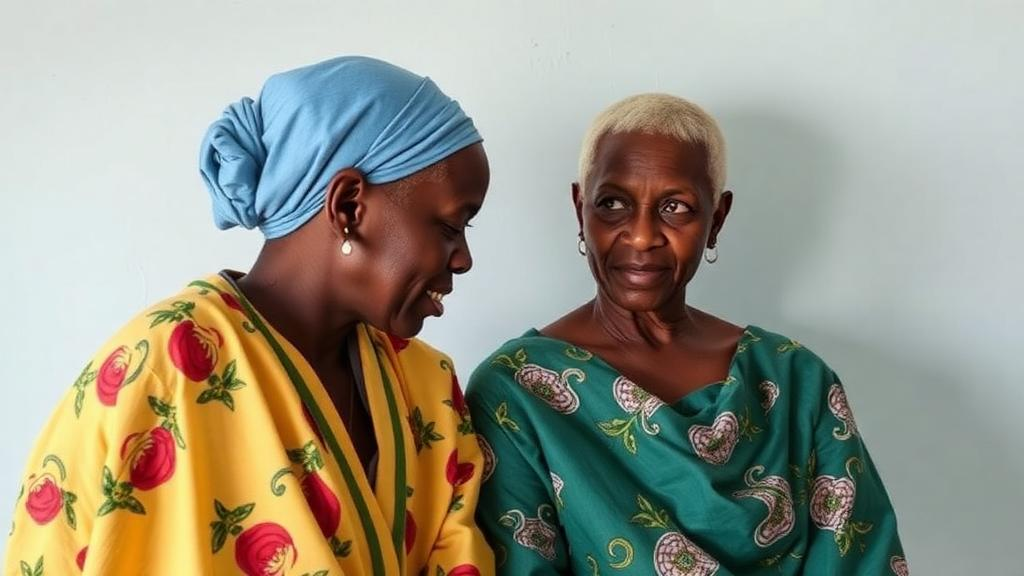
Perhaps the heaviest burden falls on informal caregivers, who are overwhelmingly women. Across settings in Uganda, Benin, Tanzania, Ghana, and the Democratic Republic of the Congo, studies found that women provide between 70 and 90 percent of informal care hours, often as spouses or adult daughters of care recipients, frequently without any training, institutional support, or financial compensation. A time-use evaluation in Benin estimated that caregivers spend 8 to 12 hours per day supervising patients, assisting with daily activities, and managing behavioral symptoms. Three studies using the standardized Zarit Burden Interview reported moderate to severe burden among caregivers, and research in Nigeria found that 40 percent of caregivers experienced psychological distress, with nearly a quarter reporting emotional exhaustion, strongly associated with the severity of patients’ behavioral and psychological symptoms.
The economic toll is equally sobering. In Benin, researchers estimated the annual cost of dementia care in 2021 at 2,399 international purchasing power parity dollars per person, with 92 percent of that cost attributed to informal care. Global modeling studies cited in the review estimate that Sub-Saharan Africa spent 552 million dollars on dementia in 2019, just 0.7 percent of total health spending, a figure projected to rise to nearly 7 billion dollars by 2050. A separate macroeconomic model estimates the total economic burden of Alzheimer’s disease and related dementias in the region at approximately 158 billion international dollars between 2020 and 2050, equivalent to about 0.108 percent of gross domestic product. With health spending across the region averaging just 92 dollars per capita in 2021, the lowest of any world region, most families pay out of pocket, and weak insurance coverage pushes many households into catastrophic health expenditures, defined as spending more than 10 percent of household income on care.
Despite the grim picture, the review identifies genuine reasons for optimism. Cognitive Stimulation Therapy, a low-cost, group-based behavioral intervention, has proven feasible and effective in improving cognitive and language outcomes in low-resource settings across eight countries. A tablet-based dementia screening app administered by non-specialist community health workers in rural Tanzania demonstrated that culturally adapted digital tools can work when paired with training. In Uganda, gardening interventions were associated with improved mental health among caregivers, while a singing training program in South Africa boosted caregiver confidence, and a community stigma-reduction program in Kenya showed high acceptance and improved attitudes toward dementia. Expanding mobile phone penetration and growing digital health initiatives provide a platform for scaling such approaches, provided national digital health strategies and electronic records systems catch up.
The authors frame their recommendations through the WHO financing framework’s three functions: mobilizing revenue, pooling resources, and purchasing services. They point to South Korea and Brazil as models, showing how universal health care platforms can be leveraged to provide comprehensive dementia coverage, including formal long-term care support. They also argue that Sub-Saharan Africa’s relatively young population offers a rare window of opportunity to invest in prevention-oriented, life-course strategies before the demographic wave crests. Key proposals include embedding dementia within national aging and non-communicable disease policies, establishing dementia registries, task-shifting to community health workers, and building region-specific dementia data warehouses to guide resource allocation with locally collected evidence.
What emerges from this review is a call to reframe dementia not merely as a medical condition but as a social and governance challenge intertwined with gender equity, environmental policy, and economic development. Older women in some communities face discrimination and violence because of beliefs that cognitive decline results from witchcraft, a stark reminder that clinical solutions alone will not suffice. The researchers acknowledge limitations, including the heterogeneity of studies across countries and the reliance on documented literature that may miss undocumented community practices. But their central conclusion is difficult to dispute: without simultaneous investment in technology, workforce, caregiver support, and financial protection, millions of families across Sub-Saharan Africa will continue to shoulder a burden that health systems were never designed to share, and the region’s demographic transition will turn a manageable challenge into an unmanageable catastrophe.
Subject of Research: Gaps in dementia care across Sub-Saharan Africa spanning technology, environment, caregiving, and financing
Article Title: Dementia care gaps in Sub-Saharan Africa: A scoping review of technology, environmental, community perspectives, and financial constraints
Article References: Borty, S. C., Block Ngaybe, M. G., Apeagyei, A. E., Bhagianadh, D., Swahn, M. H., & Sakib, N. (2026). Dementia care gaps in Sub-Saharan Africa: A scoping review of technology, environmental, community perspectives, and financial constraints. PLOS Global Public Health, 6(10), e0007265. https://doi.org/10.1371/journal.pgph.0007265
Image Credits: AI Generated
DOI: 10.1371/journal.pgph.0007265
Keywords: dementia, Sub-Saharan Africa, scoping review, informal caregiving, digital health, health systems, global public health, Alzheimer's disease, health financing, cognitive screening, telemedicine, population aging
News Source: Cassandra Pierce. (October 10, 2026). Dementia Care in Sub-Saharan Africa Faces a Widening Crisis as Populations Age. Scienmag.