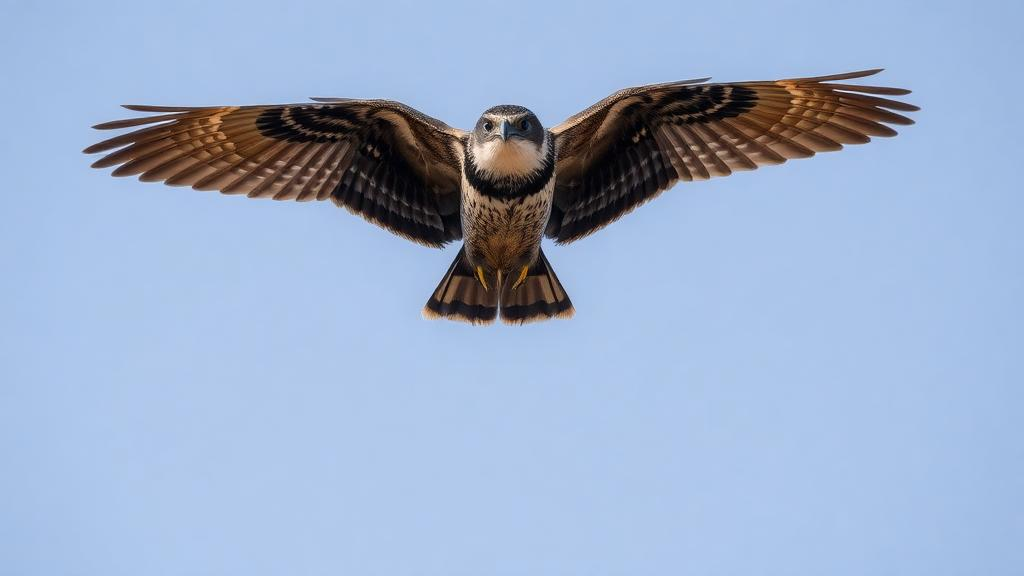
The European nightjar is a bird built for two very different lives. Every year it migrates thousands of kilometres between breeding grounds in Europe and wintering areas in southern Africa, a journey that would seem to demand the long, slender wings of a champion endurance flyer. Yet the same wings must also serve the bird in its nightly hunt for insects, which requires slow flight, sharp turns and precise control in the dark. A new study from Lund University, published in PLOS Biology, shows how these competing demands have shaped the nightjar’s flight mechanics, and reveals that its wings are not the perfectly optimised flying machine that intuition might suggest, but a carefully balanced compromise.
Researchers led by Christoffer Johansson, associate professor at Lund University, set out to understand how a single wing design can serve both long-distance migration and the demanding, low-speed manoeuvres of aerial insect hunting. Using a wind tunnel, they observed nightjars flying at different speeds and measured the airflow behind the birds. This technique allows scientists to quantify the forces a flying animal generates with each wingbeat, by analysing how the wake it leaves behind carries momentum into the surrounding air. By examining the wake at a range of flight speeds, the team could reconstruct how efficiently the wings produced lift and thrust as the birds adjusted their flight style.
The results revealed a clear aerodynamic cost tied to the nightjar’s wing shape. The bird has broad wing tips, a feature that is likely advantageous when flying slowly, because broad wings generate more lift at low speeds and give the animal greater control during tight turns and slow pursuit of prey. That is exactly what a nocturnal insect hunter needs. But the wind tunnel measurements showed that as the nightjar increases its flight speed, lift production becomes less efficient. The very feature that helps the bird hunt appears to penalise it during fast, sustained flight, the kind of performance that matters most on a migratory journey of thousands of kilometres.
“This runs counter to the intuitive image of a long-distance migrant as a perfectly optimised flying machine. Instead, the nightjar’s wings appear to be a compromise between several different demands. The bird can fly slowly and manoeuvre while hunting, but the trade-off is reduced efficiency in lift generation at higher speeds,” says Christoffer Johansson. In other words, the nightjar pays a measurable aerodynamic price at cruising speeds for the ability to fly slowly and agilely when catching insects. Its wings are not specialised for either task alone; they are shaped by the sum of everything the bird must do to survive.
This finding challenges a common way of thinking about migratory birds. Long-distance migrants are often assumed to have wings finely tuned for efficient forward flight, with shapes that minimise the energy cost of covering vast distances. The nightjar tells a more nuanced story. Evolution does not optimise a single performance metric; it balances multiple tasks that an animal must perform throughout its life. For the nightjar, the ability to forage effectively at night is at least as important as migratory efficiency, and its wing morphology reflects that balance between long-distance travel, foraging, slow flight and advanced manoeuvrability.
The study also produced a second, unexpected discovery that reaches well beyond nightjars. The researchers found that the nightjar generates thrust even when its wings move upward during the wingbeat. In most birds, the upstroke is largely a recovery phase: the wings fold and are brought back into position, contributing little or no forward force. An actively thrust-producing upstroke, in which the wings push against the air on the way up, had previously been associated mainly with bats and insects rather than birds. Bats, whose wing membranes cannot fold as compactly as feathered wings, rely on active upstrokes to keep generating force throughout the beat cycle.
“What’s interesting is that the same type of aerodynamic solution seems to appear in quite different animals. This suggests that the upstroke does not have to be merely a passive or lift generating part of the wingbeat. It can be actively used to generate thrust when the wings cannot be folded very much,” says Christoffer Johansson. The nightjar’s broad wings, so useful for slow flight, apparently cannot be folded very much during each wingbeat. That constraint, it turns out, links the two discoveries in the study. The same wing geometry that reduces lift efficiency at high speed also restricts wing folding, and when folding is restricted, the bird turns its upstroke into a source of thrust rather than letting it go to waste.
This convergence between birds, bats and insects is scientifically striking because these groups evolved flight independently and have very different wing structures. Birds fly with feathered wings attached to modified forelimbs, bats with elastic membranes stretched between elongated finger bones, and insects with rigid or flexible chitinous plates. Yet when the mechanical constraints are similar, when wings cannot be folded much during the stroke, similar aerodynamic solutions emerge. The finding suggests that active upstroke thrust is not an exotic peculiarity of bats and insects, but a general principle of flapping flight that appears whenever wing anatomy demands it, and that birds can and do make use of it as well.
The broader significance of the work lies in what it says about how evolution shapes animals that must perform several different tasks. A wing does not need to be optimised for a single type of flight to be successful. Instead, it may represent a balance among migration, foraging, slow flight and manoeuvrability, with each function pulling the morphology in a different direction. For the nightjar, the compromise is visible in the numbers: broad wing tips that enable slow, agile hunting at the cost of less efficient lift generation at higher speeds, and limited wing folding that turns the upstroke into an active thrust-producing phase. The bird’s flight performance is thus a record of the ecological demands placed on it, readable through careful measurement of the air it leaves behind.
The findings may also prove relevant beyond biology. Flapping drones and other flying robots face constraints similar to those of birds, including limits on how much their wings can fold during each wingbeat. Understanding how the nightjar extracts thrust from its upstroke could inform the design of flapping-wing aircraft that must operate efficiently across a range of speeds and flight styles. “We now want to investigate how common this way of generating force is among other birds and flying animals. It could help us understand which aerodynamic principles are specific to the nightjar and which are more general. This knowledge may also inspire the development of new types of flapping aircraft,” Christoffer Johansson concludes. The nightjar, a bird long known for its silent, ghostly flight through summer nights, has now shown that even a seemingly familiar wing can hold surprises about the physics of flight and the compromises that evolution strikes between living fast, flying far and hunting slow.
Subject of Research: Aerodynamic trade-offs in the flight mechanics of the European nightjar
Article Title: Nightjar wings reveal a trade-off between hunting slowly and travelling far
Article References: Nightjar wings reveal a trade-off between hunting slowly and travelling far. (n.d.). Original publication
Image Credits: AI Generated
DOI: Not provided
Keywords: nightjar, flight mechanics, aerodynamics, migration, wind tunnel, upstroke thrust, wing morphology, PLOS Biology, Lund University, evolution, flapping flight, biomechanics
News Source: Gavin Prescott. (October 10, 2026). Nightjar wings reveal a trade-off between hunting slowly and travelling far. Scienmag.