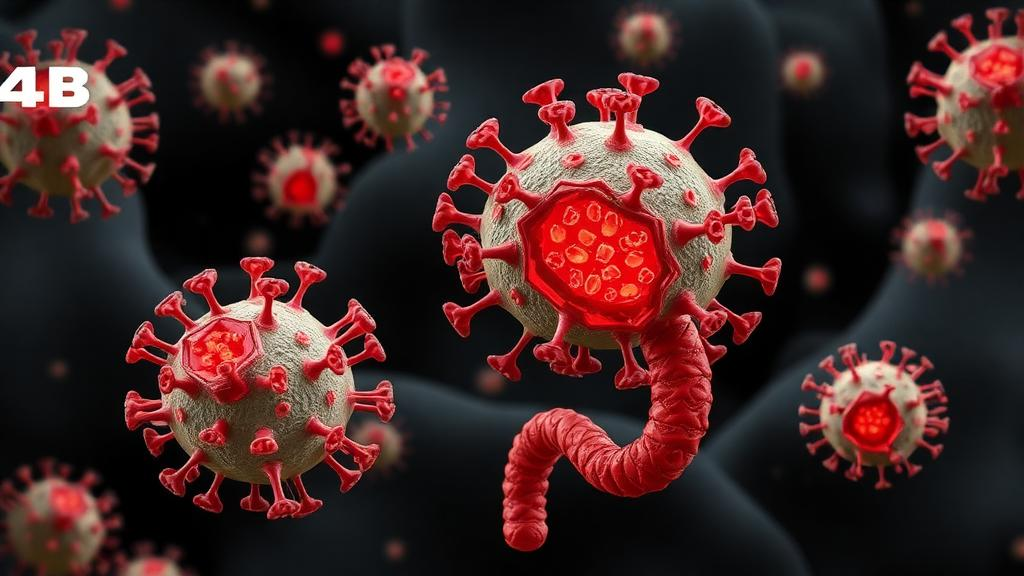
Viruses are masters of cellular exploitation, and few steps of their replication cycle are as consequential as the final one: getting out of an infected cell and into the next host. For enveloped viruses, egress often involves budding through cellular membranes, a process that leaves the particle wrapped in a lipid cloak. Non-enveloped viruses, by contrast, have historically been assumed to burst their host cells open, releasing progeny in a wave of lysis. Over the past two decades, however, virologists have come to appreciate that many non-enveloped enteric viruses can depart their host cells without destroying them, co-opting normal cellular export pathways in the process. A new study published in PLOS Pathogens adds a striking entry to this growing list of non-lytic exit strategies, showing that astroviruses, a major cause of pediatric diarrhea worldwide, ride out of infected cells on a tide of mucus.
Astroviruses are small, non-enveloped RNA viruses that infect the small intestine, where they cause gastroenteritis that can be particularly severe in young children, the elderly, and immunocompromised patients. Despite their clinical importance, fundamental aspects of the astrovirus replication cycle have remained poorly resolved, including the deceptively simple question of how newly assembled viral particles leave the cells that produce them. The research team, led by Natalie Pedicino and colleagues, reasoned that the answer might lie in a distinctive feature of astrovirus tropism: these viruses preferentially infect goblet cells, the specialized epithelial cells of the intestinal lining whose entire existence is organized around the production and secretion of mucus.
Goblet cells are the mucus factories of the gut. They synthesize enormous quantities of mucins, the heavily glycosylated proteins that give mucus its gel-like protective properties, and store them in membrane-bound secretory granules packed within the cytoplasm. When appropriately stimulated, goblet cells undergo regulated exocytosis, fusing these granules with the plasma membrane and expelling their mucin cargo into the intestinal lumen. This process, known as mucus secretion, is a fundamental component of intestinal barrier function, and it is driven in large part by intracellular calcium signals that trigger granule fusion. Because astroviruses infect precisely the cells that perform this function, the researchers hypothesized that the viruses might have evolved to exploit the secretory pathway itself, packaging themselves into the same cellular cargo that goblet cells are built to release.
To test this hypothesis, the team turned to the murine astrovirus model, a well-established experimental system that permits the study of astrovirus infection in its natural intestinal context. Examining infected intestinal tissue, the researchers made a striking observation: the release of virus from infected cells co-occurred almost exclusively with episodes of mucus secretion from goblet cells. Wherever virus was being shed, mucus was being expelled, and the two events appeared to be tightly coupled rather than merely coincidental. This spatial and temporal association suggested that viral egress was not an independent process but was physically and mechanistically linked to the secretory activity of the infected goblet cells.
The correlation extended beyond individual cells to the level of the whole tissue. When the researchers tracked infection kinetics over time, they found that mucus secretion rates rose and fell in parallel with viral load. As the infection progressed and the immune system began to clear the virus, mucus secretion returned toward baseline levels, mirroring the decline in viral shedding. This coordinated pattern reinforced the idea that the secretory state of the tissue and the propagation of the virus were intimately connected throughout the course of infection, not just at a single snapshot in time.
Correlation alone, however, cannot establish causation, so the researchers next manipulated mucus secretion directly and asked what happened to viral release. When they disrupted mucin biosynthesis, thereby impairing the goblet cells’ ability to produce and package their mucus cargo, viral shedding from infected tissue was reduced. Conversely, when they stimulated mucus secretion pharmacologically using carbachol, a drug that activates muscarinic receptors and triggers the calcium-dependent secretory pathway, viral release increased. The bidirectional nature of this effect, in which dampening secretion reduced virus release and enhancing secretion boosted it, provided strong functional evidence that the mucus secretory pathway is not merely a passive correlate of infection but an active route of viral egress.
To determine whether this mechanism extends to human astroviruses, which are clinically the most relevant, the team needed an appropriate cell culture system. They established a new infection model using LS174T cells, a human cell line derived from a colonic adenocarcinoma that retains goblet-cell-like properties, including the capacity to produce and secrete the major intestinal mucin MUC2. In these infected goblet-like cells, the researchers observed that human astrovirus particles colocalized with MUC2 within the cell, suggesting that the virus and the mucin cargo occupy the same intracellular compartments during the secretory process. The association was further confirmed using purified mucin granules, with viral particles found in association with the isolated granules themselves.
The pharmacological experiments in the human cell model recapitulated and extended the findings from the murine system. Stimulating LS174T cells with carbachol enhanced the release of both mucus and virus, and this dual effect could be blocked by the addition of a muscarinic receptor antagonist, which prevents the receptor-mediated activation of the secretory pathway. The researchers also probed the intracellular signal that drives granule exocytosis: calcium. When they blocked intracellular calcium signaling, the trigger that normally causes mucin granules to fuse with the plasma membrane, virus release was reduced. Together, these experiments traced the egress pathway from receptor activation through calcium signaling to granule exocytosis, showing that human astrovirus exploits each step of the canonical mucus secretion machinery.
The significance of these findings lies in what they reveal about both the astrovirus replication cycle and the broader biology of non-enveloped enteric viruses. Egress is the step of the viral life cycle that determines how efficiently a virus spreads from cell to cell and, ultimately, from host to host. By demonstrating that astroviruses use mucus secretion as a non-lytic form of egress, the study resolves a longstanding gap in understanding how these viruses complete their replication cycle. It also suggests a possible explanation for aspects of astrovirus pathogenesis: a virus that exits the cell by hitching a ride on mucus is delivered directly into the luminal mucus layer of the intestine, positioning itself for transmission while potentially modulating the barrier and immune functions of the mucus itself. The tight coupling between viral shedding and secretory activity may therefore have consequences that extend beyond viral spread to the diarrhea and intestinal dysfunction that characterize astrovirus disease.
More broadly, the work adds mucus secretion to the repertoire of host pathways that non-enveloped viruses can commandeer for exit, joining mechanisms such as extracellular vesicle release and cell-to-cell spread that have been described for other enteric pathogens. It also highlights the value of studying viruses in the context of the specific cell types they naturally infect. The connection between astroviruses and goblet cells was the key insight that made this discovery possible, and it serves as a reminder that viral strategies are often best understood not in generic cell culture systems but in the specialized cellular environments where infection actually occurs. As researchers continue to probe how this novel egress pathway shapes astrovirus transmission and disease, the findings open new avenues for therapeutic intervention, since drugs or interventions that modulate mucus secretion could, in principle, influence viral shedding and the course of infection.
Subject of Research: Non-lytic egress of astroviruses through mucus secretion from intestinal goblet cells
Article Title: Astroviruses use mucus secretion as a novel form of viral egress
Article References: Pedicino, N., Kirkpatrick, M. G., Pablo, M. A., Gulman, J., Heredia-Osuna, N., & Cortez, V. (2026). Astroviruses use mucus secretion as a novel form of viral egress. PLOS Pathogens, 22(10), e1014683. https://doi.org/10.1371/journal.ppat.1014683
Image Credits: AI Generated
DOI: 10.1371/journal.ppat.1014683
Keywords: astrovirus, viral egress, goblet cells, mucus secretion, MUC2, mucin granules, pediatric diarrhea, non-enveloped viruses, calcium signaling, carbachol, LS174T cells, murine astrovirus
News Source: Kristina Jarvis. (October 10, 2026). Astroviruses Hijack Goblet Cell Mucus Secretion to Exit the Gut. Scienmag.