For decades, the standard answer to a confirmed papillary thyroid carcinoma has been surgery: remove part or all of the thyroid gland, accept a scar at the base of the neck, and often commit to lifelong thyroid hormone replacement. But as ultrasound imaging has become ever more sensitive, millions of people are being diagnosed with tiny thyroid cancers — tumors measuring one centimeter or less — that may never have threatened their lives. That diagnostic flood has triggered an intense international debate about whether every small papillary thyroid carcinoma truly needs to be cut out, and a new retrospective cohort study from Sir Run Run Shaw Hospital at Zhejiang University School of Medicine in Hangzhou, China, adds an important piece of evidence to that conversation. The research, published in BMC Cancer, examined whether radiofrequency ablation, a minimally invasive technique that destroys tumors with heat delivered through a thin needle, can be used safely even when the tumor sits in anatomically dangerous territory within the neck.
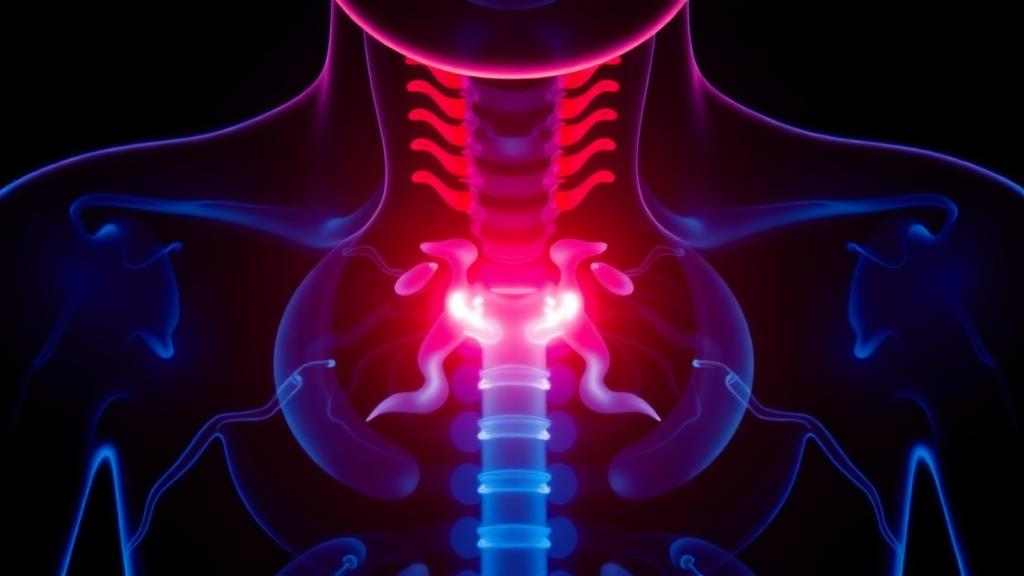
The stakes in this debate are anatomical. The thyroid gland is a small, butterfly-shaped structure wrapped around the windpipe, and it shares that crowded space with some of the most delicate structures in the human body. The recurrent laryngeal nerves, which control the vocal cords, run directly alongside the gland; injury to them can leave a patient with permanent hoarseness or breathing difficulties. The parathyroid glands, which regulate calcium, are similarly vulnerable. The trachea, esophagus, and major blood vessels of the neck all lie within millimeters of the thyroid capsule. For these reasons, tumors located adjacent to the capsule, the trachea, or the recurrent laryngeal nerve have traditionally been considered high-risk locations — and many guidelines and practitioners have treated them as contraindications to thermal ablation, reserving heat-based treatment only for tumors comfortably surrounded by normal thyroid tissue.
That conservative stance is now being re-examined. In 2024, an expert consensus broadened the potential indications for thermal ablation in papillary thyroid carcinoma, opening the door to treating tumors that were previously excluded on anatomical grounds. The Zhejiang University team, led by corresponding author Shiyan Li of the Department of Ultrasound, set out to test that expansion empirically. Their question was direct: when a small papillary thyroid carcinoma is classified as being in a high-risk location, does radiofrequency ablation performed by experienced hands produce outcomes that are meaningfully worse than ablation of tumors in low-risk locations? If the answer were no, the anatomical objection to ablation would lose much of its force.
To answer it, the researchers assembled a cohort of 268 patients with T1aN0M0 papillary thyroid carcinoma — the staging designation for tumors one centimeter or smaller with no lymph node involvement and no distant metastasis — who underwent radiofrequency ablation between January 2020 and April 2024. Each tumor was classified according to its position within the gland, dividing the cohort into a high-risk location group and a low-risk location group. All procedures were carried out by senior radiologists with more than five years of ablation experience, a detail the authors emphasize because operator skill is widely believed to be the decisive variable in whether tumors near critical structures can be treated safely. Patients were then followed until September 2025, yielding a median follow-up of 23.5 months.
The technical logic of radiofrequency ablation helps explain both its appeal and its risks. Under ultrasound guidance, a slender electrode is threaded through the skin and into the tumor, and an alternating electrical current is passed through the tissue. The resistance of the tissue generates frictional heat, creating a zone of coagulative necrosis that kills the cancer cells in place. Contrast-enhanced ultrasound is typically used afterward to confirm that the entire tumor has been devascularized. The technique avoids an incision, spares the remaining thyroid tissue, preserves thyroid function in most patients, and can often be performed with local anesthesia and same-day discharge. But near the trachea or the recurrent laryngeal nerve, the same heat that destroys the tumor can theoretically damage those structures, which is precisely why high-risk locations have been treated with such caution.
The primary endpoint of the study was the disease progression rate — whether the cancer grew, spread, or recurred during follow-up. The secondary endpoints covered the practical questions patients care about most: how much the tumor shrank, how often it disappeared completely, and how often complications occurred, along with postoperative anxiety and marked pain. The headline result was striking in its simplicity. Across the entire cohort, the complete tumor disappearance rate was 61.6 percent, and there was no statistically significant difference between the high-risk and low-risk groups, with a p value of 0.665. In other words, tumors nestled against the trachea or the nerve were just as likely to vanish after ablation as tumors in easy-to-treat positions.
Disease progression was rare in both groups, which is itself informative but also creates a statistical challenge. When an outcome is uncommon, conventional regression models can become unstable, so the researchers turned to Firth penalized logistic regression, a method designed to handle rare events and small cell counts. After adjusting for the baseline maximum tumor diameter, they found that high-risk location classification was not significantly associated with disease progression: the adjusted odds ratio was 1.77, with a 95 percent confidence interval stretching from 0.17 to 239.22 and a p value of 0.689. The extraordinarily wide confidence interval is worth pausing on. It reflects the fact that so few patients progressed at all that the data cannot precisely pin down the size of any effect — but the central estimate and the p value both indicate no detectable harm from treating tumors in high-risk positions.
The safety findings followed the same pattern. The researchers detected no significant associations between high-risk tumor location and the incidence of complications, postoperative anxiety, or marked pain. For a field in which fear of nerve injury and tracheal damage has long limited the use of ablation, that null result carries real weight. It suggests that, in the hands of operators with substantial experience, the heat zone can be shaped and controlled with enough precision to treat tumors even where the margin for error is measured in millimeters. Techniques such as the so-called moving shot method, hydrodissection to push critical structures away from the ablation zone, and continuous monitoring of the patient’s voice during the procedure are among the tools experienced operators use to make this possible.
The authors are careful about what their study can and cannot claim. As a retrospective cohort study, it analyzed archived routine patient data rather than randomly assigning patients to treatment arms, so it cannot rule out selection effects — the possibility that patients chosen for ablation of high-risk tumors differed in subtle ways from those with low-risk tumors. The follow-up of roughly two years on median is also shorter than the slow natural history of papillary thyroid carcinoma would ideally demand; these indolent cancers can recur many years after treatment. And the confidence intervals on the progression analysis, while statistically unremarkable, are wide enough that a modest increase in risk cannot be entirely excluded. The researchers frame their conclusions accordingly: in this retrospective cohort, no statistically significant differences in observed outcomes were detected between the high-risk and low-risk groups, and these preliminary findings support further evaluation of radiofrequency ablation performed by experienced operators in carefully selected patients.
Even with those caveats, the study lands at a consequential moment. The 2024 expert consensus has already shifted the regulatory and clinical landscape toward broader use of thermal ablation, and active surveillance — the watch-and-wait strategy pioneered for small papillary thyroid carcinomas in Japan — has established that many of these tumors can be safely observed without any intervention at all. The emerging picture is one of expanding options rather than a single replacement for surgery: observation for patients comfortable with surveillance, ablation for those who want the tumor treated but dread losing the gland, and surgery for cases where nodal disease or tumor behavior demands it. What the Zhejiang data add is evidence that the anatomical map of the thyroid, long used to draw a bright line between ablatable and non-ablatable tumors, may matter less than the skill of the operator holding the electrode. If larger, prospective studies confirm these results, the treatment of the smallest thyroid cancers may become less about where the tumor sits and more about who is treating it — a shift that could spare thousands of patients a scar, a hospital stay, and a lifetime of daily medication.
Subject of Research: Radiofrequency ablation of T1aN0M0 papillary thyroid carcinoma in high-risk anatomical locations
Article Title: Efficacy and safety of radiofrequency ablation for high-risk locations of T1aN0M0 papillary thyroid carcinoma: a retrospective cohort study
Article References: Wan, F., Xu, L., Lou, H., Shou, J., Xu, H., Li, Q., Zhou, L., Fan, G., & Li, S. (2026). Efficacy and safety of radiofrequency ablation for high-risk locations of T1aN0M0 papillary thyroid carcinoma: a retrospective cohort study. BMC Cancer. https://doi.org/10.1186/s12885-026-17125-5
Image Credits: AI Generated
DOI: 10.1186/s12885-026-17125-5
Keywords: papillary thyroid carcinoma, radiofrequency ablation, thyroid cancer, interventional radiology, high-risk location, thermal ablation, active surveillance, recurrent laryngeal nerve, T1aN0M0, retrospective cohort study, minimally invasive therapy, Zhejiang University
News Source: Nathaniel Bowman. (October 10, 2026). Radiofrequency Ablation Shows Promise for Thyroid Tumors in High-Risk Spots. Scienmag.