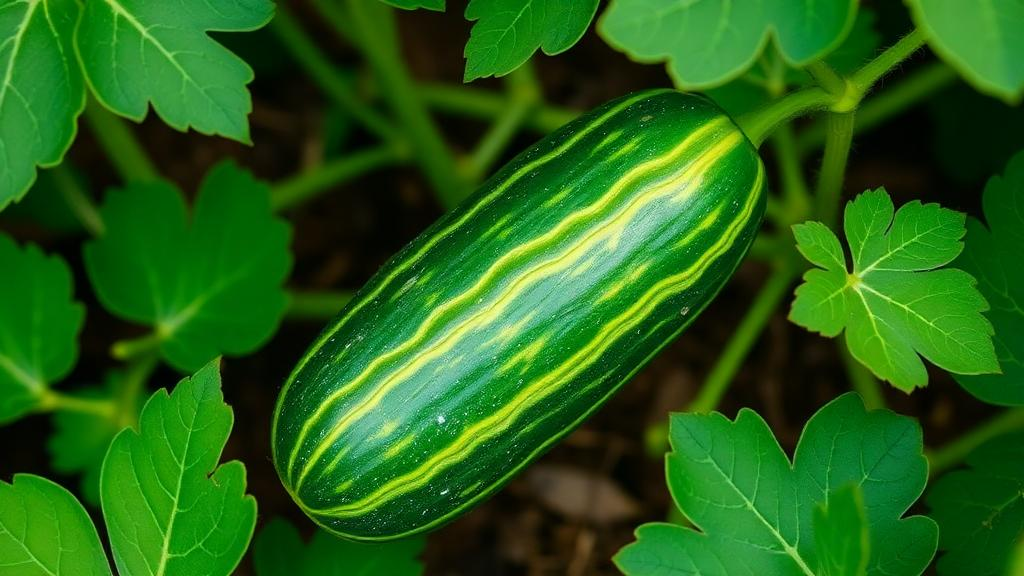
A cucumber fruit looks deceptively simple: a crisp, elongated wall of green tissue wrapped around a soft interior. Beneath that simplicity, however, lies a tightly choreographed hormonal conversation that determines whether a flower becomes a fruit, how large that fruit grows, and how its inner and outer tissues mature at different rates. A new study from Shanxi Agricultural University in China has now added a precise piece to that puzzle by mapping, in fine detail, where and when a single gibberellin-deactivating gene called CsGA2ox2 switches on during cucumber fruit development. The work, published in Molecular Biology Reports, offers the first tissue-resolved expression profile of this gene across the full four-week window of fruit growth in the widely used cucumber line ‘9930’.
Gibberellins are a family of plant hormones that have shaped agriculture for decades. They drive stem elongation, seed germination, and, crucially for growers, fruit set and expansion. But hormones are only useful to a plant when they are present in the right amount at the right place and time, which means that both their production and their destruction must be carefully controlled. That is where the GA2ox family of enzymes comes in. These enzymes, known formally as gibberellin 2-oxidases, act as molecular brakes: they convert bioactive gibberellins into inactive forms, effectively lowering the hormone signal inside plant tissues. Since the first gibberellin 2-oxidases were molecularly cloned and functionally characterised in the late 1990s, researchers have recognised C19-gibberellin 2-oxidation as a major gibberellin inactivation pathway in flowering plants, with genetic studies in Arabidopsis confirming its central role in controlling hormone levels.
What remained unclear, until now, was how one particular GA2ox gene behaves during the development of a cucurbit fruit, and whether its activity differs between the distinct tissues that make up that fruit. Cucumber fruit is an ideal system for asking this question because it can be cleanly dissected into two compartments: the pulp, the inner fleshy tissue that surrounds the developing seeds, and the pericarp, the outer fruit wall that gives the fruit its structure and its commercial appearance. These two tissues do not mature in lockstep, and previous work on gibberellin oxidase gene families in cucumber had not examined their expression with this level of tissue resolution.
The research team, led by Wenjiao Wang of the College of Horticulture at Shanxi Agricultural University, with Xiaoning An and Yupeng Liu conducting the experiments and Zhiping Liu contributing phylogenetic and promoter analyses, sampled cucumber fruit of the ‘9930’ line at five carefully chosen time points: 0, 7, 14, 21 and 28 days after pollination. This sampling strategy spans the entire arc of early fruit development, from the moment of pollination through fruit set, rapid expansion, and the beginning of maturation. At each time point, the researchers separated the pulp from the pericarp, ensuring that any differences in gene activity between the two tissues could be detected rather than averaged away, as would happen if whole fruits had been ground up for analysis.
To quantify how actively CsGA2ox2 was being transcribed in each sample, the team used quantitative real-time PCR, a technique that measures the abundance of specific messenger RNA molecules with high sensitivity. The measurements were calculated using the 2^(−ΔΔCt) method, a standard approach that normalises the target gene’s signal against a stable reference gene, in this case the Actin gene designated LOC101215469. This normalisation is essential because the total amount of RNA and the overall transcriptional activity of a tissue can vary dramatically between developmental stages, and without a reliable internal reference, comparisons across time points and tissues would be meaningless.
The results revealed a clear and consistent pattern. CsGA2ox2 was transcribed at every developmental stage the researchers examined, but its activity was not uniform. Transcript abundance was low at 0 and 7 days after pollination, the earliest phases of fruit set and initial growth. By 21 days after pollination, transcript levels had increased significantly, suggesting that the gene’s gibberellin-deactivating function ramps up as the fruit transitions through its mid-development phase. Just as striking was the tissue bias: at all stages examined, CsGA2ox2 transcripts were consistently and significantly more abundant in the pulp than in the pericarp. In other words, the inner flesh of the cucumber fruit maintains a stronger gibberellin-braking signal than the outer wall throughout development, a pattern that hints at different hormonal economies operating in the two compartments.
Beyond the expression data, the team characterised the protein that CsGA2ox2 encodes using a battery of computational, or in silico, analyses. The gene specifies a protein of 342 amino acid residues that shares between 71.84 percent and 74.96 percent amino acid identity with GA2ox homologues from other cucurbit species, placing it firmly within the evolutionary lineage of gibberellin 2-oxidases in the Cucurbitaceae family. Structural predictions painted a picture of an unstable, hydrophilic, non-secretory protein, meaning it is predicted to function inside the cell rather than being exported, and its secondary structure is dominated by random coils, flexible regions of the protein chain that lack a fixed helical or sheet-like geometry. The researchers also predicted phosphorylation sites, locations on the protein where other enzymes could attach phosphate groups to modulate its activity, a common mechanism of post-translational regulation in plant signalling proteins.
Perhaps the most intriguing computational finding came from the gene’s promoter, the stretch of DNA upstream of the coding sequence that governs when and where the gene is switched on. The team annotated the promoter’s cis-acting elements, short DNA motifs that serve as binding sites for regulatory proteins, and found elements responsive to abscisic acid, to light, and to meristem activity. Abscisic acid is another major plant hormone, often acting in opposition to gibberellins, so the presence of abscisic acid-responsive elements suggests a potential point of cross-talk between the two hormonal pathways during fruit development. Light-responsive elements hint at possible environmental modulation of the gene’s activity, while meristem-responsive elements connect the gene’s regulation to the developmental programme of actively dividing plant tissues.
The authors are careful and explicit about the limits of what their data can show. All protein-level results presented in the study are computational predictions, and they provide no direct functional evidence about what the CsGA2ox2 protein actually does inside cucumber cells. The expression data themselves are descriptive and correlative: they show that the gene’s transcript accumulation is stage- and tissue-specific, with a marked bias toward the pulp, but they do not demonstrate that this pattern causes any particular aspect of fruit development. The study is explicitly framed as a foundation for future functional studies on gibberellin catabolism in Cucurbitaceae fruit development, and the authors state that no datasets were generated or analysed beyond those reported in the study itself.
Even so, the work fills a genuine gap. Gibberellin oxidase gene families have been catalogued and characterised in a growing list of crops, including potato, apple, grape, maize, litchi, marigold, pear, and wheat, where GA2ox-related genes underpin agriculturally important traits such as dwarfism, and recent multi-omics work has implicated the gibberellin biosynthesis gene CsGA20OX1 in hormone-mediated parthenocarpy of cucumber. By adding a tissue-resolved, time-course expression profile of CsGA2ox2 to this body of knowledge, the Shanxi team has provided breeders and molecular biologists with a candidate gene whose pulp-biased, developmentally regulated expression pattern makes it a compelling target for functional studies. If future experiments confirm that CsGA2ox2 shapes gibberellin levels specifically within the developing flesh of the fruit, it could inform strategies for modulating cucumber fruit texture, size, and maturation timing, traits that matter enormously in a crop grown intensively in greenhouses around the world.
Subject of Research: Stage- and tissue-specific expression of the gibberellin 2-oxidase gene CsGA2ox2 during cucumber fruit development
Article Title: Expression profiling of the gibberellin 2-oxidase gene CsGA2ox2 (Cucumis sativus L.) reveals stage- and tissue-specific transcript accumulation during fruit development
Article References: An, X., Liu, Y., Liu, Z., & Wang, W. (2026). Expression profiling of the gibberellin 2-oxidase gene CsGA2ox2 (Cucumis sativus L.) reveals stage- and tissue-specific transcript accumulation during fruit development. Molecular Biology Reports, 53(1), Article 1679. https://doi.org/10.1007/s11033-026-12796-6
Image Credits: AI Generated
DOI: 10.1007/s11033-026-12796-6
Keywords: cucumber, CsGA2ox2, gibberellins, GA2-oxidase, fruit development, gene expression, qRT-PCR, bioinformatics, Cucurbitaceae, plant hormones, pericarp, pulp
News Source: Juliet Wilcox. (October 10, 2026). Cucumber Gene CsGA2ox2 Shows Stage- and Tissue-Specific Activity During Fruit Growth. Scienmag.