• HOME
  • NEWS
  • EXPLORE
    • CAREER
      • Companies
      • Jobs
    • EVENTS
    • iGEM
      • News
      • Team
    • PHOTOS
    • VIDEO
    • WIKI
  • BLOG
  • COMMUNITY
    • FACEBOOK
    • INSTAGRAM
    • TWITTER
Saturday, February 7, 2026
BIOENGINEER.ORG
No Result
View All Result
  • Login
  • HOME
  • NEWS
  • EXPLORE
    • CAREER
      • Companies
      • Jobs
        • Lecturer
        • PhD Studentship
        • Postdoc
        • Research Assistant
    • EVENTS
    • iGEM
      • News
      • Team
    • PHOTOS
    • VIDEO
    • WIKI
  • BLOG
  • COMMUNITY
    • FACEBOOK
    • INSTAGRAM
    • TWITTER
  • HOME
  • NEWS
  • EXPLORE
    • CAREER
      • Companies
      • Jobs
        • Lecturer
        • PhD Studentship
        • Postdoc
        • Research Assistant
    • EVENTS
    • iGEM
      • News
      • Team
    • PHOTOS
    • VIDEO
    • WIKI
  • BLOG
  • COMMUNITY
    • FACEBOOK
    • INSTAGRAM
    • TWITTER
No Result
View All Result
Bioengineer.org
No Result
View All Result
Home NEWS Science News Biology

TPU scientists equip chemical sensors with ‘traps’ to detect toxic substances

Bioengineer by Bioengineer
July 24, 2017
in Biology
Reading Time: 2 mins read
0
Share on FacebookShare on TwitterShare on LinkedinShare on RedditShare on Telegram
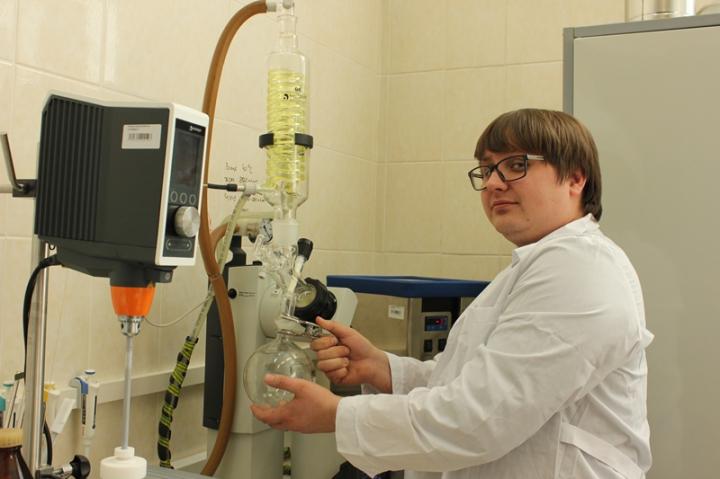
IMAGE

Credit: Tomsk Polytechnic University

Scientists from Tomsk Polytechnic University and the University of Chemistry and Technology (Prague, Czech Republic) have created novel chemical sensors for Raman spectrometers, i.e. the devices that allow determining quantitative and qualitative composition of substances and their structure with high accuracy. TPU scientists have equipped sensors with organic chemical compounds. They have already obtained sensors for determining dyes prohibited in Europe and heavy metals in water at ultralow concentrations.

The latest outcomes of the study have been published in Sensors and Actuators B: Chemical.

A sensor is a multi-layer material based on a thin gold film with the size of 1×0.5 cm. The surface of the substrate is modified into a wave-like structure. Using special reagents, TPU scientists graft organic compounds on the surface of the substrate by a covalent surface modification via diazonium chemistry.

'In the study we demonstrate possibility of creating such chemical sensors. The novelty is that we combined both chemical and physical methods. Our colleagues in Prague prepare substrates by physical methods and we modify organic compounds using chemical methods. Due to this combination we eventually got the opportunity to detect heavy metals at ultralow concentrations. We can monitor trace concentrations of substances. Thus, the sensitivity of sensors for dyes reaches 10-16 mol and for heavy metals it is about 10-14 mol,' says Pavel Postnikov, the Associate Professor of the Department of Organic Substances and Polymer Materials.

'The process of analysis is very simple: we put the sensor into the water and molecules of toxic substances are immobilized on the surface of the substrate. The analysis of dyes is more difficult,' notes Pavel Postnikov. We use an interesting polymer which is water-soluble at room temperature and when heated it turns into insoluble form. Polymer chains capture dye molecules and, when heated, press them to the surface. Then, we take out the substrate and place it in the spectrometer. We get the result in two minutes.'

In the long term, these sensors may be used to monitor liquids in food technology, medicine and environmental studies.

'It takes several minutes to carry out this analysis. Therefore, it can be used on site, for example, one may take samples from the reservoirs and receive an immediate result that would show if there are any toxic substances present in the water even at ultralow concentrations,' adds the researcher.

###

Media Contact

Kristina Nabokova
[email protected]
7-382-270-5685
@TPUnews_en

http://www.tpu.ru/en

Original Source

https://tpu.ru/en/about/tpu_today/news/view?id=3063 http://dx.doi.org/10.1016/j.snb.2017.07.018
Share12Tweet7Share2ShareShareShare1

Related Posts

Florida Cane Toad: Complex Spread and Selective Evolution

Florida Cane Toad: Complex Spread and Selective Evolution

February 7, 2026
New Study Uncovers Mechanism Behind Burn Pit Particulate Matter–Induced Lung Inflammation

New Study Uncovers Mechanism Behind Burn Pit Particulate Matter–Induced Lung Inflammation

February 6, 2026

DeepBlastoid: Advancing Automated and Efficient Evaluation of Human Blastoids with Deep Learning

February 6, 2026

Navigating the Gut: The Role of Formic Acid in the Microbiome

February 6, 2026
Please login to join discussion

POPULAR NEWS

  • Robotic Ureteral Reconstruction: A Novel Approach

    Robotic Ureteral Reconstruction: A Novel Approach

    82 shares
    Share 33 Tweet 21
  • Digital Privacy: Health Data Control in Incarceration

    63 shares
    Share 25 Tweet 16
  • Study Reveals Lipid Accumulation in ME/CFS Cells

    57 shares
    Share 23 Tweet 14
  • Breakthrough in RNA Research Accelerates Medical Innovations Timeline

    53 shares
    Share 21 Tweet 13

About

We bring you the latest biotechnology news from best research centers and universities around the world. Check our website.

Follow us

Recent News

Phage-Antibiotic Combo Beats Resistant Peritoneal Infection

Boosting Remote Healthcare: Stepped-Wedge Trial Insights

Barriers and Boosters of Seniors’ Physical Activity in Karachi

Subscribe to Blog via Email

Enter your email address to subscribe to this blog and receive notifications of new posts by email.

Join 73 other subscribers
  • Contact Us

Bioengineer.org © Copyright 2023 All Rights Reserved.

Welcome Back!

Login to your account below

Forgotten Password?

Retrieve your password

Please enter your username or email address to reset your password.

Log In
No Result
View All Result
  • Homepages
    • Home Page 1
    • Home Page 2
  • News
  • National
  • Business
  • Health
  • Lifestyle
  • Science

Bioengineer.org © Copyright 2023 All Rights Reserved.