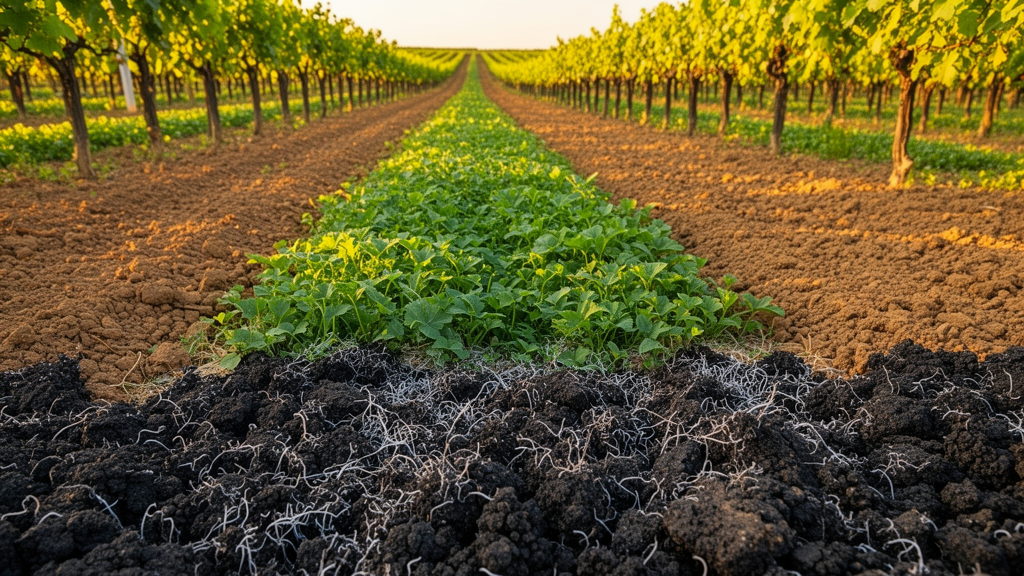
In a working vineyard in the Bordeaux appellation, something remarkable is happening beneath the grass-covered soil between the vines. Grapevines growing beside plum trees planted a decade ago are drawing on a hidden network of microbial activity that their counterparts in treeless rows simply do not have. A new field study published in Plant and Soil shows that the age of trees planted within vine rows measurably changes the chemistry of the soil, the enzymatic machinery of rhizosphere microbes, and even the nitrogen status of the vines themselves, all without any detectable cost to grape yield. The findings offer some of the most detailed evidence yet that vitiforestry, the deliberate integration of trees into vineyards, can improve the biological functioning of a perennial cropping system from the ground up.
The research team, led by Anne Janoueix of the EGFV research unit at the University of Bordeaux, INRAE and Bordeaux Sciences Agro, worked in an organic vineyard in Lapouyade, France, established in 2008 with Merlot vines grafted onto 101-14 MGt rootstock. Over the years, growers had planted plum trees, quince trees and field maples directly within the vine rows at spacings of five to nine metres. This created a natural experiment: some vines had lived beside trees for ten years, others for only five, and a third group grew in rows far from any trees. Because all vines shared the same soil, climate and management history, differences between the groups could be attributed with reasonable confidence to the trees and the length of time they had been co-cultivating with the vines.
The researchers sampled both bulk soil, collected roughly fifty centimetres from tree trunks, and rhizosphere soil, the thin, biologically charged layer clinging to grapevine fine roots. They measured a suite of physicochemical properties, including soil organic carbon, total nitrogen, pH, and extractable phosphorus, potassium and magnesium. The headline result was unambiguous: bulk soils near the ten-year-old plum trees contained significantly more soil organic carbon, at 1.71 percent compared with 1.16 percent near control vines, and significantly more total nitrogen, at 1.40 parts per thousand versus 1.01. Soils near the five-year-old trees showed intermediate values that did not differ significantly from the controls, hinting that these belowground changes accumulate gradually over years of co-cultivation.
The enzymatic story proved even more striking. Soil microbes secrete extracellular enzymes to break down complex organic matter and release the carbon, nitrogen and phosphorus they need, so measuring these enzymes reveals what microbial communities are actively investing in. The team quantified seven enzymes using fluorogenic substrates in high-throughput microplate assays: four carbon-acquiring enzymes including beta-glucosidase and cellobiohydrolase, two nitrogen-acquiring enzymes, and acid phosphatase for phosphorus. In the grapevine rhizosphere, every one of these functional categories showed significantly higher activity near the ten-year-old plum trees than near the young trees or in control rows. The bulk soil, by contrast, showed only modest and mostly non-significant differences, underscoring that the rhizosphere, not the whole soil volume, is where tree-vine interactions play out most intensely.
To interpret these patterns, the researchers applied vector analysis of eco-enzymatic stoichiometry, a framework that converts the relative activities of carbon-, nitrogen- and phosphorus-acquiring enzymes into two metrics: vector length, which signals relative microbial investment in carbon acquisition, and vector angle, which indicates the balance between nitrogen and phosphorus acquisition. In bulk soil, vector angles rose significantly near trees of both age cohorts compared with controls, exceeding forty-five degrees and pointing toward proportionally greater microbial investment in phosphorus-scavenging enzymes. This shift occurred even though extractable soil phosphorus pools barely changed, suggesting that trees altered microbial nutrient demand in ways not captured by conventional soil chemistry. In the rhizosphere, vector length tended to increase near the younger trees, hinting at heightened carbon investment in that compartment.
Notably, the surge in rhizosphere enzyme activity near older trees was not accompanied by any change in extractable DNA concentration, a rough proxy for microbial biomass. This dissociation matters: it implies that the microbial communities near trees did not simply become larger, but functionally reorganised, reallocating their enzymatic effort in response to altered substrate availability and nutrient demand. Rhizosphere microbes are known to adjust their functional investment rapidly, and the tree-driven enrichment of soil organic matter, through litterfall, pruning residues, root turnover and rhizodeposition, appears to have created conditions favouring a more metabolically active, phosphorus-hungry community around the vine roots.
The consequences extended above ground. In May 2024, the team used a hand-held Dualex fluorescence sensor to measure the Nitrogen Balance Index, the ratio of leaf chlorophyll to flavonol content, which serves as a non-destructive indicator of a vine’s instantaneous nitrogen status. Vines growing near the ten-year-old plum trees showed significantly higher NBI values than both the five-year-old cohort and the controls. Although petiole nitrogen and must nitrogen did not differ significantly among treatments on their own, the NBI correlated strongly and positively with both petiole nitrogen concentration and ammoniacal nitrogen in the must, reinforcing the interpretation that vines near mature trees were better nourished. Enhanced rhizosphere enzyme activity, the authors suggest, may have accelerated organic matter mineralisation and increased nitrogen availability to the vines.
Crucially, none of these belowground changes came at the vines’ expense. Yield per vine, measured by weighing all bunches at harvest in September 2024, showed no significant differences among treatments. Carbon isotope composition of the must, an integrative indicator of seasonal water stress, ranged from minus 25.99 to minus 27.15 parts per thousand and did not differ among groups, indicating little to no water limitation and no evidence of trees outcompeting vines for soil moisture. The one caveat is that 2024 was an exceptionally wet growing season in Bordeaux, so competition for water could yet emerge under drier conditions. Berry must from vines near older trees did show higher gluconic and tartaric acid contents and thus higher total acidity, a compositional shift that winemakers may find worth monitoring.
The temporal dimension of the study carries perhaps its most important practical message. Significant gains in soil organic carbon under agroforestry are typically reported only after fifteen years or more of tree establishment, and earlier studies often found weak or undetectable effects in systems younger than five years. Here, clear differences between the five- and ten-year cohorts, spanning soil chemistry, enzyme activity, stoichiometric strategy and vine nitrogen status, demonstrate that the benefits of vitiforestry build progressively as tree-vine interactions mature. The five-year-old trees generally produced intermediate responses, suggesting a trajectory rather than a threshold, and the pattern held when all tree species were pooled, indicating it was driven by planting age rather than species identity.
Vitiforestry remains rare in modern temperate viticulture, largely because growers fear competition between trees and vines, both above and below ground. Historic European systems such as hautains and joualles once embedded vines among fruit trees, but mechanisation and intensification largely erased them. This study, conducted under real commercial production conditions, suggests those fears may be at least partially misplaced, at least over the first decade and in the oceanic climate of southwest France. The rhizosphere emerges as the decisive arena where trees reshape vine nutrition, and soil microbes as the mediators of that influence. Longer-term monitoring, drought-year replication, and molecular tools such as metabarcoding and metagenomics will be needed to confirm the mechanisms and test the limits, but the direction of the evidence is clear: planting trees in vine rows may cultivate a healthier, more resilient soil ecosystem while the grapes keep coming.
Subject of Research: Effects of tree planting age on rhizosphere microbial activity and nitrogen nutrition of grapevines in temperate vitiforestry
Article Title: Grapevine rhizosphere microbial activity and nitrogen nutrition vary with tree planting age in a temperate vitiforestry system
Article References: Janoueix, A., Fanin, N., Milin, S., & Lauvergeat, V. (2026). Grapevine rhizosphere microbial activity and nitrogen nutrition vary with tree planting age in a temperate vitiforestry system. Plant and Soil. https://doi.org/10.1007/s11104-026-09166-3
Image Credits: AI Generated
DOI: 10.1007/s11104-026-09166-3
Keywords: vitiforestry, agroforestry, grapevine, rhizosphere, soil microbes, enzymatic activity, nitrogen status, soil organic carbon, phosphorus acquisition, eco-enzymatic stoichiometry, Bordeaux vineyard, sustainable viticulture
News Source: Alan Morgan. (October 9, 2026). Trees in Vineyard Rows Quietly Rewire Soil Microbes and Boost Vine Nitrogen. Scienmag.