Port-wine stains are among the most recognizable birthmarks in medicine: flat, reddish-purple patches of skin caused by congenital malformations of small blood vessels called capillaries. For most people who have them, the marks are a cosmetic and occasionally a structural concern, thickening or darkening over time. But in a subset of patients, a port-wine stain on the face signals something far more serious: Sturge-Weber syndrome, a rare neurocutaneous disorder in which the same vascular malformations invade the brain and the eye, bringing seizures, glaucoma, and stroke-like episodes in their wake. Now, a new exploratory study raises the possibility that these conditions may affect another sensory system that has largely escaped clinical attention: hearing.
The study, published in the Archives of Dermatological Research by a team led by Ashley N. Houff and Monique Kumar of the University of Central Florida College of Medicine, together with colleagues at Mass Eye and Ear and Harvard Medical School, set out to answer a deceptively simple question: do individuals with port-wine stains or Sturge-Weber syndrome experience hearing loss more often than the rest of the population? The answer, based on both a systematic review of the medical literature and a survey of patient support communities, is a cautious but intriguing maybe, one that could reshape how dermatologists, neurologists, and audiologists think about these conditions.
The biological rationale for the investigation rests on a single gene. Most cases of both port-wine stains and Sturge-Weber syndrome are driven by somatic mutations in GNAQ, a gene encoding the alpha q subunit of a heterotrimeric G protein, a molecular switch that relays signals from cell-surface receptors into the interior of the cell. The landmark 2013 discovery in the New England Journal of Medicine showed that a specific activating mutation in GNAQ, arising after fertilization and therefore present in only a mosaic subset of the body’s cells, underlies both the isolated birthmarks and the full syndrome. Because the mutation occurs during embryonic development, its distribution across tissues is unpredictable, which helps explain why the same genetic lesion can produce anything from a small skin patch to a life-altering neurological disorder.
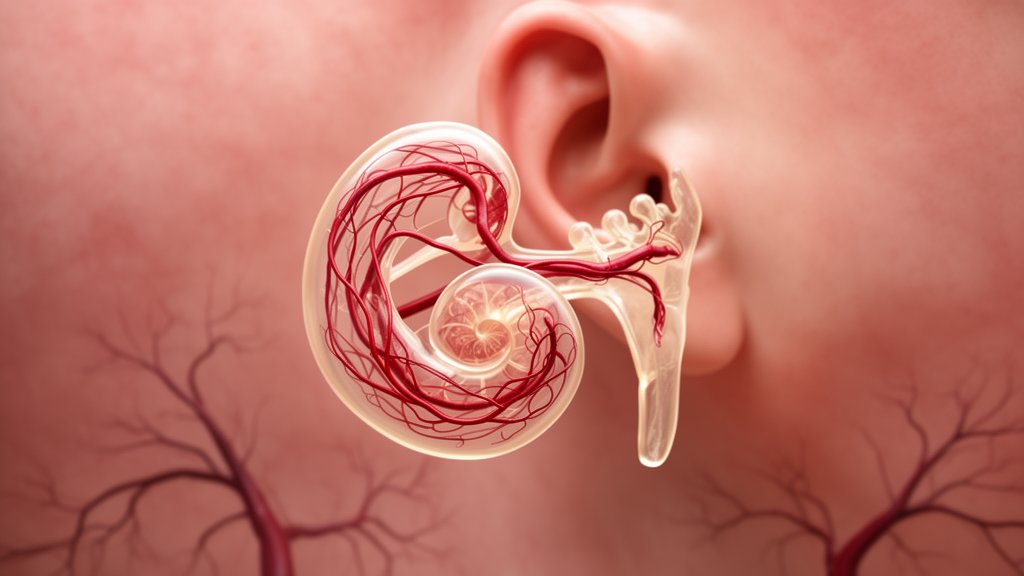
What makes the hearing question scientifically plausible is that G proteins are not strangers to the inner ear. Earlier work on the mammalian cochlea identified G protein isoforms localized presynaptically in the efferent nerve terminals, the fibers that modulate how hair cells transmit sound information to the brain. If GNAQ signaling participates in the maintenance or function of cochlear structures or their vascular supply, a mosaic mutation affecting those tissues could, in principle, compromise hearing. The literature also contains tantalizing case reports, including a description of port-wine stains associated with large vestibular aqueduct syndrome in a patient carrying mutations in both GNAQ and SLC26A4, a gene classically linked to hereditary hearing loss.
To gather the available evidence, the researchers first combed PubMed for published reports of hearing impairment in patients with either condition. The search identified hearing loss documented in three individuals with port-wine stains alone and in 77 individuals with Sturge-Weber syndrome. Prior reports have described several possible mechanisms, including vascular malformations of the external auditory canal, as in a documented case of multiple angiomas within the ear canal, and broader neuro-otological manifestations in patients with hemifacial port-wine stains. Yet the total number of cases remained small, and no systematic estimate of how common hearing problems might be had ever been attempted.
To fill that gap, the team turned to an unconventional but increasingly popular research tool: electronic surveys distributed through Facebook support groups for people with port-wine stains and Sturge-Weber syndrome. The survey asked members about their diagnosis, whether they had experienced hearing impairment or loss, and, for those who had, the characteristics of that loss, including its severity, duration, and treatment. Eighty-four responses were included in the analysis. Of these, 50 respondents, or 59.5 percent, had port-wine stains alone, 31, or 36.9 percent, had both port-wine stains and Sturge-Weber syndrome, and 3, or 3.6 percent, had Sturge-Weber syndrome alone.
The headline finding was striking: 53 of the 84 respondents, a sample proportion of 63.1 percent with a 95 percent confidence interval spanning 52.4 to 72.6 percent, reported hearing loss. The researchers are careful, and rightly so, to emphasize what that number does and does not mean. Because the sample was self-selected, drawn from people motivated enough to join support groups and respond to a survey, it cannot be taken as a measure of prevalence in the general population of people with these conditions. The confidence interval, calculated using standard methods for binomial proportions, reflects the precision of the sample estimate rather than a true population rate. Still, the sheer proportion of respondents reporting hearing difficulties is difficult to dismiss, particularly when compared with background rates of hearing loss in the United States, which rise steeply with age but remain comparatively low in children and young adults.
The characteristics of the reported hearing loss add further texture. Among the 53 respondents with hearing loss, the overwhelming majority, 36 people or 67.9 percent, did not know what type of hearing loss they had, a gap that itself underscores how rarely these patients undergo formal audiological evaluation. Those who did know reported sensorineural loss, arising from the inner ear or auditory nerve, in 7 cases, mixed loss in 6, and conductive loss, involving the outer or middle ear, in 4. Severity spanned the full clinical spectrum: 21 respondents described their loss as mild, 18 as moderate, and 13 as severe. Most strikingly, the largest group, 21 respondents or 39.6 percent, reported that their hearing symptoms had persisted for more than ten years, suggesting a chronic process rather than a transient one.
Treatment patterns revealed both the burden of the problem and the gaps in care. Thirty-four respondents with hearing loss, or 64.2 percent, reported receiving at least one form of treatment. Hearing aids were by far the most common intervention, used by 23 respondents, while 10 reported other surgeries, 5 reported other treatments, 2 reported medication, and one reported a cochlear implant. Because some respondents selected multiple treatment types, the individual percentages sum to more than the overall treatment rate. The predominance of hearing aids is consistent with the profile of chronic, largely irreversible hearing loss, and the presence of surgical interventions hints at the structural ear abnormalities that case reports have long suggested in this population.
The authors are explicit about the limits of their work. Self-perceived symptoms were not confirmed by audiometry, the gold-standard objective measurement of hearing thresholds, and the support-group sample cannot establish prevalence or prove an association between GNAQ-driven vascular malformations and hearing impairment. What the study does accomplish is to elevate a scattered handful of case reports into a coherent, testable hypothesis: that somatic GNAQ mutations, already known to disrupt blood vessels in the skin, brain, and eye, may also affect the delicate vascular and neural architecture of the auditory system. The authors call for future studies with objective audiological assessments to determine whether hearing loss is genuinely associated with port-wine stains and Sturge-Weber syndrome, and if so, to characterize its prevalence and mechanism well enough to inform screening recommendations. If those studies confirm the signal, the implications could be significant, since early identification of hearing loss in children is critical for language development, and a simple audiological screening protocol could prevent years of undiagnosed impairment in a vulnerable population. For now, the message for clinicians and families is one of heightened awareness: a birthmark on the face may be more than skin deep, and the possibility that it reaches the inner ear deserves a careful listen.
Subject of Research: Hearing impairment in patients with port-wine stains and Sturge-Weber syndrome linked to GNAQ mutations
Article Title: Hearing impairment in individuals with Port-wine stains and Sturge-Weber syndrome
Article References: Houff, A. N., Velez, D. E., Guerin, P., Gupta, S., Gupta, I., & Kumar, M. (2026). Hearing impairment in individuals with Port-wine stains and Sturge-Weber syndrome. Archives of Dermatological Research, 318(1), Article 514. https://doi.org/10.1007/s00403-026-04914-y
Image Credits: AI Generated
DOI: 10.1007/s00403-026-04914-y
Keywords: port-wine stains, Sturge-Weber syndrome, GNAQ, hearing loss, vascular malformations, neurocutaneous syndromes, cochlea, sensorineural hearing loss, audiology, somatic mutation, dermatology, patient survey
News Source: Juliet Wilcox. (October 9, 2026). Birthmark Gene May Reach the Inner Ear: Hearing Loss Emerges as an Overlooked Feature of Port-Wine Stains and Sturge-Weber Syndrome. Scienmag.