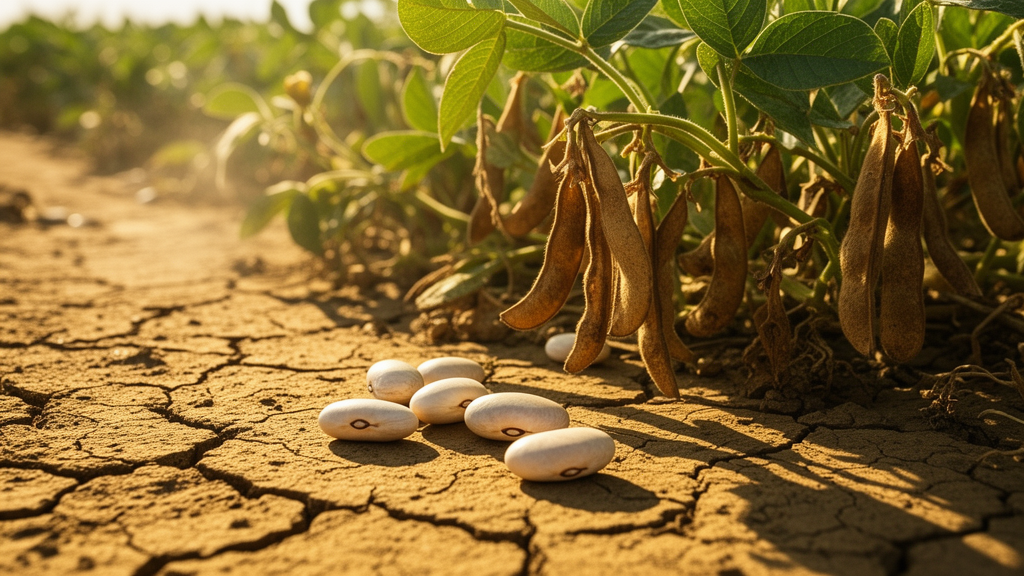
In the semiarid backlands of Northeast Brazil, temperatures that would wilt most crops are simply part of the growing season, and the lima bean has long been one of the few legumes stubborn enough to persist there. A new study published in BMC Plant Biology by a team at the Federal University of Piauí has now revealed just how costly that persistence really is. Following five genetically contrasting lima bean genotypes through their entire developmental cycle under two punishing thermal regimes, natural field conditions reaching 44 to 46 degrees Celsius and an even more severe stress treatment of 50 to 52 degrees Celsius, the researchers uncovered a striking pattern: the plants that best withstand extreme heat do so by quietly abandoning reproduction. The finding reframes how breeders may need to think about heat tolerance in one of the world’s most climate-vulnerable cropping regions.
The experimental design was unusually comprehensive for a heat-stress trial. Rather than exposing plants to a single heat shock at flowering, the team tracked vegetative development, leaf gas exchange, photosynthetic pigment content, and a battery of biochemical stress markers across the whole life cycle. These markers included hydrogen peroxide and malondialdehyde, two classic indicators of oxidative damage, alongside the activities of the antioxidant enzymes superoxide dismutase, ascorbate peroxidase, and guaiacol peroxidase. The researchers also assessed male gametophyte viability, asking whether pollen itself was the weak link that causes yields to collapse under heat. Statistical treatment combined classical analysis of variance with Tukey’s post-hoc comparisons and multivariate tools, including canonical variable analysis and GGE biplots, which allowed the team to separate genotypes that genuinely differ in heat strategy from those that merely differ in vigor.
What emerged was a metabolic compensation system, a coordinated physiological response in which the plants appear to prioritize individual survival over pod formation. Under the harshest temperatures, the genotypes that maintained the healthiest vegetative canopies and the lowest levels of reactive oxygen species were often the same ones that produced fewer pods and filled fewer grains. This trade-off between reproductive success and the production of defense-related proteins suggests that the lima bean is not simply failing under heat stress; it is making an active physiological choice, redirecting its limited resources toward keeping itself alive at the expense of the next generation.
The biochemistry behind this choice is telling. Heat stress in plants typically triggers an overproduction of reactive oxygen species, which attack membranes, proteins, and DNA, and malondialdehyde serves as the fingerprint of that lipid peroxidation. In the genotypes that coped best, the team observed reduced concentrations of these reactive oxygen species, accompanied by the activity of the enzymatic antioxidant shield, with superoxide dismutase converting superoxide radicals into hydrogen peroxide and ascorbate peroxidase and guaiacol peroxidase then detoxifying that hydrogen peroxide before it could accumulate to damaging levels. The fact that antioxidant defense and reproduction moved in opposite directions across genotypes is the central evidence for the compensation strategy: the metabolic budget spent on defense proteins appears to be the same budget that would otherwise fund flowers, pods, and seeds.
Perhaps the most consequential conclusion of the study concerns pollen. For many crops, heat-induced yield loss is attributed primarily to the exquisite sensitivity of the male gametophyte, the pollen grain, which desiccates and loses viability at temperatures only slightly above optimal. The Brazilian team’s data suggest a more nuanced picture for lima bean. While male gametophyte viability was assessed and varied across the thermal treatments, the authors conclude that the main limitation to production during high-temperature periods may not be gametophyte sensitivity alone. Instead, the yield collapse appears to be tied to a preferential allocation of photoassimilates, the sugars produced by photosynthesis, toward vegetative maintenance structures and toward the accumulation of osmolytes, the small compatible solutes that help cells retain water and protect proteins under thermal and osmotic stress.
This source-sink reinterpretation matters because it changes the target for breeders. If pollen death were the sole bottleneck, the fix would be to select for thermotolerant gametophytes. But if the plant itself is diverting sugars away from developing pods and toward its own survival machinery, then even viable pollen and successful fertilization may not translate into filled grains, because the carbohydrate supply simply never arrives at the sink. Grain filling depends on the translocation of photoassimilates from leaves to seeds, and heat stress is known to disrupt that translocation pipeline. The new results indicate that in lima bean this disruption may be less a failure of transport and more a deliberate reallocation, with the vegetative source tissues retaining sugars that the reproductive sink desperately needs.
The five genotypes examined did not all behave identically, and that variation is itself valuable. Contrasting adaptive strategies were evident in the multivariate analyses, with canonical variables and GGE biplots separating genotypes along axes that combined photosynthetic performance, antioxidant capacity, oxidative damage, and reproductive output. Some lines leaned toward vegetative robustness and biochemical defense, others retained comparatively more reproductive function at the cost of greater oxidative stress. For a crop like lima bean, which is grown largely by smallholder farmers in Northeast Brazil and holds cultural and nutritional significance across Latin America, this within-species diversity represents raw material for breeding programs that must now contend with increasingly erratic and extreme temperatures.
The context of the study gives its findings added urgency. Lima bean production in the region is already confined to periods of milder temperatures and increased rainfall, a narrowing window as climate change intensifies. Field conditions of 44 to 46 degrees Celsius are not laboratory exaggerations but representative of what plants actually experience, and the severe treatment of 50 to 52 degrees Celsius simulates the heat spikes that heat waves increasingly deliver. Understanding which genotypes can metabolically compensate, and at what reproductive price, offers a roadmap for developing cultivars that balance survival and yield rather than maximizing one at the total expense of the other. The trade-off documented here is, in effect, a measurable currency that breeders can now begin to manage.
The study also contributes to a broader conceptual debate in plant physiology about whether stress responses should be viewed as damage or as strategy. The evidence for metabolic compensation, reduced reactive oxygen species paired with diminished reproduction, fits the latter view: the plant is not merely succumbing but actively reorganizing its metabolism. That framing aligns with a growing body of literature on source-sink regulation and stress-induced shifts in carbon partitioning, and it echoes patterns reported in other legumes and cereals, though rarely with the full life-cycle resolution employed here. If the pattern holds across more genotypes and seasons, thermotolerance screening may need to incorporate reproductive allocation metrics as standard practice, rather than relying on vegetative survival alone as the proxy for heat resilience.
For now, the message from the Piauí field plots is both sobering and hopeful. Sobering, because the very trait that allows lima bean plants to endure brutal heat, a robust antioxidant and osmolyte-based defense funded by diverted photoassimilates, is the trait that starves their seeds. Hopeful, because the variation among just five genotypes shows that this trade-off is not fixed by the species’ biology and can, in principle, be shifted by selection. As heat waves push more of the world’s croplands toward the conditions that Northeast Brazilian farmers already know intimately, the lima bean’s hard-won lesson, that surviving the heat and feeding the future are competing demands on the same finite metabolic budget, may become one of the most important equations in modern agriculture.
Subject of Research: Heat stress tolerance and reproductive trade-offs in lima bean genotypes
Article Title: Thermotolerance at the cost of reproduction: contrasting adaptive strategies of lima bean genotypes under heat stress conditions
Article References: de Castro, M. V. C., da Silva Almeida, D. B., da Costa Oliveira Santos, F. R., Monteiro da Cruz, C. P., Carvalho, J. A., Caetano, K. R., Ferreira, P. E. A., Martins, L. D. V., Costa, M. F., Matos Filho, C. H. A., de Souza Miranda, R., de Almeida Lopes, Â. C., Gomes, R. L. F., & da Silva, V. B. (2026). Thermotolerance at the cost of reproduction: contrasting adaptive strategies of lima bean genotypes under heat stress conditions. BMC Plant Biology. https://doi.org/10.1186/s12870-026-10127-2
Image Credits: AI Generated
DOI: 10.1186/s12870-026-10127-2
Keywords: lima bean, heat stress, thermotolerance, Phaseolus lunatus, antioxidant enzymes, reactive oxygen species, source-sink, photoassimilate allocation, plant breeding, climate change adaptation, plant physiology, Brazil semiarid
News Source: Alan Morgan. (October 9, 2026). Heat-Hardened Lima Beans Survive by Sacrificing Their Seeds. Scienmag.