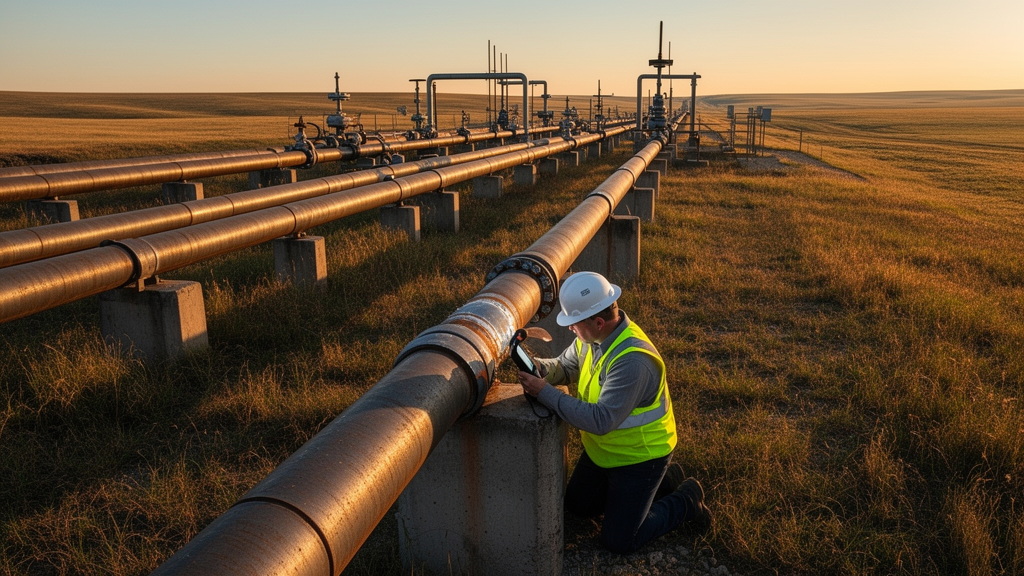
Hydrogen has long been cast as the versatile workhorse of a decarbonized economy, a molecule that can be produced from water with clean electricity and then burned or converted back to power without carbon emissions. But between the electrolyzer or reformer where it is made and the factory, power plant, or fueling station where it is used lies a problem that receives far less attention than production costs: moving the stuff. Hydrogen is the lightest molecule in the universe, it embrittles certain steels, it leaks through seals that hold methane comfortably, and it carries less energy per unit volume than natural gas by a factor of roughly three. Any serious national hydrogen strategy therefore lives or dies on pipeline infrastructure, and a new peer-reviewed study published in Nature Communications argues that the models planners have been using to estimate what such infrastructure would cost are badly out of step with reality.
The research, led by Ayush Singh and Haibo Zhai of the University of Wyoming together with Eugene Holubnyak and Curtis Biggs, tackles a deceptively simple question: what would it actually cost, in dollars and in emissions, to move hydrogen across the United States by pipeline? The team’s starting point is a striking finding about the existing literature. According to the authors, conventional pipeline models have remarkably underestimated the construction-related material and labor costs of building hydrogen pipelines when compared against historical U.S. data. That mismatch matters enormously, because capital expenditure dominates the economics of pipeline transport, and any planning tool that systematically lowballs construction costs will paint an artificially rosy picture of hydrogen’s competitiveness against alternatives like ammonia shipping, trucking, or on-site production.
To correct that picture, the researchers developed an integrated modeling framework that combines three previously separate strands of analysis: engineering performance models of pipeline operation, detailed economic models of construction and financing, and life cycle assessment of the emissions associated with building and running the infrastructure. The framework evaluates two fundamentally different pathways for building a hydrogen transport network. The first is the construction of dedicated pipelines, purpose-built from the ground up to carry pure hydrogen. The second is the repurposing of existing natural gas pipelines, converting steel arteries that already crisscross the continent to serve a new molecule. Each option carries its own engineering constraints, cost structure, and carbon footprint, and the study is among the first to compare them head-to-head across the entire country rather than for a single corridor or demonstration project.
The technical challenges of dedicated hydrogen pipelines begin with metallurgy. High-strength steels that perform flawlessly with natural gas can suffer hydrogen embrittlement, a process in which atomic hydrogen diffuses into the metal lattice and accumulates at defects, promoting crack initiation and growth under cyclic pressure loading. Designers mitigate this by using lower-strength steel grades, thicker walls, more conservative operating pressures, and careful weld inspection, all of which add cost. Compression is another burden: because hydrogen’s volumetric energy density is low, moving a given amount of energy requires either higher pressures or larger diameter pipe, and the compressors themselves must be designed to handle a molecule that attacks conventional seal and valve materials. These engineering realities feed directly into the performance model, which links pipe diameter, pressure, throughput, and compressor duty to the delivered cost of the hydrogen.
On the economics side, the study’s insistence on calibrating against historical U.S. construction data is what sets it apart. Pipeline construction costs in the United States vary widely with terrain, population density, permitting timelines, right-of-way acquisition, and the availability of skilled labor, and the historical record shows that these factors can push real-world costs far above the tidy figures found in engineering handbooks. By grounding the cost model in what pipelines have actually cost to build, the researchers aim to give investors and regulators numbers they can trust. The result is a levelized cost of hydrogen transport, expressed per unit of hydrogen delivered, that varies substantially with location, pipeline capacity, and transport distance. A large-diameter pipeline running through flat, sparsely populated terrain can deliver hydrogen at a very different cost than a smaller line threading through a congested metropolitan corridor, even if the distance is identical.
The analysis of repurposed natural gas pipelines reveals an equally nuanced story. Converting an existing line can slash upfront capital expenditure, since the most expensive elements, the right-of-way, the trenching, the pipe steel itself, are already in place. But repurposing is not free, and it is not always clean. Existing lines may require integrity assessments, in-line inspection, repairs, and replacement of valves, meters, and compressor stations that were never designed for hydrogen. The study finds that while leveraging existing natural gas pipelines can substantially reduce upfront capital expenditures, it may involve tradeoffs in both cost and life cycle emissions. Those tradeoffs arise because the conversion process itself consumes materials and energy, because repurposed lines may operate under constraints that raise operating costs, and because the embodied emissions of the original construction must be accounted for in a life cycle framework that asks not just what a pipeline costs but what it costs the climate.
This multi-criteria approach, weighing dollars and emissions simultaneously rather than in isolation, is the study’s central methodological contribution. A network that looks cheapest on a spreadsheet may carry a heavier carbon footprint than a more expensive alternative, depending on how the pipeline is built, what materials go into it, and how intensively it is used over its lifetime. Conversely, the greenest option on paper may be financially unbuildable. By integrating performance, economic, and emissions models into a single framework, the researchers can identify where each pathway wins and where the tradeoffs bite, producing a kind of decision map for the engineers, planners, and investors who will ultimately decide whether a nationwide hydrogen transport network gets built and what shape it takes.
The geographic scope of the analysis is one of its most valuable features. Hydrogen demand in a decarbonizing United States will not be evenly distributed: industrial clusters such as Gulf Coast refining and ammonia production, emerging steel and fertilizer hubs in the Midwest, and potential clean power generation regions in the Mountain West each create their own production and consumption patterns. A pipeline that makes economic sense connecting a low-cost production region to a nearby industrial user may be uneconomic across longer distances or lower volumes. The study’s finding that levelized transport costs vary with numerous factors, including location, capacity, and distance, underscores that there is no single national hydrogen pipeline cost. Instead, the economics must be evaluated corridor by corridor, which is precisely what an integrated, geographically resolved model makes possible.
The timing of this work is significant. Federal support for hydrogen hubs, clean hydrogen production incentives, and state-level decarbonization mandates are converging to push hydrogen from laboratory curiosity toward commercial deployment, and infrastructure decisions made in the next few years will lock in physical assets for decades. If planning models systematically underestimate construction costs, projects may be approved on the basis of economics that never materialize, or competing technologies may be unfairly discounted. Conversely, an overly pessimistic view of pipeline costs could stall a technology that, at large scale and high utilization, remains one of the cheapest ways to move large volumes of energy across land. Getting the numbers right, the authors argue, is a prerequisite for sustainable infrastructure investment.
Ultimately, the study is a reminder that the hydrogen economy will be built not only in electrolyzer factories and fuel cell plants but in trenches, compressor stations, and steel welds along thousands of miles of right-of-way. The University of Wyoming team’s integrated models, calibrated against the stubborn realities of American construction costs and evaluated through the twin lenses of economics and life cycle emissions, offer a more honest foundation for those decisions than the optimistic estimates that have circulated in the literature. Whether the nation’s hydrogen travels through gleaming new dedicated lines or through the repurposed veins of its aging natural gas network, the choice will now be made with better information, and that, in a field crowded with hype, is genuine progress. The work was supported by the Wyoming Innovation Partnership program and the University of Wyoming’s School of Energy Resources, and the authors report no competing interests.
Subject of Research: Economic and life cycle emissions modeling of dedicated and repurposed hydrogen pipeline infrastructure in the United States
Article Title: Pipeline infrastructure for hydrogen transport in the United States
Article References: Singh, A., Zhai, H., Holubnyak, E., & Biggs, C. (2026). Pipeline infrastructure for hydrogen transport in the United States. Nature Communications. https://doi.org/10.1038/s41467-026-78402-2
Image Credits: AI Generated
DOI: 10.1038/s41467-026-78402-2
Keywords: hydrogen, pipeline infrastructure, hydrogen transport, natural gas pipeline repurposing, levelized cost, life cycle assessment, hydrogen embrittlement, energy economics, decarbonization, capital expenditure, hydrogen hubs, United States
News Source: Faith Mcneil. (October 9, 2026). Rethinking America’s Hydrogen Highways: Pipelines Hold Surprises. Scienmag.