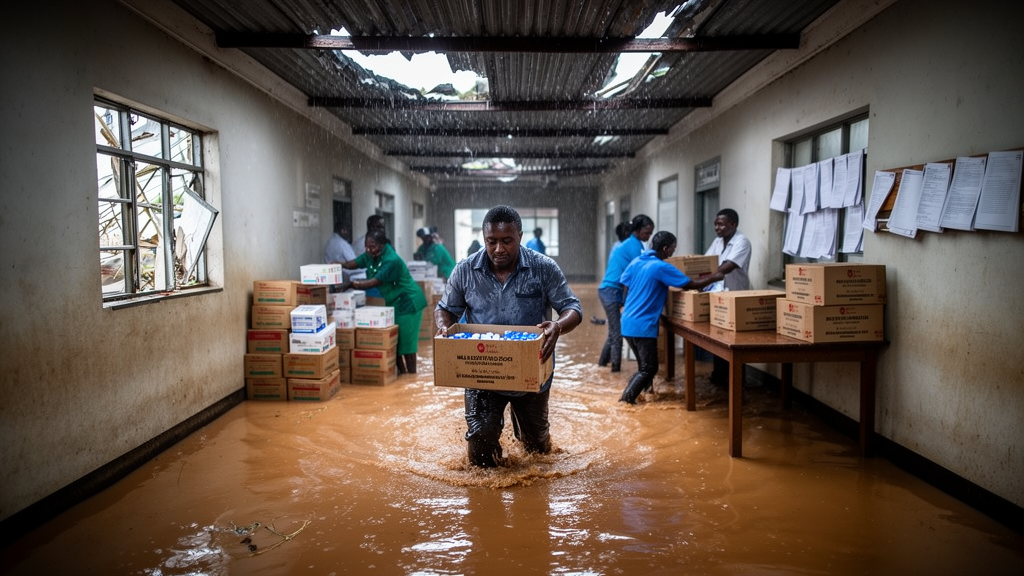
When Cyclone Freddy tore across southern Malawi in March 2023, it left behind more than flattened homes and flooded fields. It delivered a stress test to the district health systems responsible for keeping hundreds of thousands of people alive, and the results of that test have now been documented in rare detail. A qualitative study published in BMC Public Health by Chancy Skenard Chimatiro and Martina Lembani, researchers at the University of the Western Cape’s School of Public Health, interviewed fifteen members of the District Health Management Teams in Blantyre and Phalombe, two of the districts hardest hit by the storm. Their accounts reveal how a single extreme weather event can simultaneously destroy the physical infrastructure of healthcare, inflate demand for services, sever the communication networks that coordinate care, and push the health workforce itself to the edge of psychological exhaustion.
Cyclone Freddy was no ordinary storm. It carved an extraordinary track across the Indian Ocean and southern Africa, and in Malawi it triggered flooding and landslides that killed hundreds of people and displaced many more. The health consequences described by the district managers went well beyond injuries sustained during the disaster itself. The cyclone destroyed health infrastructure outright, damaging facilities and equipment needed for routine care. At the same time, it accelerated the spread of infectious diseases and worsened breeding conditions for disease vectors such as mosquitoes, raising the specter of malaria and cholera outbreaks precisely when the health system was least able to respond. The combination of reduced supply and surging demand formed the central paradox that the district teams had to manage in the weeks and months after landfall.
The study used a descriptive qualitative design, relying on key informant interviews with purposively selected members of the District Health Management Teams, the officials who plan, budget, staff, and supervise health services at the district level. Participants were chosen for their direct roles and experience in managing the district health system during the cyclone response. Interview data were analyzed thematically, allowing the researchers to distill the managers’ experiences into three overarching themes: the effects of Cyclone Freddy on the health system, the coping strategies the teams deployed, and the challenges they faced while responding. This approach does not measure outcomes numerically, but it captures something quantitative surveys often miss, namely the lived, operational reality of managing a health system in the middle of a climate-driven catastrophe.
The first theme, the effects on the health system, painted a picture of cascading failure. Physical destruction of clinics and hospitals was only the starting point. The cyclone disrupted health information system networks, cutting off the digital and communication channels through which districts report disease surveillance data, order supplies, and coordinate with the national ministry. Without reliable information flows, managers were effectively flying blind during a public health emergency. Health workers themselves were overstretched, working long shifts in damaged facilities while often dealing with losses and displacement in their own families. The study also documented psychological and mental health challenges among staff, a dimension of disaster response that is frequently overlooked but which the researchers found to be significant for the very people charged with leading the recovery.
A striking finding emerged when the researchers compared the two districts. Phalombe, a rural district, experienced more extensive damage to health infrastructure than Blantyre, an urban district, even though both were in the cyclone’s destructive path. The authors attribute this difference partly to disparities in infrastructure resilience and vulnerability to climate-related hazards. Rural facilities in Malawi are often older, more lightly built, and more geographically isolated, making them both easier to damage and harder to repair. The comparison matters because it suggests that the burden of climate change on health systems will not fall evenly, and that investment decisions about where and how to build climate-resilient infrastructure carry life-or-death consequences for rural populations who already face the longest travel distances to care.
Against this backdrop of destruction, the district teams improvised a set of coping strategies that the study documents in detail. They recruited temporary and surge health workers to reinforce exhausted permanent staff, a rapid staffing expansion that kept services running despite the crisis. They established temporary shelters and set up mobile and outreach clinics, taking care to communities that could no longer reach damaged or cut-off facilities. These mobile services proved essential in a landscape where roads were flooded or washed away and where displaced populations had gathered in camps with acute sanitation and health needs. The teams also leaned heavily on collaboration with partners, including non-governmental organizations and international agencies, pooling resources and expertise that no single district could have mustered alone.
Yet the coping strategies were stretched thin by persistent challenges. Limited access to health facilities remained a fundamental obstacle, as damaged roads and flooded terrain prevented both patients from reaching care and health workers from reaching patients. Inadequate staffing meant that even surge recruitment could not fully compensate for the scale of the emergency, leaving facilities chronically short of hands. Limited space for service delivery compounded the problem, since damaged buildings and crowded displacement sites left few suitable locations for consultations, vaccinations, or maternal care. These constraints illustrate a hard truth about disaster response in resource-limited settings: improvisation can buy time, but it cannot substitute for resilient infrastructure and adequate workforce planning.
The findings land at a moment when the scientific consensus on climate change makes such events increasingly likely. Extreme weather events of the intensity of Cyclone Freddy are projected to become more frequent and more severe, and health systems in low-income countries are among the most exposed. The authors argue that District Health Management Teams should prioritize investments in climate-resilient health infrastructure to strengthen the capacity of health systems to withstand and respond effectively to such events. In practical terms, that means building facilities that can survive high winds and flooding, hardening the communication and information systems that coordinate emergency response, planning for workforce surges before disasters strike rather than improvising them afterward, and attending to the mental health of the health workers who form the backbone of any response.
What makes this study valuable is its ground-level perspective. Much of the literature on climate and health focuses on epidemiological outcomes, counting cases and deaths after the fact. By listening to the managers who ran the response, Chimatiro and Lembani illuminate the operational anatomy of a health system under climate stress, from the failure of information networks to the quiet psychological toll on staff. The research was supported by the Belgian Directorate General for Development Cooperation through its framework agreement with the Institute of Tropical Medicine, and it was approved by ethics committees in both South Africa and Malawi, with informed consent obtained from all participants. The work is open access, allowing health planners across cyclone-prone regions to draw on its lessons directly.
The story of Cyclone Freddy in Malawi is ultimately a story about fragility and ingenuity coexisting in the same system. District health managers in Blantyre and Phalombe held services together through surge staffing, mobile clinics, and partner collaboration, but they did so against odds that better infrastructure and planning would have substantially reduced. As climate change loads the dice for more Freddys in the years ahead, the study’s central message is clear: the time to fortify health systems is now, before the next storm makes landfall, and the districts that are most rural, most remote, and least resourced deserve to be first in line.
Subject of Research: Health system impacts of and responses to Cyclone Freddy in Blantyre and Phalombe districts, Malawi
Article Title: Experiences of district health management team members during Cyclone Freddy (2023) in two districts of Malawi: a qualitative study
Article References: Chimatiro, C. S., & Lembani, M. (2026). Experiences of district health management team members during Cyclone Freddy (2023) in two districts of Malawi: a qualitative study. BMC Public Health. https://doi.org/10.1186/s12889-026-29469-5
Image Credits: AI Generated
DOI: 10.1186/s12889-026-29469-5
Keywords: Cyclone Freddy, Malawi, health systems, district health management, climate change, extreme weather, qualitative research, public health, health infrastructure, disaster response, rural health, Blantyre
News Source: Ophelia Keating. (October 9, 2026). When Cyclone Freddy Struck Malawi, Health Managers Fought to Keep Care Alive. Scienmag.