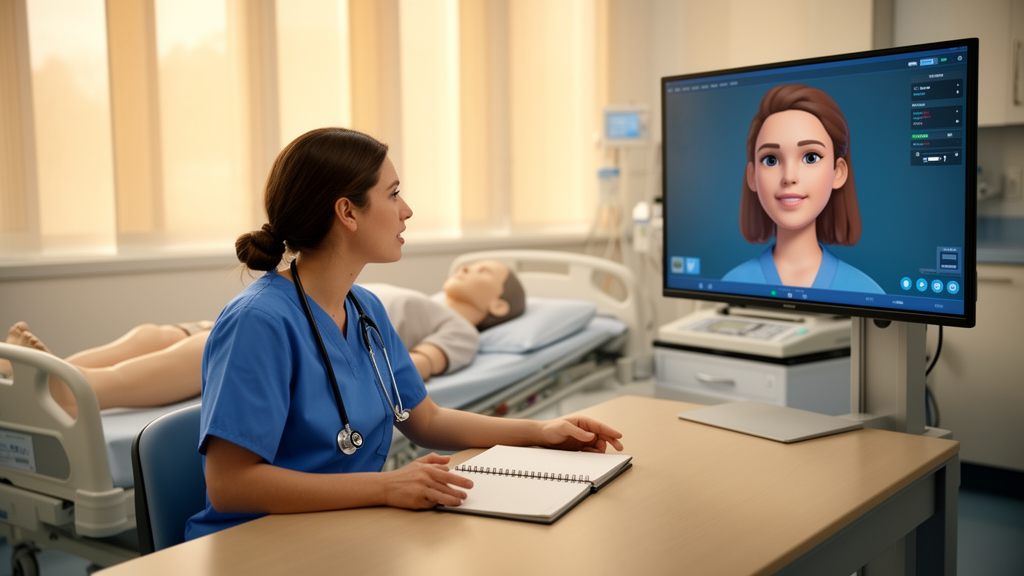
Artificial intelligence has quietly entered one of the most human corners of professional training: the bedside conversation. A new qualitative study from researchers at Akdeniz University in Turkey, published in BMC Nursing, has examined what happens when third-year nursing students are asked to counsel a virtual patient powered by ChatGPT, and the results paint a nuanced picture of what large language models can and cannot teach future nurses about empathy, communication, and clinical readiness. The research, led by Ayşegül Korkmaz Doğdu of the Fundamentals of Nursing Department and Ayşe Dağistan Akgöz of the Public Health Nursing Department, used a phenomenological design to capture the lived experience of students as they navigated simulated counseling sessions with an AI-supported virtual patient.
The study was embedded in a Family Health Nursing elective course, where students interacted with a virtual patient through predefined ChatGPT prompts that simulated a counseling session. This approach is technically straightforward but pedagogically significant. Rather than building a bespoke simulation engine, the researchers harnessed the conversational fluency of a widely available generative AI tool, shaping its behavior through carefully constructed prompts so that it would respond as a patient seeking guidance. The design reflects a broader trend in health professions education, where accessible AI tools are being repurposed as low-cost, scalable simulation platforms that can be deployed without the expensive mannequins, standardized patient programs, or virtual reality infrastructure that traditional simulation requires.
To understand how students actually experienced these encounters, the researchers gathered data through two complementary channels: focus group interviews and online reflective diaries. Focus groups allowed participants to discuss their experiences collectively, surfacing shared reactions and disagreements, while the reflective diaries captured individual, in-the-moment impressions that might otherwise be lost between the simulation and the group discussion. The data were then subjected to thematic analysis, a qualitative method that identifies recurring patterns of meaning across participant accounts. This methodological combination is well suited to phenomenological research, which aims to describe the essence of an experience as it is perceived by those who live it, rather than to measure outcomes numerically.
The analysis revealed three central themes, and the first is the one that gives the study its most cautionary edge: an unrealistic empathy and communication experience. Students perceived that conversing with the AI-supported virtual patient fell short of the emotional texture of interacting with a real person. Genuine patient encounters carry subtle cues, hesitation, ambivalence, distress, and the unpredictable flow of human feeling, and the students recognized that the AI’s responses, however fluent, did not fully replicate that depth. For educators, this finding matters because empathy is not a peripheral skill in nursing; it is central to therapeutic communication, patient trust, and health outcomes. If a simulation feels emotionally flat, students may practice the mechanics of a conversation without touching its human core.
Yet the second theme complicates any simple conclusion that AI simulation is inferior. Participants described a solution-oriented and effective communication experience, noting that ChatGPT’s interaction style offered structure and clarity. The virtual patient conversations were perceived as organized and purposeful, giving students a framework for how a counseling session can unfold. In real clinical settings, conversations with patients can be messy, interrupted, and emotionally charged, which is valuable in its own way but can also overwhelm novices. A structured, solution-focused exchange may function as a scaffold, allowing students to rehearse the architecture of a professional conversation, opening, assessment, guidance, and closure, before they attempt it under the pressures of real clinical life.
The third theme points toward the future: communication and empathy awareness, future communication strategies, and professional preparation. Students reported that the ChatGPT-supported experience prompted reflection and self-assessment about their own communication and empathy, helping them identify areas for improvement before they ever faced a real patient. This reflective function may be the most valuable contribution of AI-supported simulation in nursing education. Learning to communicate therapeutically requires not just practice but metacognition, the ability to step back and evaluate one’s own performance. If an AI patient conversation serves as a mirror that shows students where their questioning, listening, or empathic responding falls short, it occupies a pedagogical niche that lectures and textbooks cannot fill.
The authors’ overall conclusion is carefully balanced: ChatGPT-supported virtual patient communication cannot replace real patient encounters, but it can serve as a complementary educational tool that encourages reflective learning and prepares nursing students for subsequent clinical communication experiences. This framing is important because debates about AI in education often collapse into binary positions, either replacement or rejection. The evidence from this study supports neither extreme. Instead, it positions generative AI as one layer in a layered curriculum, a low-stakes rehearsal space that sits between classroom theory and the high-stakes reality of clinical practice.
The study’s technical and ethical context deserves attention as well. The research received ethical approval from the Akdeniz University Clinical Research Ethics Committee and was conducted in accordance with the Declaration of Helsinki, with participants identified by coded identifiers to protect confidentiality. The authors also disclosed their own use of AI tools, employing DeepL Translator and Grammarly for translation and editing from Turkish to English, and ChatGPT to enhance readability, while stating that they reviewed and edited the content and take full responsibility for the published article. This transparency about AI use in the research process mirrors the very technology under investigation and reflects emerging norms of disclosure in academic publishing, where journals increasingly require authors to declare how generative tools contributed to their work.
Placed in a wider context, the findings arrive at a moment when nursing programs worldwide are grappling with clinical placement shortages, growing student cohorts, and the need to prepare graduates for increasingly complex patient interactions. Standardized patients, actors trained to portray clinical scenarios, are effective but costly and difficult to scale. High-fidelity mannequins excel at physiological simulation but cannot converse. Large language models occupy a different point on that spectrum: they are conversational by nature, endlessly patient, and available at any hour, but they lack genuine emotional presence. The Akdeniz study suggests that this conversational capability, paired with deliberate prompt design, is enough to create a meaningful, if imperfect, learning experience, and that the imperfection itself may be instructive when students are guided to recognize it.
For the nursing profession, the message is one of cautious integration. The students in this study did not mistake the AI for a human being, and that awareness shaped their learning: they valued the structure and the opportunity for self-assessment while remaining clear-eyed about the limits of simulated empathy. That combination, engagement without illusion, may be exactly what educators should aim for. As generative AI continues to improve in fluency and realism, the challenge for nursing education will be to preserve the authentic human encounters that define the discipline while using AI-supported virtual patients to extend practice opportunities, deepen reflection, and build confidence before students step into rooms where the patient across from them is real, vulnerable, and waiting to be heard.
Subject of Research: Nursing students' communication and empathy experiences with ChatGPT-supported virtual patient simulation in nursing education
Article Title: Exploring nursing students’ communication experiences with artificial intelligence–supported virtual patients: a qualitative study
Article References: Korkmaz Doğdu, A., & Dağistan Akgöz, A. (2026). Exploring nursing students’ communication experiences with artificial intelligence–supported virtual patients: a qualitative study. BMC Nursing. https://doi.org/10.1186/s12912-026-05448-4
Image Credits: AI Generated
DOI: 10.1186/s12912-026-05448-4
Keywords: artificial intelligence, ChatGPT, virtual patient, nursing education, empathy, communication skills, qualitative research, simulation, reflective learning, health communication, nursing students, generative AI
News Source: Ophelia Keating. (October 9, 2026). Nursing Students Practice on ChatGPT Virtual Patients and Find an Unexpected Lesson. Scienmag.