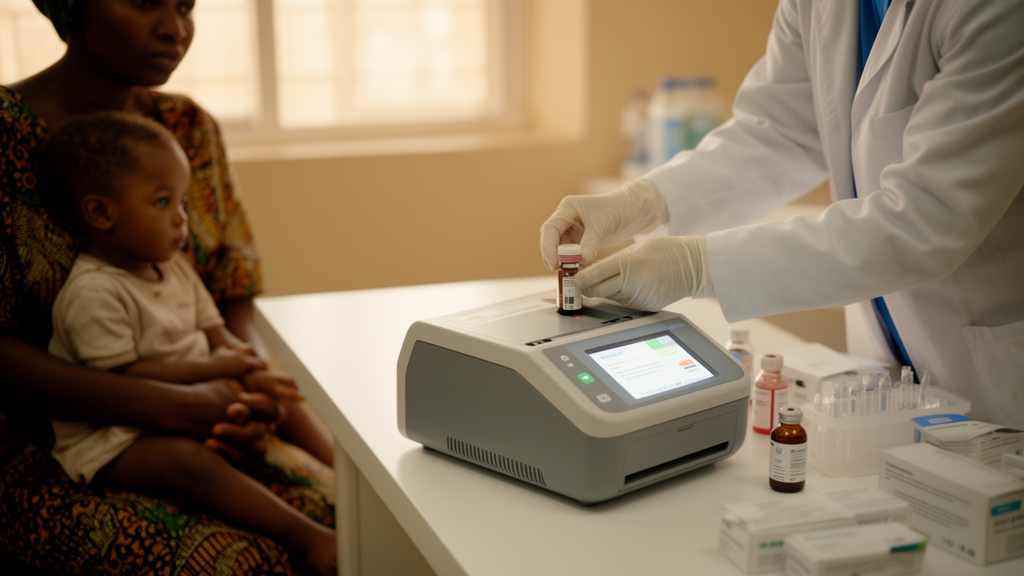
Malaria continues to exact a devastating toll across sub-Saharan Africa, and Nigeria sits at the epicenter of that burden, carrying a substantial share of the world’s cases and deaths, particularly among children under five years of age. In a new study published in PLOS Digital Health, researchers report that an automated machine learning framework, applied to ordinary household survey data rather than clinical tests, can identify minors at elevated risk of malaria with impressive accuracy. The work suggests that the demographic and socioeconomic fingerprints of a household may reveal which children deserve priority screening long before a rapid diagnostic test is ever administered.
The research team, led by Ashiqur Rahman Khan and colleagues, built their predictive models using the Nigeria Malaria Indicator Survey 2021, a nationally representative dataset that captures demographic, household, and socioeconomic characteristics across the country. This choice of data source is significant. In many resource-limited settings, rapid diagnostic tests are the frontline screening tool, but they are not perfect. False-negative results can send an infected child home without treatment, and delays in confirmatory microscopy can postpone care until the disease has progressed. A statistical model that flags high-risk children using information already collected in routine surveys could serve as an early warning layer that complements, rather than replaces, conventional diagnostics.
The methodological pipeline began with 43 candidate variables drawn from the survey. Through careful preprocessing and statistical dependency testing, the team whittled this list down to 13 statistically significant predictors. This dimensionality reduction is more than a housekeeping step; it guards against overfitting, the phenomenon in which a model memorizes noise in the training data rather than learning genuine patterns that generalize to new populations. By retaining only variables with demonstrated statistical relevance, the researchers improved the odds that their models would perform reliably on unseen data.
Five machine learning approaches were then trained and compared: Logistic Regression, a Decision Tree, a Support Vector Classifier, Extreme Gradient Boosting, and H2O AutoML, a platform that automatically searches across many model configurations to find strong candidates. Evaluation followed rigorous practice, using stratified train-test splitting to preserve class proportions and 10-fold cross-validation to ensure that performance estimates were not artifacts of a single lucky split. Because missing a true malaria case is far more dangerous than a false alarm, the researchers emphasized the F2-score, a metric that weights recall, the ability to catch actual positives, more heavily than precision.
On the full dataset, the H2O AutoML Generalized Linear Model achieved the highest F2-score at 79.38 percent, with a recall of 83.08 percent, meaning it correctly identified more than four out of five children who truly belonged in the high-risk category. XGBoost, the gradient-boosted ensemble famous for dominating tabular data competitions, posted the highest test accuracy at 75.54 percent. The contrast between these two results illustrates a classic tension in medical machine learning: overall accuracy treats false positives and false negatives as equally costly, while a recall-oriented metric reflects the clinical reality that a missed infection can be fatal.
One of the study’s most interesting innovations addresses a subtle but important problem: regional confounding. Nigeria’s malaria epidemiology varies dramatically by geography, driven by differences in rainfall, ecology, and intervention coverage. A model that simply learns regional identifiers risks encoding where a child lives rather than the underlying risk factors, producing a tool that may not transfer to new regions or that obscures the true drivers of risk. To mitigate this, the team performed Agglomerative Hierarchical Clustering on the eight most important predictors after deliberately excluding regional identifiers, allowing the data to reveal natural population subgroups on its own.
The clustering analysis yielded two optimal population subgroups, with a Silhouette Score of 0.3939, a moderate but acceptable indication that the two clusters are internally coherent and distinct from one another. Rather than treating the entire nation as a homogeneous population, the researchers then trained cluster-specific models. The results validated the strategy: in Cluster 1, the H2O Generalized Linear Model delivered the best recall-oriented performance with an F2-score of 83.31 percent, while in Cluster 2, XGBoost took the lead with an F2-score of 83.25 percent. Both cluster-specific figures exceed the best overall-dataset F2-score, demonstrating that accounting for population heterogeneity measurably improves predictive performance.
The implications for public health practice in Nigeria and beyond are considerable. Malaria control programs already collect rich household survey data through instruments like the Malaria Indicator Survey, yet these data are often analyzed only in aggregate for policy planning. This study shows that the same data can be repurposed into an operational risk-stratification tool. Health workers equipped with a model trained on such data could prioritize households for bed net distribution, targeted testing campaigns, or preemptive treatment, stretching scarce resources further in settings where every diagnostic kit and every clinic visit counts.
The choice of H2O AutoML as the top performer also carries practical weight. Automated machine learning platforms reduce the expertise barrier, allowing public health analysts without deep data science backgrounds to retrain models as new survey waves arrive. In a country where malaria transmission dynamics shift with seasons and intervention campaigns, a framework that can be refreshed regularly, without a team of specialists hand-tuning algorithms, is far more likely to be sustained in practice than a bespoke model that decays as conditions change.
Caveats remain, as they do with any model built on survey data rather than clinical measurements. The predictors capture demographic, household, and socioeconomic conditions, not parasitological evidence, so the framework identifies risk rather than confirming infection, and it is designed to complement rapid diagnostic tests and microscopy, not to replace them. Still, the study demonstrates a robust and automated pathway toward early malaria risk assessment in the populations that need it most. If validated prospectively in field settings, cluster-aware AutoML screening could become a quiet but powerful addition to the toolkit fighting one of the world’s oldest and deadliest diseases.
Subject of Research: Machine learning-based early malaria risk prediction in Nigerian minors using non-clinical survey data
Article Title: Early malaria risk screening in Nigerian minors using AutoML and cluster-based analysis of non-clinical survey data
Article References: Khan, A. R., Mahbub, N., Aziz, R. A., Siddique, M. H., & Sayeem, Z. I. (2026). Early malaria risk screening in Nigerian minors using AutoML and cluster-based analysis of non-clinical survey data. PLOS Digital Health, 5(9), e0001736. https://doi.org/10.1371/journal.pdig.0001736
Image Credits: AI Generated
DOI: 10.1371/journal.pdig.0001736
Keywords: malaria, Nigeria, AutoML, machine learning, risk prediction, hierarchical clustering, XGBoost, public health, Malaria Indicator Survey, rapid diagnostic tests, children under five, resource-limited settings
News Source: Ophelia Keating. (October 9, 2026). AutoML flags malaria risk in Nigerian children before symptoms appear. Scienmag.