For millions of women with dense breast tissue, a routine mammogram can feel like searching for a snowball in a snowstorm. Dense tissue and potential tumors both appear white on a mammogram, which means that abnormalities can slip past even experienced radiologists. Supplemental ultrasound has increasingly become the safety net of choice, but the handheld version of the technology carries well-known limitations. Now, one of the largest direct comparisons of the two approaches suggests that automated breast ultrasound, a technology that has lingered on the margins of screening for more than a decade, may finally be ready to take on a much bigger role.
A new study published in the Journal of the American College of Radiology, led by investigators at the University of Illinois Chicago and the University of Vermont, found that automated breast ultrasound, commonly abbreviated ABUS, and handheld ultrasound, or HHUS, achieved similar cancer detection rates in women with dense breasts. Critically, the automated approach did so with a lower rate of false-positive findings, meaning fewer women were called back for imaging they ultimately did not need. The research team describes the results as the strongest evidence to date supporting ABUS as an alternative to handheld scanning for supplemental screening.
The study drew on clinical data from three diverse registries of the Breast Cancer Surveillance Consortium, a long-running research network that collects detailed information on breast imaging outcomes across the United States. The analysis encompassed 25,328 screening ultrasound examinations, of which 4,218 were performed with ABUS and 21,110 with handheld ultrasound. These examinations were carried out among 21,446 women and interpreted by 98 radiologists working across 27 facilities, giving the comparison a breadth and real-world texture that earlier, smaller studies could not match.
Rather than focusing on a single performance metric, the researchers examined a cluster of measures that together define the practical value of a screening test. They compared abnormal interpretation rates, the frequency with which radiologists recommended short-interval follow-up imaging, cancer detection rates, and false-positive rates for both initial assessments and biopsy recommendations. This comprehensive framework matters because a screening technology can excel at finding cancers while simultaneously generating a flood of unnecessary callbacks, biopsies, and anxiety, a trade-off that health systems and patients alike must weigh carefully.
The results were strikingly consistent in ABUS’s favor on the measures that reflect screening burden. Lead investigator Garth H. Rauscher, PhD, of the Division of Epidemiology and Biostatistics at the University of Illinois Chicago School of Public Health and the University of Illinois Cancer Center, reported that ABUS was associated with a lower abnormal interpretation rate and a lower false-positive initial assessment rate compared with handheld ultrasound. At the same time, the study found no apparent differences between the two modalities in cancer detection rate, biopsy recommendation rate, or false-positive biopsy recommendation rate. In plain terms, the automated system found just as many cancers while flagging fewer women for unnecessary additional workup.
That combination of findings has significant implications for how screening programs are designed. Women whose screening ultrasound yields a false-positive result often face short-interval follow-up imaging, a recommendation to return in six months rather than a year for another round of scans. These callbacks carry costs that extend beyond the financial: repeated imaging exposes patients to additional appointments, prolonged uncertainty, and the psychological toll of waiting to learn whether a suspicious finding is cancer. By reducing the rate of abnormal interpretations and short-interval follow-up recommendations while holding cancer detection steady, ABUS appears to trim much of this collateral burden from the screening process.
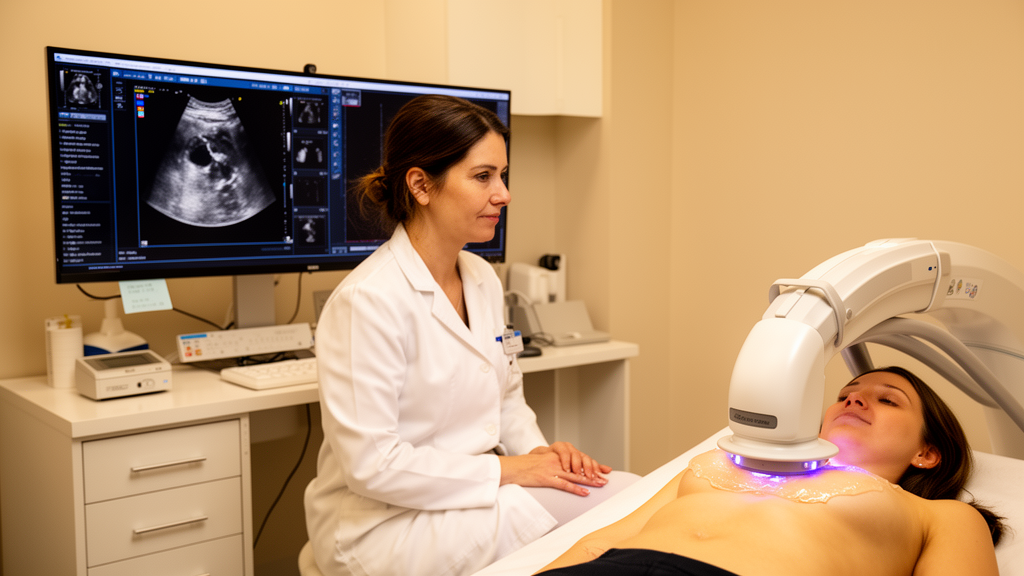
The technology behind ABUS helps explain why it behaves differently from its handheld counterpart. In an automated examination, a specially designed device sweeps a large, high-frequency transducer across each breast, systematically acquiring a volumetric data set that covers the entire breast in a standardized fashion. The examination protocol is highly reproducible: the same technique, the same coverage, and the same image quality regardless of which technologist performs the scan. Handheld ultrasound, by contrast, depends entirely on the skill, technique, and judgment of the operator holding the probe, which introduces variability in both image acquisition and interpretation. This operator dependency and lack of reproducibility have long been recognized as the principal drawbacks of handheld screening ultrasound.
ABUS received approval from the U.S. Food and Drug Administration in 2012 as an adjunct to screening mammography, but it has remained an emerging technology in breast cancer screening, adopted unevenly across radiology practices. One reason is that prior evidence base was fragmented. Earlier studies had evaluated ABUS and HHUS separately, each against its own benchmarks, leaving clinicians without a clear head-to-head picture of how the two modalities perform when deployed in routine clinical practice. According to the investigators, the new analysis is the first direct comparison of the screening performance of ABUS versus handheld ultrasound in clinical practice in the United States, a gap the study was explicitly designed to close.
The timing of the research is significant because demand for supplemental ultrasound screening is rising. State laws and federal rules now require radiology clinics to inform women with dense breasts about the limitations of mammography, a policy shift that has made patients more aware of the blind spots in their screening and more likely to seek additional imaging. Dense breast tissue is common, and because it masks abnormalities on mammograms, women notified of their breast density often pursue ultrasound as a complementary test. Expanding capacity to meet this demand with handheld ultrasound alone would require substantial sonographer and radiologist time, whereas automated scanning offers a pathway to scale supplemental screening without a proportional increase in hands-on scanning labor.
Senior author Brian L. Sprague, PhD, Co-Leader of the Population Sciences and Cancer Outcomes Program at the University of Vermont Cancer Center and a researcher in the university’s Department of Surgery, concluded that the results provide the strongest evidence to date supporting the use of ABUS as an alternative to HHUS for supplemental screening of women with dense breasts. For radiology clinics weighing an investment in automated systems, and for women deciding whether supplemental screening is worth the hassle of callbacks and repeat imaging, the study offers a data-driven answer: automated breast ultrasound can deliver equivalent cancer detection with fewer false alarms, positioning it as a practical engine for expanding screening capacity at a moment when the population of women seeking it continues to grow.
Subject of Research: Comparison of automated versus handheld ultrasound for supplemental breast cancer screening in women with dense breasts
Article Title: Study finds automated breast ultrasound is an effective alternative to handheld ultrasound for breast cancer screening
Article References: Study finds automated breast ultrasound is an effective alternative to handheld ultrasound for breast cancer screening. (n.d.). Original publication
Image Credits: AI Generated
DOI: Not provided
Keywords: automated breast ultrasound, handheld ultrasound, breast cancer screening, dense breasts, mammography, false positives, cancer detection rate, Breast Cancer Surveillance Consortium, supplemental screening, radiology, screening technology, finds
News Source: Nathaniel Bowman. (October 9, 2026). Automated Breast Ultrasound Matches Handheld Screening Accuracy With Fewer False Alarms. Scienmag.