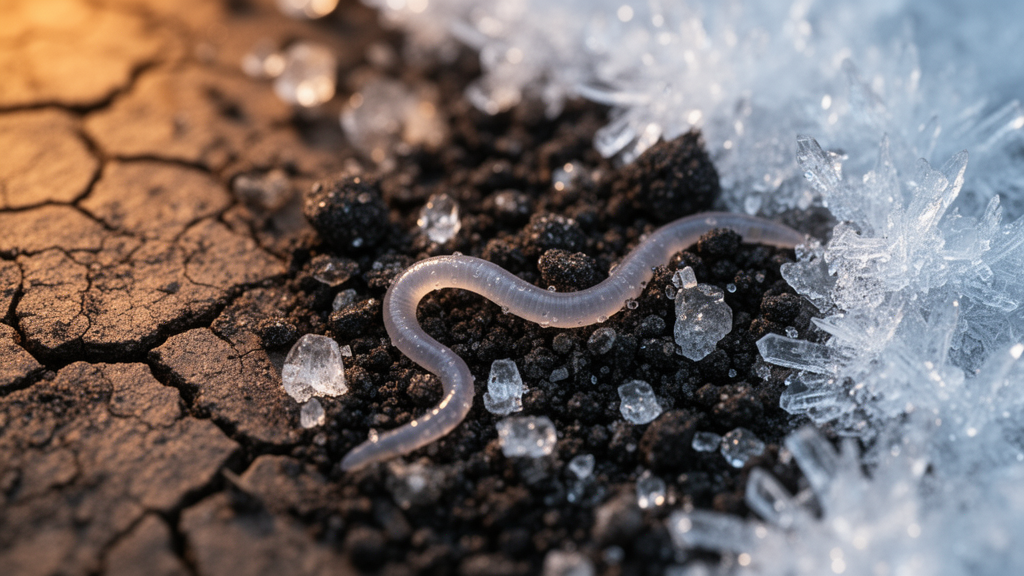
Beneath some of the most hostile landscapes on Earth, from the frozen valleys of Antarctica to the windswept heights of the Tibetan Plateau and the parched sands of the world’s driest deserts, lives an animal so small it is invisible to the naked eye, yet so resilient it has quietly colonized nearly every terrestrial habitat on the planet. Soil nematodes, microscopic roundworms that number among the most abundant animals on Earth, are the unlikely protagonists of a sweeping new review published in the journal Web Ecology, which for the first time pulls together global research on how these creatures survive, spread, and respond to climate change in extreme environments.
The review, led by Han Chen, Tairan Zhang, and Wanyanhan Jiang, synthesizes decades of field studies and experiments from polar, alpine, and arid ecosystems, three of the most punishing habitat types on the planet. Polar regions subject their inhabitants to extreme cold, permafrost, and drastic seasonal swings in daylight. Alpine zones combine low temperatures with intense ultraviolet radiation, low atmospheric pressure, and sharp diurnal temperature fluctuations. Arid zones impose severe water scarcity and dramatic day-night temperature swings. Yet despite these different stressors, the researchers found that nematode communities across all three systems share strikingly similar survival strategies, a pattern of convergent evolution that suggests extreme environments impose predictable and universal selective pressures.
At the heart of nematode survival lies a remarkable physiological trick known as cryptobiosis, the ability to enter a state of suspended metabolism when conditions turn lethal and to resume normal life once they improve. The best-studied form is anhydrobiosis, a survival mode for dry conditions in which nematodes can lose more than 95 percent of their body water, physically contracting into a coiled shape that reduces the surface area exposed to evaporation while synthesizing protective compounds that shield their cellular structures. Nematodes in the McMurdo Dry Valleys of Antarctica famously adopt this coiled morphology, allowing them to endure extreme cold, salinity, and aridity. For freezing conditions, the counterpart strategy is cryobiosis: because intracellular ice crystals are typically lethal, nematodes produce antifreeze proteins and other ice-inhibiting factors that block ice growth and recrystallization, preserving cellular integrity through deep freezes.
Beyond physiology, the review highlights a second pillar of survival: opportunistic life histories. In environments where resources appear only in brief, unpredictable windows, such as a rare desert rainfall or a short warm spell, nematodes dominated by so-called r-strategists thrive. These species prioritize rapid growth and reproduction over competitive staying power, with generation times often shorter than two weeks, fecundity exceeding fifty eggs per female, and low metabolic maintenance costs that let them ride out bad times on minimal energy. Ecologists track these traits using colonizer-persister values, and in extreme environments communities are typically dominated by low-value taxa, chiefly bacterivores and fungivores, that can explode in number whenever conditions briefly allow. In the desert steppe of Inner Mongolia, for example, nematode communities show tolerance to warming, though warming primarily affects the diversity and stability of deep-soil nematodes while nitrogen deposition mainly shapes shallow-soil communities.
These life history traits feed into a third signature of extreme environments: truncated, microbe-based food webs. In places where vascular plants are scarce or absent, the energy that fuels the soil food web comes almost entirely from microorganisms capable of chemosynthesis or photosynthesis, such as bacteria, fungi, and algae. Nematode communities are therefore dominated by bacterivores and fungivores, forming a highly specialized energy channel, while predators and omnivores, which require continuous biomass at lower trophic levels, are largely missing. In the Antarctic Dry Valleys, the soil food web consists of only a few species of microbivorous nematodes and protozoa, with a complete absence of higher-level predators. This tight coupling means that any disturbance to the microbial community can cascade rapidly through the entire food web, making these simplified systems both fragile and scientifically valuable as natural laboratories where the links between environmental drivers and biological responses are unusually clear.
When it comes to where these worms live and why, the review finds that water is the universal master variable, but that each ecosystem adds its own rules. Polar and subpolar tundra supports nematode densities one to two orders of magnitude lower than temperate grasslands, a consequence of harsh climate, sparse vegetation, and nutrient-poor soils. In the Arctic, the critical threshold is 0 degrees Celsius: warming drives permafrost thaw and deepening of the active layer, which can trigger waterlogging and oxygen depletion, and it is this abrupt shift from a frozen, aerated soil to a thawed, anoxic one, rather than temperature itself, that most threatens nematode communities. In Antarctica’s hyper-arid Dry Valleys, the story is paradoxically reversed: increased glacial meltwater acts as a disturbance, dissolving soil salts and causing osmotic shock to the drought-adapted dominant species Scottnema lindsayae, while opening the door for moisture-loving competitors and predators. The result is a fundamental shift in community assembly, from control by harsh abiotic conditions to control by biological interactions, a transition that may occur quickly and prove irreversible.
In alpine regions, exemplified by the Qingzang Plateau, often called the Third Pole, biogeographic patterns are more complex. Nematode distributions are governed not by temperature or precipitation alone but by their interaction: in dry areas, warming can boost soil moisture through snowmelt and benefit nematodes, while in wetter areas the same warming intensifies evapotranspiration and causes drought stress. Effective moisture availability, not rainfall per se, is the decisive factor. Along elevational gradients, abundance and diversity generally decline with altitude, accompanied by shifts in trophic structure, with bacterivorous nematodes dominating lower, more productive elevations and fungivorous and omnivorous forms gaining ground higher up where fungal decomposition pathways prevail. Yet the review emphasizes that these broad climatic trends are frequently overridden by local soil properties such as organic matter and pH, and by vegetation patches and biocrusts that create crucial micro-refugia. In deserts, similarly, nematode life is confined to spatiotemporal moisture islands, such as plant rhizospheres and biological soil crusts, and their activity pulses in synchrony with rare rainfall events.
Perhaps the review’s most consequential conclusion concerns climate change, whose impacts on these communities turn out to be primarily indirect. Rather than simply cooking or freezing the worms, warming reshapes the ecosystems around them. In the Arctic, thawing permafrost and shifting vegetation, including shrub expansion, alter microbial community composition, which in turn cascades upward to restructure nematode trophic guilds, often favoring fungivores over bacterivores. In alpine zones, warming pushes vegetation upslope, but nematodes following face spatiotemporal mismatches: soil properties change far more slowly than climate, so migrating worms may arrive in maladapted soils, and a shrub removal experiment on the Qingzang Plateau showed that warming can indirectly reduce nematode body size and reproductive rates, weakening their dispersal ability. Altered hydrological regimes compound the problem, with earlier snowmelt creating false springs and mid-season droughts, while extreme drought selectively eliminates higher trophic levels, leaving energy flow concentrated in microbivorous nematodes and degrading food web function for years or decades after the drought ends.
The stakes extend beyond the worms themselves. Nematodes mediate the mineralization of carbon and nutrients, making them critical to biogeochemical cycling, and their well-established taxonomy, sensitivity to soil changes, and rapid response times make them ideal indicators of ecosystem health. The review warns that low species diversity in extreme environments means low functional redundancy: if dominant species decline, there may be no ecological substitutes to fill their roles. Warming is also weakening the natural barriers that once kept temperate species, including plant-parasitic nematode pests, out of polar and alpine regions, while direct human pressures add further stress; in alpine grasslands of the Qingzang Plateau, fungicide application has been shown to reduce nematode diversity by 25 to 40 percent and simplify food web structure. The authors call for long-term experiments spanning more than five years, standardized sampling protocols that integrate molecular metabarcoding with traditional morphology, and the incorporation of nematode-based indices, such as the Maturity Index, into global monitoring networks as early warning systems. Because shifts in nematode community structure may presage soil degradation months before vegetation loss becomes visible, these tiny animals may offer humanity one of its most sensitive barometers for the fate of Earth’s most vulnerable ecosystems.
Subject of Research: Adaptations, biogeography, and climate change responses of soil nematode communities in polar, alpine, and arid extreme environments
Article Title: Soil nematode communities in extreme environments: adaptations, biogeography, and climate change responses
Article References: Chen, H., Zhang, T., & Jiang, W. (2025). Soil nematode communities in extreme environments: adaptations, biogeography, and climate change responses. Web Ecology, 25(2), 241-254. https://doi.org/10.5194/we-25-241-2025
Image Credits: AI Generated
Keywords: soil nematodes, extreme environments, cryptobiosis, anhydrobiosis, permafrost thaw, Antarctic Dry Valleys, Tibetan Plateau, soil food web, climate change, biogeography, desert biocrusts, nutrient cycling
News Source: Sloane Callahan. (October 9, 2026). How Tiny Soil Worms Survive Earth’s Harshest Places. Scienmag.