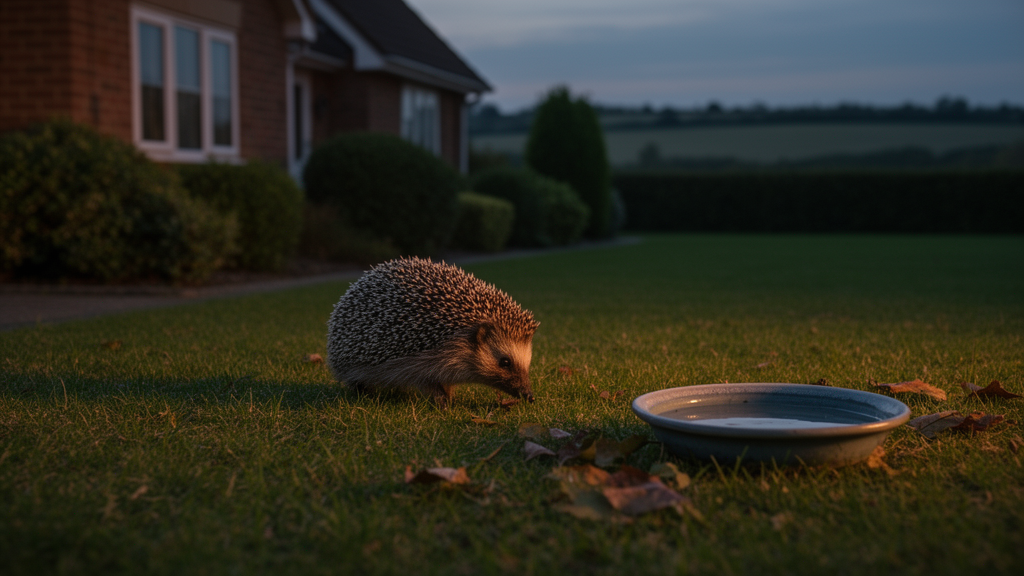
One of Britain’s most beloved animals is vanishing from its countryside. A sweeping new analysis, published in Ecology and Evolution, has pooled data from five long-running national monitoring schemes to build the most comprehensive picture yet of the West European hedgehog’s (Erinaceus europaeus) fortunes across England, Scotland and Wales. The verdict is stark: in rural landscapes, hedgehog numbers have fallen by as much as 70 per cent over four decades, while in towns and cities the picture is strikingly different, with garden populations appearing stable or even recovering in recent years.
The study, led by David Wembridge of the People’s Trust for Endangered Species together with statisticians from the British Trust for Ornithology and the Game and Wildlife Conservation Trust, brings together records collected between 1981 and 2024. Because hedgehogs are nocturnal, widely dispersed and often present at low densities, no single survey can capture the national trajectory of the species. Instead, the researchers combined five independent sources: the BTO’s Garden BirdWatch, PTES’ Living with Mammals, the Breeding Bird Survey run by BTO, JNCC and RSPB, PTES’ Mammals on Roads, and the National Gamebag Census maintained by the Game and Wildlife Conservation Trust. Each scheme uses different methods, covers different periods and samples different habitats, which makes agreement between them all the more persuasive.
The most alarming signal comes from the National Gamebag Census, which records animals accidentally killed in tunnel traps set by gamekeepers for species such as stoats and brown rats. In the first five years of the dataset, from 1981 to 1985, an average of 19.3 per cent of participating estates reported hedgehogs each year. By 2019 to 2023, that figure had collapsed to just 2.7 per cent, with the number of contributing sites in England falling from 124 per year to seven. After statistical smoothing, the national index showed a decline of 70.7 per cent between 1981 and 2023, with England faring worst at 80.4 per cent and Scotland at 64.9 per cent. Crucially, the rate of decline has accelerated: the mean annual rate over the last ten years of the series was 6.81 per cent, more than double the long-term average.
The spatial story is equally troubling. When the researchers mapped standardised counts across 10 by 10 kilometre grid squares, hedgehogs in the 1980s appeared widespread and comparatively abundant across much of Great Britain. By the 2010s, high-density areas had contracted to a narrow band covering south-east Scotland, north Wales and eastern England. Zones with no hedgehog records expanded eastward from the west coast, and the animals are no longer reported from most of western and northern Scotland, apart from some Hebridean islands, nor from parts of the West Midlands, northern England and the southern regions. The researchers argue that this pattern is unlikely to be an artefact of changing reporting behaviour, since a shift in attitudes among gamekeepers would not produce a decline that begins in the south-west and spreads east; the data instead point to genuine population loss.
Two further rural datasets corroborate the trend. The Breeding Bird Survey, in which volunteers walk randomly selected 1-kilometre transects each spring, recorded an 80.4 per cent decline in hedgehog occurrence between 2002 and 2023. Mammals on Roads, which logged casualties reported by volunteers on summer journeys, showed a 54.4 per cent drop in encounter rates between 2002 and 2013. The authors took care to control for journey length and recording method, both of which influenced casualty counts, yet the underlying decline persisted. Together with the Gamebag Census, these three independent schemes, using three different methodologies, tell a consistent story of steep rural decline.
Against this backdrop, the urban data come as a surprise. Garden BirdWatch, drawing on more than 5,000 gardens, showed an initial dip in the proportion of sites recording hedgehogs, but the index rose above its 2009 baseline by 2017, ending the series 24 per cent higher. Living with Mammals, which surveys green spaces within 200 metres of buildings, showed a plateau after 2012 and an overall occurrence change of minus 23.9 per cent between 2004 and 2024, though with wide uncertainty. More tellingly, average maximum counts at sites where hedgehogs were actually seen increased in both surveys, by 6.7 per cent in Garden BirdWatch and 20 per cent in Living with Mammals. In other words, where hedgehogs persist in towns, they appear to be doing reasonably well.
Why would a species thrive in cities while collapsing in the countryside? The authors point to several plausible mechanisms. Urban gardens offer a mosaic of habitat features, supplementary food and connectivity through garden boundaries, and hedgehogs are known to select such environments even within intensively farmed landscapes. Densities of badgers, an intraguild predator that can dominate hedgehogs, are generally lower in built-up areas than in rural ones, and badger populations have grown substantially since the 1980s. In the wider countryside, agricultural intensification has reduced habitat diversity and the abundance of the invertebrate prey on which hedgehogs depend, while road mortality compounds pressures at local scales. The study’s analysis of Living with Mammals sites found significant changes in garden characteristics over two decades, including increases in ponds, bird feeders and, remarkably, a 40.7 per cent rise in the proportion of sites with hedgehog nest boxes, suggesting that wildlife-friendly gardening may be actively supporting urban populations.
The authors are candid about the limitations of their evidence. None of the five schemes was designed specifically to monitor hedgehogs, and detection of a nocturnal species during daytime surveys is inherently low; the Breeding Bird Survey’s estimated detection rate was just 8.6 per cent. Changes in participant effort, trap design, legislation protecting non-target species and the growing use of trail cameras could all influence the indices. Yet the researchers found no evidence that trapping effort in the Gamebag Census declined, with capture rates for stoats and weasels remaining similar between the early 1980s and recent years, which suggests the hedgehog decline is real and specific. They also note that self-selection bias in garden surveys means participants are likely to be wildlife enthusiasts whose sites may not represent gardens in general.
The broader significance extends beyond one charismatic species. Hedgehogs are generalists, and the decline of a widespread, adaptable mammal may signal wider ecological degradation of the British landscape, echoing the well-documented collapses of farmland birds and butterflies across Europe. Because common species contribute disproportionately to ecosystem functioning, their loss can matter more than the extinction of rare ones. The hedgehog was recently reassessed as Vulnerable in Great Britain and Near Threatened globally, and the new figures will feed into ongoing conservation planning, including a national hedgehog conservation strategy coordinated by the IUCN’s Conservation Planning Specialist Group.
The study’s authors call for a standardised, hedgehog-specific monitoring programme to fill knowledge gaps, verify regional patterns and produce robust density estimates across habitats. A pilot project using camera-trap arrays within a citizen science framework is already under way and may address some of the detection problems that have hampered volunteer surveys to date. In the meantime, the findings carry a clear message for the public: the gardens, parks and allotments of Britain’s towns may now be among the last strongholds of one of its most cherished mammals, and the choices made in those green spaces, from hedgehog highways in fences to ponds and supplementary feeding, could shape the species’ future more than any rural intervention currently on offer.
Subject of Research: National-scale population trends and conservation status of the West European hedgehog in Great Britain
Article Title: West European Hedgehog (Erinaceus europaeus) Decline in Great Britain: Evidence From Multiple National‐Scale Surveys
Article References: Wembridge, D. E., Langton, S. D., Pringle, H., Aebischer, N. J., Ewald, J. A., Noble, D. G., & Petrovan, S. O. (2026). West European Hedgehog ( Erinaceus europaeus ) Decline in Great Britain: Evidence From Multiple National‐Scale Surveys. Ecology and Evolution, 16(10), Article e74321. https://doi.org/10.1002/ece3.74321
Image Credits: AI Generated
DOI: 10.1002/ece3.74321
Keywords: hedgehog, Erinaceus europaeus, population decline, citizen science, Great Britain, agricultural intensification, urban ecology, badger predation, National Gamebag Census, monitoring schemes, conservation, road mortality
News Source: Margaret Porter. (October 9, 2026). Britain’s Hedgehogs Have Collapsed in the Countryside While Urban Populations Hold On. Scienmag.