Deep in the giant Bayan Obo deposit of Inner Mongolia, a team of Chinese researchers has identified a mineral that has never before been seen in nature. The new species, named xianhuaite-(Ce), carries the ideal chemical formula K2CeNb5O15, meaning its crystal lattice is built from potassium, cerium, niobium, and oxygen. The discovery, published in the European Journal of Mineralogy, matters for two reasons. First, it adds a genuinely new entry to the catalogue of Earth’s niobium-bearing minerals, which remains surprisingly short for such a strategically important metal. Second, and more strikingly, xianhuaite-(Ce) is the first naturally occurring mineral known to adopt the tetragonal tungsten bronze structure, an atomic architecture that materials scientists have long synthesized in the laboratory but had never caught nature making on its own.
The mineral was approved by the International Mineralogical Association’s Commission on New Minerals, Nomenclature and Classification under proposal number IMA 2024-091, and carries the official symbol Xhu-Ce. Its name honors Professor Xianhua Li, an academician of the Chinese Academy of Sciences, in recognition of his contributions to research on early Earth and planetary evolution and, in particular, his recent advances in the geochronology, geochemistry, and resource development of the Bayan Obo deposit. The holotype specimen, catalogued as GMCTM2024012, is held at the Geological Museum of China in Beijing, while a co-type specimen resides in the crystal structure laboratory at China University of Geosciences, Beijing. These reference samples ensure that any future researcher can compare material against the defining specimens of the species.
Xianhuaite-(Ce) was found in two rock samples collected from different parts of the Bayan Obo complex. One specimen, BY-E2024-103, came from the East Orebody, where it occurs as black-brown megacrystalline aggregates at the contact between aegirine-type and dolomite-type niobium-rare earth-iron ores. The other, BY-EC2024-14, was collected from the East Contact Zone within dolomite-type ore. In that second sample, quantitative mineral mapping using a Tescan integrated mineral analyzer showed the rock is dominated by dolomite at nearly 72 percent by volume and magnetite at about 12 percent, with fersmite making up 8 percent. Xianhuaite-(Ce) itself accounts for a modest 0.40 volume percent, appearing alongside columbite-(Fe), aeschynite, fergusonite-(Ce), and small amounts of pyrochlore, phlogopite, barite, apatite, and other phases typical of skarn-altered assemblages.
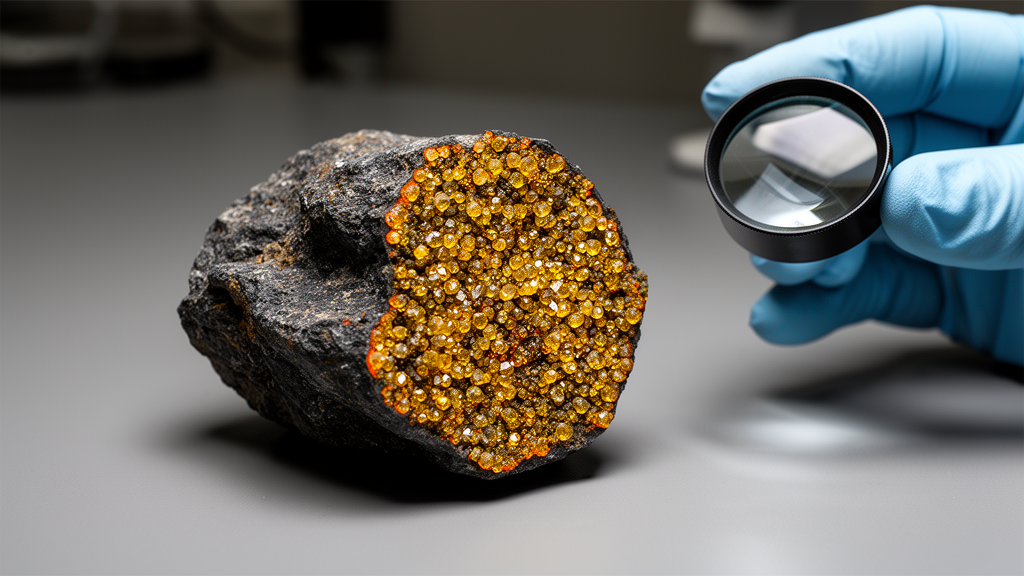
Under the microscope and in hand specimen, the new mineral presents as irregular grains or tetragonal prisms ranging from tiny slivers of roughly 0.03 by 0.03 by 0.1 millimeters up to crystals of about 0.4 by 0.4 by 0.6 millimeters. It is dark brown to blackish brown in bulk, but thin fragments transmit a pale yellow-brown to brownish-red light. It shows an adamantine luster, a white streak, perfect cleavage on the {001} plane, and a conchoidal fracture, and it is brittle. Its Mohs hardness falls between 5 and 6, and micro-indentation testing yielded a mean Vickers hardness number of 469.5 kilograms per square millimeter at a 200-gram load. The calculated density is 5.23 grams per cubic centimeter, and the mineral shows no fluorescence under longwave ultraviolet light and no magnetic response.
Chemical analysis by electron probe microanalysis with wavelength-dispersive spectrometry, performed on a JXA-iHP200F instrument at 15 kilovolts and 20 nanoamperes, established the empirical formula. Normalized to 15 oxygen atoms per formula unit, it reads (K1.30Ba0.69Sr0.02)(Ce0.39La0.31Nd0.04Pr0.02Ca0.15Na0.09)(Nb4.75Fe0.13Ti0.09Mg0.04)O15. In plain terms, the large channel sites of the structure are filled mostly by potassium and barium, with a smaller site occupied chiefly by cerium and lanthanum plus minor calcium and sodium, while the octahedral framework sites are dominated by niobium with a little iron, titanium, and magnesium. Backscattered electron imaging confirmed the crystals are chemically homogeneous at the micrometer scale, and the simplified formula (K,Ba)2(Ce,La)(Nb,Fe)5O15 rounds to the ideal K2CeNb5O15.
The structural work is where the discovery becomes remarkable. Single-crystal X-ray diffraction on a fragment measuring just 0.02 by 0.02 by 0.01 millimeters, collected with molybdenum radiation on a Rigaku XtaLAB PRO-007HF diffractometer, revealed a tetragonal unit cell with a = 12.5355 angstroms, c = 3.9213 angstroms, and a volume of 616.19 cubic angstroms, in the centrosymmetric space group P4/mbm. The refinement converged to an R1 value of 0.0189 based on 427 independent reflections, an exceptionally good fit. The structure is a textbook tetragonal tungsten bronze framework: niobium-centered oxygen octahedra share corners to build a two-dimensional network in the horizontal plane, generating rings of four and five octahedra that line vertical channels running along the c axis. The larger five-membered channels host potassium and barium in ninefold coordination, while the four-membered channels accommodate cerium and calcium in twelvefold coordination.
Raman spectroscopy independently corroborated this architecture. The spectrum shows a prominent band near 853 wavenumbers assigned to vibrations of the NbO6 octahedra, additional peaks at 645 and 537 wavenumbers corresponding to niobium-oxygen stretching modes, and low-frequency features at 175, 135, and 81 wavenumbers characteristic of cation motions in tetragonal tungsten bronze phases. The absence of any peaks above 1000 wavenumbers is consistent with a structure containing no hydroxyl or water groups. Bond valence sum calculations further confirmed that the assigned oxidation states and site occupancies are internally consistent, with the B1 octahedral site modeled as roughly 95 percent niobium and 5 percent trivalent iron, matching the chemical analyses.
What does the mineral say about how Bayan Obo formed its enormous metal endowment? The deposit has been studied for decades, yet the mechanisms of niobium enrichment remain debated, largely because the niobium is scattered across at least 30 distinct mineral species rather than locked in one dominant host. The textural evidence from the East Contact Zone sample offers a clue: xianhuaite-(Ce), fersmite, and columbite-(Fe) occur as interstitial phases between magnetite grains, and both xianhuaite-(Ce) and fersmite contain relict pyrochlore inclusions inherited from an earlier mineralization stage. The authors argue these relationships are inconsistent with primary magmatic crystallization and instead point to precipitation from niobium-bearing fluids during a later hydrothermal overprint. The surrounding assemblage of forsterite, phlogopite, chlorite, and dolomite is characteristic of magnesian skarn systems formed when granite intrudes dolomitic host rocks.
The regional context strengthens that interpretation. The East Contact Zone experienced variable degrees of skarnization during the emplacement of Permian granites, a thermal event that apparently did not add new niobium to the system but likely remobilized niobium already present. Taken together, the mineral assemblages, textures, and geology suggest xianhuaite-(Ce) formed under fluid-dominated conditions during the Permian granitic event, recording the remobilization and redistribution of niobium rather than its original accumulation. The coarse-grained East Orebody sample lacks diagnostic assemblages for direct petrographic constraints, but regional geochronology indicates the Permian thermal event affected the entire district, so the researchers tentatively assign its xianhuaite-(Ce) to the same episode, while noting that direct dating is still lacking.
The discovery also resonates beyond geology. Synthetic compounds with the same ideal composition, K2CeNb5O15, belong to a family of tetragonal tungsten bronze materials studied for their physical properties, and laboratory work has documented temperature-driven symmetry transitions within this structural family. The natural mineral refines best in the centrosymmetric high-temperature form, P4/mbm, and intensity statistics support that choice. By capturing a structure long known only from synthesis, xianhuaite-(Ce) expands the known structural diversity of natural niobium minerals and provides new mineralogical constraints on how niobium behaves during the multistage evolution of one of the world’s most extraordinary ore deposits. For a metal critical to advanced technologies, every new clue about where and how it concentrates carries practical weight.
Subject of Research: Discovery and characterization of the new niobium mineral xianhuaite-(Ce) from the Bayan Obo deposit
Article Title: Xianhuaite-(Ce), K2CeNb5O15, a new niobium mineral from the Bayan Obo deposit, China
Article References: Yang, B., Xue, Y., Yang, L., Sun, N., Li, G., Yu, J., Yan, G., Liu, J., Zhao, Y., Meng, W., Chen, Z., Chen, L., Liu, Z., Yan, Z., Hou, X., Ao, X., & Wang, J. (2026). Xianhuaite-(Ce), K 2 CeNb 5 O 15 , a new niobium mineral from the Bayan Obo deposit, China. European Journal of Mineralogy, 38(4), 449-459. https://doi.org/10.5194/ejm-38-449-2026
Image Credits: AI Generated
Keywords: xianhuaite-(Ce), Bayan Obo, niobium, new mineral, tetragonal tungsten bronze, rare earth elements, crystal structure, skarn, hydrothermal remobilization, mineralogy, Inner Mongolia, electron microprobe
News Source: Bethany Barker. (October 9, 2026). New Mineral Xianhuaite-(Ce) Reveals Hidden Niobium Story at Bayan Obo. Scienmag.