In an era when analytical chemistry is dominated by multimillion-dollar mass spectrometers and ultra-high-performance liquid chromatographs, a team of researchers in Brazil has demonstrated that one of the oldest and cheapest tools in the laboratory notebook can accomplish something its high-tech rivals cannot. In a study published in Discover Chemistry, scientists at the Federal University of Paraíba showed that thin-layer chromatography, or TLC, paired with a classic color-forming reagent, can reveal the presence of avocadyne, a characteristic lipid-derived molecule of the avocado tree, in complex avocado extracts and a commercial essential fatty acid formulation. The same molecule remained essentially invisible to conventional high-performance liquid chromatography with ultraviolet detection, the workhorse technique found in quality-control laboratories around the world. The result is a striking reminder that the choice of analytical method matters as much as the sophistication of the instrument, particularly when the target compound is chemically reluctant to announce itself.
Avocadyne belongs to a family of long-chain aliphatic acetogenins reported as characteristic constituents of Persea americana, the botanical name for the avocado. These compounds have attracted attention because they are found in the fruit’s pulp and seeds and are considered chemical markers of the species. Detecting them matters for more than academic curiosity. Avocado-derived oils and essential fatty acid formulations are widely used in dermatological and pharmaceutical applications, where bioactive lipids such as linoleic acid help maintain epidermal integrity and support the repair of the stratum corneum after skin damage. Chronic wounds, which affect millions of people globally and are notoriously difficult to heal, have driven demand for wound-healing formulations built on such lipids. Verifying that a commercial product actually contains the avocado constituents it claims to contain is therefore a genuine quality-control problem, one that hinges on being able to detect the right molecular markers.
The difficulty is that avocadyne is, from the perspective of an ultraviolet detector, almost perfectly camouflaged. Ultraviolet detection in HPLC depends on molecules absorbing UV light through electronic transitions, typically the pi-to-pi-star or n-to-pi-star transitions that require conjugated double bonds or aromatic ring systems. Avocadyne, being predominantly aliphatic and lacking any chromophore, simply does not absorb appreciably in the UV region. The researchers confirmed this experimentally: when they ran a hydroalcoholic extract of avocado fruit through an Agilent 1100 HPLC system equipped with a diode-array detector, scanning wavelengths of 210, 254, 280, and 366 nanometers, other UV-active constituents of the extract separated and registered clearly, but no corresponding signal for avocadyne appeared at any wavelength. Crucially, the authors emphasize that this absence of a peak reflects a limitation of UV-based detection, not evidence that the compound is absent from the sample.
This blind spot is not unique to avocadyne. A broad class of non-chromophoric compounds found in lipid-rich plant matrices, including long-chain aliphatic molecules and various acetogenins, share the same analytical invisibility. Conventional HPLC-UV methods applied to such samples can produce false negatives or incomplete chemical profiles, potentially compromising authenticity assessments and quality control of botanical products. The standard workarounds involve more specialized detection systems: evaporative light scattering detection, charged aerosol detection, or mass spectrometry, all of which respond to analytes regardless of their UV behavior. Previous studies have indeed identified avocado acetogenins definitively using liquid chromatography-mass spectrometry, gas chromatography-mass spectrometry, and nuclear magnetic resonance spectroscopy. But those instruments are expensive, technically demanding, and not always available in routine quality-control laboratories, especially in resource-limited settings where much of the world’s botanical product testing actually takes place.
Enter thin-layer chromatography, a technique whose basic principles have changed little since the mid-twentieth century. In TLC, samples are spotted onto a plate coated with silica gel, a solvent mixture wicks up the plate by capillary action, and different compounds migrate at different rates depending on how strongly they interact with the stationary phase and the solvent. The position of each compound is expressed as its retention factor, or Rf value, the ratio of the distance the compound travels to the distance the solvent front travels. Because most compounds are colorless, the real trick lies in visualization, and this is where the Brazilian team turned to a reagent first described in 1957: Goldin’s reagent, a derivatization spray that produces a characteristic color reaction with specific classes of compounds, allowing bands to be seen by simple visual inspection.
The experimental design was straightforward but careful. Fresh fruits of Persea americana Mill., the butter variety, were purchased from a local market in Goiana, Pernambuco, Brazil, and identified by morphological characteristics such as smooth green skin, large size, and soft pulp. One kilogram of decorticated fruit was extracted by percolation at room temperature for seventy-two hours with 2.5 liters of ethanol-water mixture, and the material was dried to yield an oily avocado fruit extract with an average yield of 18.5 percent. This hydroalcoholic extract, along with a commercial essential fatty acid formulation containing polyunsaturated oils and vitamins A and E, was then analyzed by TLC on silica gel 60 F254 aluminum plates developed in a mixture of dichloromethane, methanol, and ethyl acetate in a 70:15:15 ratio. A reference sample of avocadyne, isolated and purified in the authors’ own laboratory from avocado material using procedures adapted from previously reported methods, served as the qualitative comparison standard.
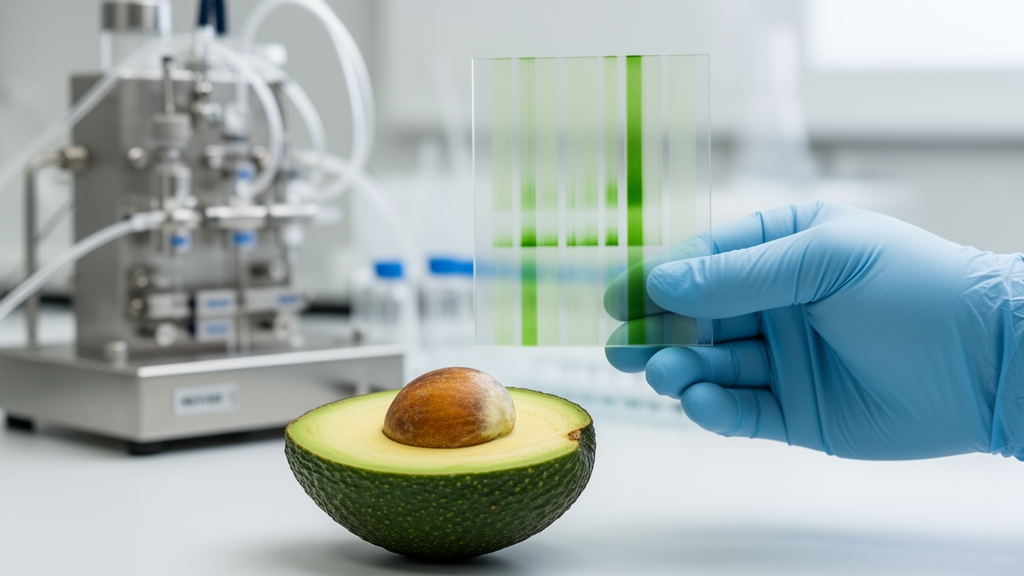
The outcome was unambiguous. After derivatization with Goldin’s reagent, both the avocado extract and the commercial formulation displayed a well-defined band at an Rf value of 0.55, matching the position of the avocadyne reference sample and consistent with values previously reported in the literature for avocado acetogenins under comparable conditions. The method also allowed visualization of the compound at different concentration levels, suggesting its suitability for qualitative screening. The authors are appropriately cautious about what this means: because no complementary structural characterization techniques were employed in this study, the assignment of the band to avocadyne should be regarded as tentative, qualitative evidence compatible with the compound’s presence rather than definitive proof. No densitometric measurements were performed, and the TLC procedure was explicitly employed as a qualitative screening method rather than a validated quantitative assay.
The contrast between the two techniques carries a broader lesson for analytical chemistry. HPLC offers superb resolution and sensitivity for compounds that absorb UV light, but when the analyte lacks chromophoric groups, separation efficiency alone is worthless if the detector cannot see the molecule. The authors argue that detection strategies should be chosen based on the molecular structure of the target compound, not solely on the efficiency of the separation. For non-chromophoric lipids, options include derivatization-based TLC, evaporative light scattering detection, charged aerosol detection, or mass spectrometry, and derivatization-assisted HPLC-UV methods that chemically install a UV-absorbing handle onto the molecule. The study also underscores how much variability quality-control methods must contend with: earlier investigations showed that extraction method markedly affects chlorophyll content, unsaponifiable matter, and lipid profile, while more recent work confirmed that cultivar, geographical origin, climate, and post-harvest handling all strongly influence the chemical composition and quality attributes of avocado oil.
Nobody is suggesting that TLC should replace advanced instrumentation. The technique provides limited structural information, cannot deliver unequivocal compound identification, and does not permit accurate quantification. The authors are explicit that TLC should be regarded as a complementary screening tool that supports routine quality-control procedures, while techniques such as LC-MS/MS, HPLC-ELSD, and HPLC-CAD remain necessary for definitive identification and quantitative analysis. Future studies, they suggest, should explore these alternative detection systems to improve the characterization of non-chromophoric avocado acetogenins. Yet the practical significance of the finding is considerable. For laboratories that need a rapid, simple, and inexpensive first-pass check on whether avocado-derived products contain the characteristic lipid markers they claim, a glass plate, a solvent mixture, and a reagent described nearly seven decades ago may be all that stands between a genuine product and an undetected fake.
Subject of Research: Thin-layer chromatography detection of the non-chromophoric avocado acetogenin avocadyne in avocado-derived matrices
Article Title: Thin-layer chromatography as a rapid screening tool for avocadyne in avocado-derived matrices
Article References: de Sena, R. F., de Pontes, E. S., Paulo, M. Q., da Silva, N. C., & Ramalho, R. H. (2026). Thin-layer chromatography as a rapid screening tool for avocadyne in avocado-derived matrices. Discover Chemistry, 3(1), Article 487. https://doi.org/10.1007/s44371-026-00943-8
Image Credits: AI Generated
DOI: 10.1007/s44371-026-00943-8
Keywords: avocadyne, avocado, thin-layer chromatography, HPLC-UV, Persea americana, acetogenins, quality control, Goldin's reagent, natural products, analytical chemistry, essential fatty acids, chromatographic fingerprinting
News Source: Bethany Barker. (October 9, 2026). Old-School TLC Outshines HPLC in Detecting Avocado’s Hidden Molecule. Scienmag.