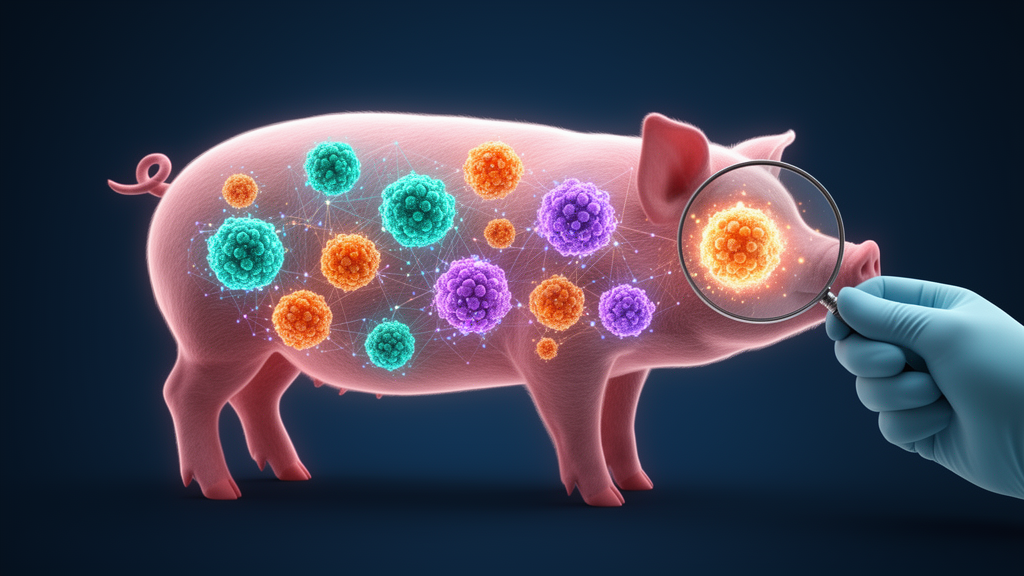
In a milestone for veterinary and agricultural immunology, researchers in China have constructed the most comprehensive single-cell atlas yet of the adaptive immune system in healthy pigs, capturing both the transcriptomes and the antigen receptor sequences of tens of thousands of immune cells across eleven tissues. The study, published in Advanced Biotechnology, provides the first systematic cross-tissue profile of T cell receptor (TCR) and B cell receptor (BCR) repertoires in healthy Duroc × Landrace × Yorkshire (DLY) crossbred piglets, an animal that sits at the heart of global pork production and, increasingly, at the interface of human and veterinary medicine.
The adaptive immune system depends on an extraordinary diversity of antigen receptors. T cells and B cells generate their receptors through a process called V(D)J recombination, in which variable, diversity, and joining gene segments are randomly stitched together, with additional nucleotide insertions and deletions at the junctions. This combinatorial and junctional diversity, together with the pairing of heavy and light chains in B cells and alpha and beta chains in T cells, allows the immune system to recognize an almost limitless range of pathogens. The composition of these repertoires reflects immune development, tissue microenvironment, antigen exposure history, and disease status, making their systematic characterization essential for understanding immune surveillance and tissue-specific immune regulation.
Previous studies of the porcine immune repertoire relied largely on bulk sequencing, which averages signals across mixed cell populations and offers limited resolution for dissecting cellular heterogeneity and lineage relationships. Although high-throughput repertoire sequencing had revealed preferential V(D)J gene usage and clonotype expansion in pigs, those studies generally lacked simultaneous transcriptomic information, meaning receptor features could not be directly linked to immune cell identity, functional state, or tissue location. The new work closes that gap by integrating single-cell RNA sequencing with paired V(D)J repertoire sequencing at single-cell resolution.
To build the atlas, the team, led by researchers from Sun Yat-Sen University, the Harbin Veterinary Research Institute, and Beijing BestopCell, sampled three clinically healthy, 14-day-old male DLY crossbred piglets weighing approximately 4 kilograms. The animals were screened by RT-qPCR for major swine pathogens, including porcine epidemic diarrhea virus, transmissible gastroenteritis virus, porcine deltacoronavirus, rotavirus, porcine reproductive and respiratory syndrome virus, and African swine fever virus, and all tests were negative. None of the piglets had been vaccinated, ensuring that the recorded immune landscape reflected a true physiological baseline rather than an antigen-driven response.
The researchers collected eleven immune-associated tissues spanning lymphoid, mucosal, and circulatory compartments: peripheral blood, spleen, thymus, tonsil, lung, bone marrow, intestinal lymph node, bronchial lymph node, Peyer’s patch, and the mucous membranes of the ileum and jejunum. After careful tissue dissociation, debris removal, and quality control filtering that eliminated 22,141 low-quality cells, a total of 71,731 cells were retained for analysis. Sequencing was performed on an MGI DNBSEQ-T7 platform, and the data were processed with the Seurat and scRepertoire frameworks against the Sscrofa11.1 reference genome.
The cellular inventory revealed the expected cast of immune players: T cells, B cells, natural killer cells, plasma cells, monocytes, and neutrophils, alongside structural endothelial, epithelial, and fibroblast populations. Cell-type identities were anchored to canonical markers, with B cells expressing CD19, MS4A1, and CD79A; T cells expressing CD3D, CD3E, and CD3G; and plasma cells marked by MZB1 and CD38. Reclustering resolved five major B-cell subpopulations, including naive, memory, germinal center, plasma, and cycling plasma cells, and nine T-cell subpopulations ranging from naive and memory CD4 and CD8 subsets to regulatory T cells, cycling T cells, and double-positive CD4-CD8 cells. The distribution of these subsets varied sharply by tissue: lymphoid organs were dominated by adaptive immune cells, mucosal tissues carried more epithelial and innate components, and double-positive T cells concentrated in thymic compartments, consistent with thymocyte development.
On the repertoire side, the team identified 3,275 BCR clones and 13,431 TCR clones. Both receptor classes showed strongly biased, non-random V(D)J gene usage. The five most frequent BCR V genes, including IGHV1S2*01 and IGHV1-15*01, together accounted for 39.41 percent of total V-gene usage, while the IGHJ5*01 segment alone represented 44.95 percent of J-gene usage. In the TCR repertoire, segments such as TRAV15 and TRBV20-2*01 were preferentially enriched, alongside dominant TRBJ genes. Complementarity-determining region 3 (CDR3) lengths, the hypervariable loops that contact antigen, fell into narrow, conserved intervals: 10 to 12 and 29 to 31 amino acids for BCRs, and 12 to 14 and 26 to 28 for TCRs, with these patterns remaining stable across tissues, reflecting structural constraints on receptor generation.
Cross-tissue analyses revealed a striking asymmetry between humoral and cellular immunity. BCR clonotypes were shared far more extensively between tissues, particularly among Peyer’s patch, intestinal lymph node, ileum mucosa, and peripheral blood, whereas TCR clones showed higher tissue specificity, with the strongest sharing between peripheral blood and spleen. Because the samples came from unchallenged animals, the authors interpret this multi-organ sharing not as antigen-driven expansion but as a manifestation of intrinsic V(D)J recombination bias, in which certain gene combinations and CDR3 lengths are preferentially generated, producing ‘public-like’ clonotypes that coexist systemically. The team also notes that B cells routinely recirculate through blood and lymph, while T cells tend toward tissue residency, though their homing-receptor analysis did not show a statistically significant difference between the two lineages, leaving the mechanistic basis open.
Mapping receptor sequences back onto the single-cell transcriptomic map through matched cell barcodes linked clonal dynamics to cell state. BCRs concentrated in plasma cell and cycling plasma cell populations, and the plasma cell subset showed enriched use of IGHA and IGHG heavy chains with elevated IGHG subclass diversity, hallmarks of antibody maturation and class-switch recombination. Immunoglobulin M accounted for more than half of heavy-chain usage in each B-cell cluster, while kappa and lambda light-chain preferences differed between subsets. TCRs were concentrated in naive CD4, naive CD8, regulatory, and memory CD4 T cells, and most TCR clonotypes existed as singletons, underscoring the enormous baseline diversity maintained even without acute immune challenge.
A key technical contribution came from the pig-specific V(D)J primers designed for the study. Compared with previously published porcine repertoire datasets, the strategy detected substantially more heavy-chain V, light-chain V, and light-chain J immunoglobulin alleles, offering improved sensitivity and broader coverage of porcine antibody diversity. The authors caution that the pooled-sample design cannot assess individual variability, that cell annotations lack independent orthogonal validation, and that antigen specificity was not directly tested. Even so, the atlas stands as a foundational reference for the healthy porcine adaptive immune system, with immediate relevance for vaccine design, infectious disease research, breeding for disease resistance, and the growing use of pigs as translational models in biomedical science.
Subject of Research: Single-cell profiling of T cell and B cell receptor V(D)J immune repertoires across tissues in healthy pigs
Article Title: A single-cell profile of the porcine immune repertoire: concurrent profiling of T cell receptor and B cell receptor V(D)J sequences in health
Article References: Zhang, H., Zhang, Q., Zhang, H., Wang, P., Geng, R., Pan, R., Li, C., Shi, F., Liu, J., Wu, Y., & Cao, Y. (2026). A single-cell profile of the porcine immune repertoire: concurrent profiling of T cell receptor and B cell receptor V(D)J sequences in health. Advanced Biotechnology, 4(4), Article 38. https://doi.org/10.1007/s44307-026-00139-2
Image Credits: AI Generated
DOI: 10.1007/s44307-026-00139-2
Keywords: single-cell RNA sequencing, V(D)J recombination, immune repertoire, T cell receptor, B cell receptor, porcine immunology, CDR3, clonotype sharing, plasma cells, DLY piglets, immunoglobulin isotypes, veterinary biotechnology
News Source: Drew Townsend. (October 9, 2026). Scientists Map the Full Landscape of the Pig Immune System, Cell by Cell. Scienmag.