Every one of the roughly 37 trillion cells in the human body descends from a single fertilized egg, and each division along the way leaves a hidden history inside the genome. For decades, biologists could only dream of reading that history in a mammal. Now, in a pair of landmark studies published in Science, two teams led by Howard Hughes Medical Institute Investigators have done what many considered impossible: they have reconstructed cellular family trees spanning millions of cells in a developing mouse, tracing how a single cell ultimately gives rise to the vast and diverse cellular population that makes up an entire animal. The achievement, announced on 8 October 2026, represents the most complete lineage map ever produced for a mammal and delivers on a promise first fulfilled in a humble worm more than forty years ago.
Jonathan Weissman, an HHMI Investigator based at the Whitehead Institute, and Jay Shendure, an HHMI Investigator at the University of Washington, worked independently on the problem, and each arrived at a solution built on the same audacious idea: instead of trying to watch cells divide, teach the cells to record their own divisions in DNA. The two teams developed distinct but conceptually related recording technologies, applied them to mouse embryos, and read out the accumulated records by sequencing individual cells. The result is a pair of complementary maps that reveal both what each cell became and where it came from, a combination that has never before been available for a mammal at this scale.
The historical benchmark for this kind of work dates to 1983, when researchers completed the lineage of the roundworm Caenorhabditis elegans, charting every single cell division from fertilized egg to adult. That feat was possible only because the roundworm embryo is transparent and develops outside the body, allowing scientists to sit at a microscope and watch each division as it happened. A mouse embryo, by contrast, grows inside its mother, hidden from direct observation, and expands from one cell to hundreds of millions of cells in just a few weeks. No microscope could follow that process, and no conventional measurement could capture it. As Weissman puts it, the new work is proof of principle that what was done with the roundworm in 1983 can now be done for mammals like mice and, by extension, like humans.
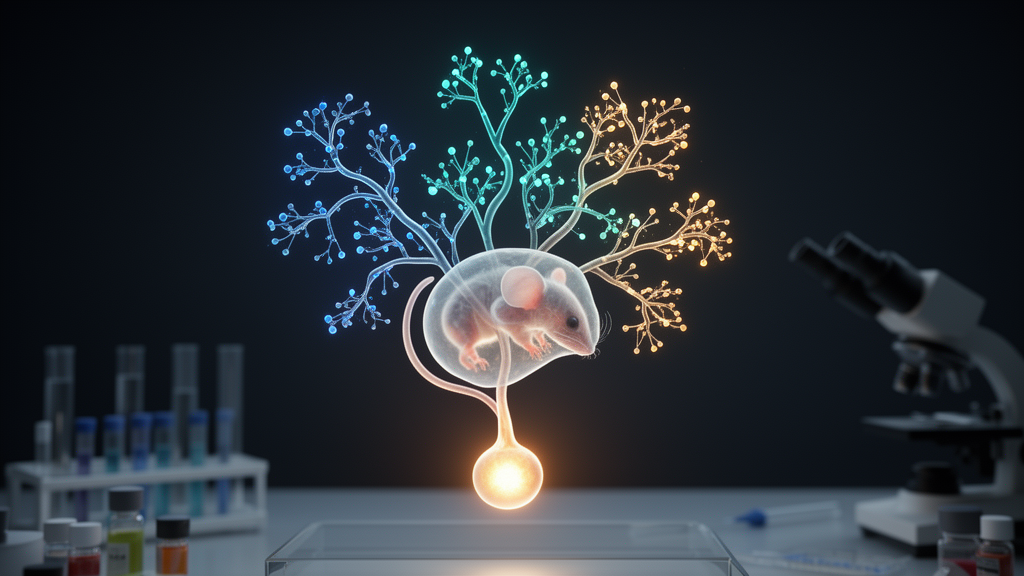
Weissman’s team solved the problem with a tool called PEtracer, unveiled in 2025, which relies on a genome-editing method known as prime editing. Prime editing can install precise, small changes into DNA without cutting both strands of the double helix, making it an ideal instrument for writing permanent marks into a genome. PEtracer deploys this capability at more than a hundred sites in the genome. Each time a cell divides, the recording machinery adds new marks, and those marks are inherited by every daughter cell, which then accumulate additional marks of their own. Over the course of development, the genome of each cell becomes a layered archive of its ancestry, with earlier marks shared by all descendants and later marks distinguishing individual branches of the family tree.
Reading the archive is where the power of the approach becomes clear. Because the marks are captured by sequencing individual cells, a single experiment yields two kinds of information at once. The shared mutations reveal the lineage, showing which cells are sisters, cousins, or distant relatives, while the natural gene expression profile of each cell reveals its identity and function. In the new research, Weissman’s team engineered stem cells carrying the PEtracer recording apparatus and injected them into a mouse embryo. As the embryo developed in utero, the heritable marks were incorporated into nearly every cell the embryo produced. By analyzing each cell at the end of development, the researchers assembled massive family trees that connected the final cell types of the mouse back to their common progenitors.
Shendure’s team took a parallel route with a technology called DNA Typewriter, which his group introduced in 2022. DNA Typewriter also uses prime editing, but it records each editing event on a dedicated string of DNA that functions like a ticker tape, logging divisions in sequence as the embryo grows. In the new study, the team injected the components of DNA Typewriter into a fertilized mouse egg, allowing the recording to begin at the very first division of life. As the cells multiplied, the tape accumulated a chronological record of the embryo’s cellular expansion. Reading that tape back allowed the researchers to reconstruct the developmental history of the animal from zygote to late organogenesis, the stage at which the major organs have taken shape.
The two technologies share a common motivation, one that Shendure articulated in explaining why recording is superior to existing approaches. Most biological measurements, he notes, depend either on live imaging, which is limited because most animal tissues are not transparent, or on genomics, which is destructive and captures only a single moment in time. Recording techniques change the equation entirely. By writing history into DNA as it happens, they enable measurements over time in settings that cannot be directly visualized, including the interior of a growing mammalian embryo. The cell divides, each daughter receives a mark, and those marks are inherited and extended through subsequent generations, so that by looking at the marks in the DNA at the end, the relationships among millions of cells can be reconstructed after the fact.
The scientific payoff of these maps is expected to be broad. Understanding how cells differentiate to build tissues is one of the central questions of developmental biology, and the new lineage trees provide a direct view of which progenitors give rise to which mature cell types. The maps also offer a way to study disease at its origins, revealing where and when a developing embryo is most vulnerable to environmental or genetic stressors. In cancer biology, the same recording tools can be turned on tumors to investigate how cancers initiate, grow, spread through the body, and develop resistance to therapies, questions that likewise unfold at moments and in places that researchers cannot observe directly. If the information can be recorded in DNA, Weissman explains, then the underlying processes can be inferred and reconstructed in detail even after they have occurred.
Beyond the immediate biological insights, the data sets generated by the two teams are destined to play a role in computational biology. The researchers plan to use the lineage and cell fate information to train artificial intelligence models of embryogenesis, with the long-term goal of building a virtual embryo, a predictive computational model capable of forecasting developmental outcomes. Such a model would allow scientists to simulate how perturbations, from genetic mutations to environmental insults, might alter the trajectory of development, opening a new frontier in which mammalian embryogenesis can be studied computationally as well as experimentally.
There is also a humbling lesson embedded in the achievement, one that Weissman draws directly from the history of the roundworm map. When the C. elegans lineage was completed in the 1980s, it led to biological discoveries that no one could have anticipated at the time, precisely because understanding a process and its underlying molecular mechanisms generates questions no one had yet thought to ask. Weissman describes the coming wave of insights from the mouse lineage maps as a source of unknown unknowns, unexpected findings that will emerge simply from having the map in hand. Forty years after a transparent worm gave biology its first complete cellular family tree, two independent teams have brought that same power to a mammal, and the full consequences for understanding development, disease, and the origins of complex tissues are only beginning to come into view.
Subject of Research: Cell lineage tracing in mammalian embryonic development using DNA recording technologies
Article Title: Mapping how a single cell becomes an entire mouse
Article References: Mapping how a single cell becomes an entire mouse. (n.d.). Original publication
Image Credits: AI Generated
DOI: Not provided
Keywords: cell lineage, mouse development, prime editing, PEtracer, DNA Typewriter, embryogenesis, single-cell sequencing, HHMI, Jonathan Weissman, Jay Shendure, developmental biology, virtual embryo
News Source: Denise Maddox. (October 9, 2026). Cellular family trees: scientists map how one cell builds an entire mouse. Scienmag.