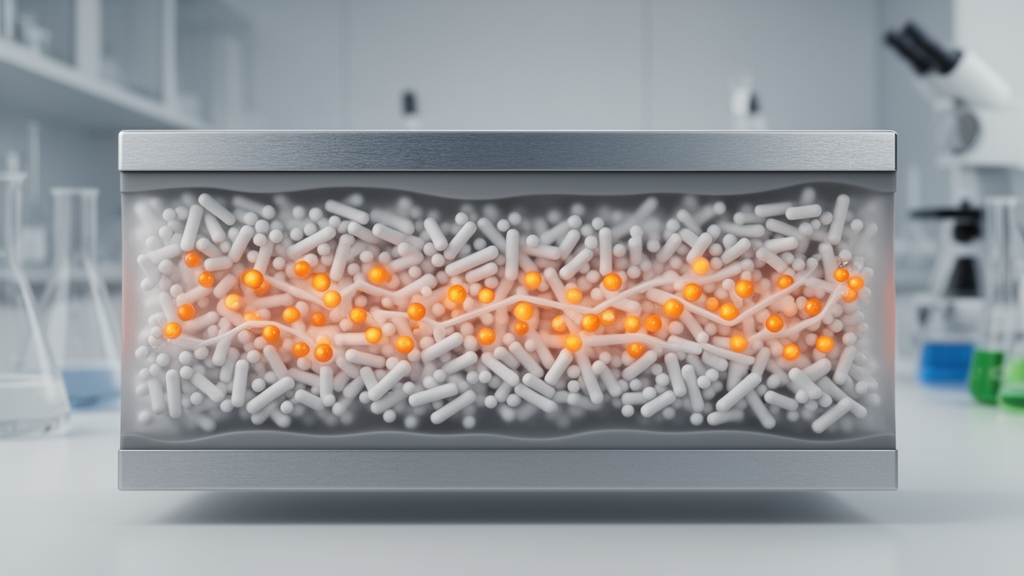
Lithium-ion batteries have transformed modern life, but their liquid electrolytes remain the weak link in an otherwise remarkable technology. These flammable organic solvents sit at the heart of every smartphone, laptop and electric vehicle, and when they fail, they can fail catastrophically. A review published in the journal Ionics by researchers at Peter the Great St. Petersburg Polytechnic University argues that a middle path between liquid and fully solid electrolytes, known as quasi-solid polymer electrolytes, may offer the best route to batteries that are simultaneously safe, powerful and durable. The key, the authors contend, lies not in the polymer itself but in the microscopic inorganic particles dispersed within it.
Quasi-solid polymer electrolytes occupy a strategic position in battery design. Conventional liquid electrolytes conduct lithium ions quickly and wet electrode surfaces efficiently, but they leak, evaporate and burn. Fully solid-state electrolytes eliminate these hazards, yet they struggle with brittle mechanical behaviour, poor contact with electrodes and stubbornly low ionic conductivity at room temperature. Quasi-solid systems blend a polymer matrix with a small quantity of liquid or plasticising component, capturing much of the ionic mobility of a liquid while retaining the mechanical integrity and processability of a solid. The concept is not new; polymer electrolytes have been studied since the early 1980s, and nanocomposite approaches date back to landmark work in the late 1990s showing that ceramic nanoparticles could dramatically improve polymer electrolyte performance.
The central difficulty, as the review by Alexander Pavlovskii and colleagues makes clear, is that no single electrolyte material excels at everything. A practical electrolyte must conduct lithium ions rapidly, block electrons, withstand high voltages, resist dendrite penetration, remain mechanically robust and, crucially, form stable interfaces with both the anode and the cathode. These requirements frequently pull in opposite directions. Polymers such as poly(ethylene oxide), or PEO, are flexible and easy to process but conduct ions poorly at room temperature and oxidise above roughly four volts. Fluorinated polymers such as poly(vinylidene fluoride-co-hexafluoropropylene) offer better electrochemical stability but depend heavily on the liquid trapped in their pores. Gel polymer electrolytes based on polyacrylonitrile, polycarbonates and cellulose each bring their own trade-offs between conductivity, stability and sustainability.
This is where inorganic fillers enter the picture. The review organises the field’s filler strategies into several families: inert oxide ceramics such as silica, alumina, titania and zirconia; lithium-ion-conducting ceramics such as garnet-structured LLZO and NASICON-type LATP; and more exotic porous frameworks including metal-organic frameworks and covalent organic frameworks. Inert oxides do not conduct lithium ions themselves, yet decades of evidence show they can substantially raise conductivity and improve cycling. The classical explanation invokes Lewis acid-base interactions: surface hydroxyl and metal centres on the ceramic compete with lithium ions for coordination with the polymer chains and the salt anions, loosening the polymer structure, promoting segmental motion and freeing more charge carriers to move. Computational studies have recently added nuance, suggesting that silica nanoparticles can also create favourable percolating pathways for lithium transport along polymer-filler interfaces.
Lithium-ion-conducting ceramics go a step further by acting as genuine fast-ion conduits embedded in the polymer. Garnet-type Li7La3Zr2O12 and its tantalum-doped variants boast bulk conductivities that rival liquids, and when distributed as particles, fibres or three-dimensional frameworks within a polymer matrix, they provide continuous highways for lithium ions. Recent work highlighted in the review shows that the garnet surface chemistry matters enormously: lithium-rich surfaces can trap anions and raise the transference number, meaning a larger fraction of the total current is carried by lithium ions rather than counterions, while fluorinated surface treatments such as fluoroethylene carbonate modification improve wettability against lithium metal and suppress parasitic reactions. Three-dimensional garnet frameworks infiltrated with in-situ polymerised monomers represent one of the most sophisticated versions of this strategy, combining ceramic-level conductivity with intimate electrode contact.
Metal-organic frameworks and covalent organic frameworks are the newcomers. These crystalline, porous materials offer tunable pore chemistry at the atomic scale. Cationic covalent organic framework nanosheets, first reported as fast lithium-ion conductors in 2018, provide ordered one-dimensional channels through which ions migrate, and functionalised variants such as lanthanum-decorated ZIF-8 have been shown to enhance quasi-solid electrolyte performance. Because their pore surfaces can be designed to anchor anions, expose lithium-binding sites or catalyse beneficial decomposition reactions, these frameworks act less like passive fillers and more like programmable interfacial machinery. The review treats them as a frontier direction, noting that cost and scalability remain open questions.
Perhaps the most consequential theme of the review is interfacial chemistry, specifically the formation of the solid electrolyte interphase on the anode and the cathode electrolyte interphase on the cathode. These nanometre-thin layers, formed by electrolyte decomposition during the first charge cycles, determine whether a battery lives or dies. A good interphase conducts lithium ions, blocks electrons and stops growing; a bad one consumes active lithium, impedes ion flow and allows dendrites to nucleate. The authors emphasise that inorganic fillers reshape both layers. Ceramic surfaces can nucleate inorganic-rich interphases composed of lithium fluoride, lithium oxide and lithium carbonate species, which are mechanically strong and electrochemically stable. Fillers can also locally concentrate lithium ions at the electrode surface, homogenising the flux and delaying dendrite initiation, a mechanism implicated in the dendrite-free cycling achieved by several sandwich-structured and multilayer quasi-solid designs.
On the cathode side, the challenges are different but equally severe. High-voltage nickel-rich layered oxides release reactive oxygen and dissolve transition metals, which migrate to the anode and poison it. Conventional PEO-based electrolytes oxidise at these potentials, and recent theoretical work has mapped the degradation pathways and predicted cathode electrolyte interphase components. The review describes how tailored fillers and layered electrolyte architectures, including quasi-double-layer designs with adjustable interphases, can buffer the cathode surface, scavenge harmful species and extend the practical voltage window. Strong Lewis-acid coordinated polymer systems have even demonstrated compatibility with 4.8-volt cathodes in all-solid-state cells delivering over 580 watt-hours per kilogram, a figure that rivals or exceeds the best liquid-electrolyte cells.
The authors are careful to frame these advances against the remaining obstacles. Scalable fabrication is the elephant in the laboratory: many of the highest-performing composite electrolytes rely on intricate in-situ polymerisation, electrospinning or framework synthesis that would be difficult to translate to gigafactory roll-to-roll processing. Advanced operando characterisation is needed to watch interphases form and evolve in real cells rather than inferring them from post-mortem analysis. The review also points to data-driven electrolyte optimisation, in which machine learning navigates the vast compositional space of polymers, salts, solvents and fillers far faster than trial-and-error experimentation. Sustainability concerns appear as well, with recent demonstrations of PFAS-free quasi-solid electrolytes and fluorine-free formulations that form lithium-oxide-rich interphases signalling a push toward greener chemistry.
What emerges from the survey is a coherent design philosophy rather than a single breakthrough material. The performance of a quasi-solid polymer electrolyte is not dictated by any one component but by the engineered interplay between polymer chemistry, filler identity, filler surface treatment and the resulting electrode-electrolyte interphases. Rational filler selection, the authors conclude, is as important as the polymer matrix itself, and interface engineering is the lever that converts good materials into practical batteries. With the International Energy Agency projecting continued rapid growth in electric vehicle adoption and safety standards such as IEC 62660-3 tightening requirements for automotive cells, the incentive to commercialise non-flammable, high-performance electrolytes has never been stronger. Quasi-solid polymer electrolytes, armed with intelligently chosen inorganic fillers, may be the architecture that finally delivers it.
Subject of Research: Roles of inorganic fillers in quasi-solid polymer electrolytes for lithium-ion batteries
Article Title: Interfacial chemistry and hybrid phase engineering in quasi-solid polymer electrolytes: roles of inorganic fillers in advanced lithium-ion batteries
Article References: Pavlovskii, A. A., Pushnitsa, K., Kosenko, A., Novikov, P., & Popovich, A. A. (2026). Interfacial chemistry and hybrid phase engineering in quasi-solid polymer electrolytes: roles of inorganic fillers in advanced lithium-ion batteries. Ionics. https://doi.org/10.1007/s11581-026-07488-x
Image Credits: AI Generated
DOI: 10.1007/s11581-026-07488-x
Keywords: quasi-solid polymer electrolytes, lithium-ion batteries, inorganic fillers, solid electrolyte interphase, cathode electrolyte interphase, garnet ceramics, metal-organic frameworks, covalent organic frameworks, interface engineering, hybrid materials, solid-state batteries, ionic conductivity
News Source: Denise Maddox. (October 9, 2026). Tiny Ceramic Fillers Could Crack the Biggest Problem in Solid-State Batteries. Scienmag.