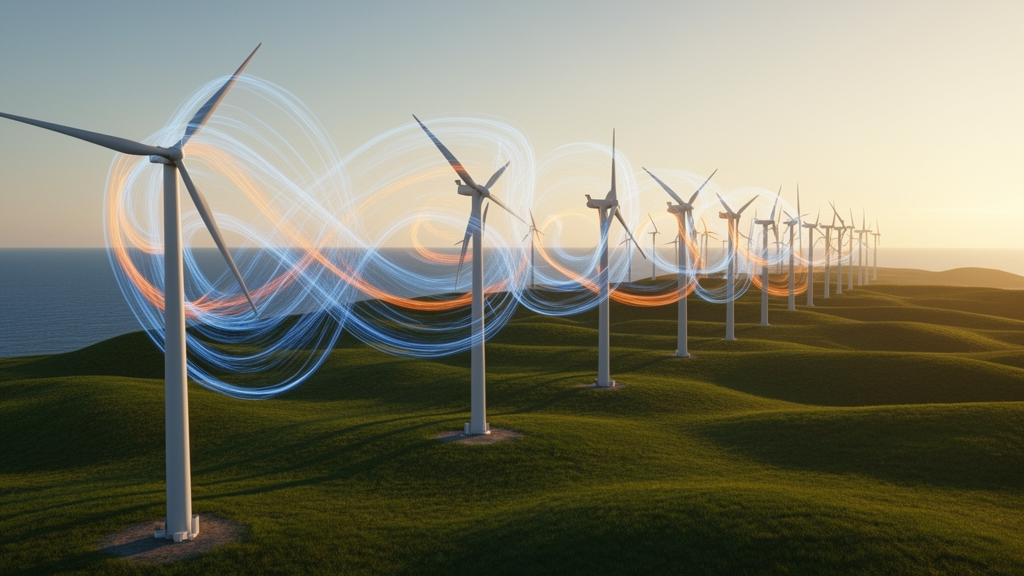
Every wind turbine leaves behind a trail of slower, more turbulent air, and how those trails interact can make or break the output of an entire wind farm. Predicting them accurately has long forced engineers into a painful trade-off: ultra-realistic simulations that take enormous supercomputing resources, or fast engineering models that gloss over the messy physics of the real atmosphere. A team led by Lawrence Cheung of Sandia National Laboratories, publishing in the journal Wind Energy Science, now reports a middle path. Their new tool, called SANDWake3D, captures the full three-dimensional complexity of turbine wakes under realistic atmospheric conditions while running in minutes on a single computer processor rather than days on thousands of graphics cards.
The problem the researchers set out to solve is rooted in the atmosphere itself. Wind does not blow uniformly across the height of a turbine rotor. Near the surface, friction slows the flow, producing wind shear, a gradient of speed from the bottom of the rotor disk to the top. The wind direction also rotates with height, a phenomenon known as veer, driven in part by the Coriolis force from Earth’s rotation. On top of that, thermal stratification, the vertical layering of temperature in the atmospheric boundary layer, changes how turbulence mixes momentum into the wake. When wakes from multiple turbines overlap downwind, all of these effects compound, and the semi-empirical models that dominate industrial wind farm design struggle to keep up.
Traditional engineering wake models, from the classic Jensen model of the 1980s to modern empirical Gaussian formulations, assume an analytical shape for the wake deficit and calibrate free parameters to match observations. They are fast enough to evaluate tens or hundreds of thousands of layout and control scenarios during wind farm optimization, which is exactly what their users need. But they typically handle shear and veer through corrections rather than physics, and consistently representing interacting wakes or wake-added turbulence remains an open question. At the other extreme, large-eddy simulations, or LES, resolve the turbulent eddies of the atmosphere directly and capture all of these behaviors faithfully, yet their computational expense rules them out for design work.
SANDWake3D takes a third approach rooted in a decades-old idea. Instead of solving the full elliptic equations of fluid motion, which allow information to propagate in all directions and require iterative global solutions, the team parabolized the Reynolds-averaged Navier-Stokes equations. By assuming that second-order derivatives in the streamwise direction are small compared with those in the lateral and vertical directions, the governing equations become parabolic: the solution can be marched downstream, plane by plane, starting from a known inflow profile. The formulation uses a k-epsilon turbulence closure, a workhorse model chosen because it has previously been shown to handle stratified atmospheric boundary layers, and it includes a Boussinesq treatment of buoyancy, Coriolis forces, and a pressure Poisson equation reformulated as a diffusion problem in artificial time so that the same marching algorithm can solve it.
The efficiency of the scheme comes from an alternating-direction implicit method, which splits the lateral and vertical differencing into two half-steps that each reduce to a tri-diagonal matrix solve. This implicit structure permits relatively large streamwise steps, and the whole three-dimensional solution for velocity, temperature, turbulent kinetic energy, dissipation, and pressure advances quickly. For a single-turbine case using the 15-megawatt IEA reference turbine, with a grid of 81 by 41 points and 10-meter mesh spacing, a simulation took between 10 and 25 seconds on one Intel Xeon processor. Turbines enter the equations as actuator disk body forces, initially with a uniformly loaded disk model and later with a more sophisticated Joukowski constant-circulation model that captures swirl and near-wake effects.
Because the parabolic formulation discards some standard model constants, the team calibrated the k-epsilon coefficients against high-fidelity LES data produced with the Kynema-SGF solver, a massively parallel adaptive-mesh code run on the Frontier exascale supercomputer. The calibration compared rotor-plane velocities four and six rotor diameters downstream, minimizing the difference between LES and RANS using the L-BFGS-B optimization algorithm. The resulting coefficients, including a turbulent viscosity constant of 0.076, were then tested against cases not used in calibration. The atmospheric scenarios came from floating-buoy lidar measurements near the coast of the New York Bight, representing low-turbulence, stably stratified offshore conditions at two wind speeds, both with pronounced shear and veer.
The validation results are striking. For single-turbine wakes, SANDWake3D reproduced the wake stretching and skewing caused by veer, effects that axisymmetric and Gaussian engineering models cannot represent at all. In the medium-wind-speed case, both the LES and the new RANS model showed that wake deficits persist much farther downstream at lower elevations than at higher ones, a signature of veer interacting with the wake. The modeled turbulent kinetic energy, though not part of the calibration, agreed qualitatively with the resolved turbulence of the LES, aligning with the shear regions around the wake. A convectively unstable onshore case with the NREL 5-megawatt turbine, tested with the same coefficients, also matched the LES wake evolution well.
The real test for any wake model is whether it handles overlapping wakes, and here the parabolic approach shines. In a two-turbine configuration with the second machine five diameters downstream, SANDWake3D captured the wake superposition and the corresponding increase in wake-added turbulence without any recalibration. The team then simulated a nine-turbine, three-row wind farm with turbines spaced five diameters apart in both directions. The LES for that case consumed roughly 86,400 GPU-hours on Frontier; the RANS calculation needed about four CPU-minutes on a domain of roughly four kilometers by four kilometers. Despite the staggering difference in cost, the wake deficits, skewing, and turbulence distributions across all three rows tracked the high-fidelity results closely.
The implications for wind energy are considerable. Wake losses can siphon off a substantial fraction of a wind farm’s potential output, and optimizing layouts, yaw-based wake steering, and active wake-mixing strategies requires evaluating enormous numbers of flow scenarios. A solver that runs in seconds yet retains the physics of shear, veer, stratification, and wake interaction occupies a sweet spot between FLORIS-style engineering tools and exascale LES. The authors note limitations: the parabolic formulation cannot capture upstream blockage effects from turbine induction, the current implementation is serial, and the model is calibrated so far for stable conditions using Monin-Obukhov inflow profiles, which excludes phenomena like low-level jets. But they outline a clear path forward, including parallelization, coupling to turbine controllers, superposed induction fields, and calibration across a wider range of atmospheric states. If those extensions pan out, SANDWake3D could become a standard engine inside the optimization loops that shape the next generation of offshore wind farms.
Subject of Research: A three-dimensional parabolic RANS wake model for wind turbines in stratified atmospheric boundary layers
Article Title: SANDWake3D: a 3D parabolic RANS solver for atmospheric surface layers and turbine wakes
Article References: Cheung, L., Mohan, P., Henry de Frahan, M. T., Yalla, G. R., Hsieh, A., Brown, K., deVelder, N., Kaufman-Martin, S., Day, M., & Sprague, M. (2026). SANDWake3D: a 3D parabolic RANS solver for atmospheric surface layers and turbine wakes. Wind Energy Science, 11(9), 3719-3743. https://doi.org/10.5194/wes-11-3719-2026
Image Credits: AI Generated
Keywords: wind energy, turbine wakes, RANS modeling, atmospheric boundary layer, wind shear, wind veer, large-eddy simulation, wake superposition, wind farm optimization, k-epsilon turbulence model, actuator disk model, computational fluid dynamics
News Source: Alan Morgan. (October 9, 2026). New 3D Wake Solver Promises Faster, More Accurate Wind Farm Design. Scienmag.