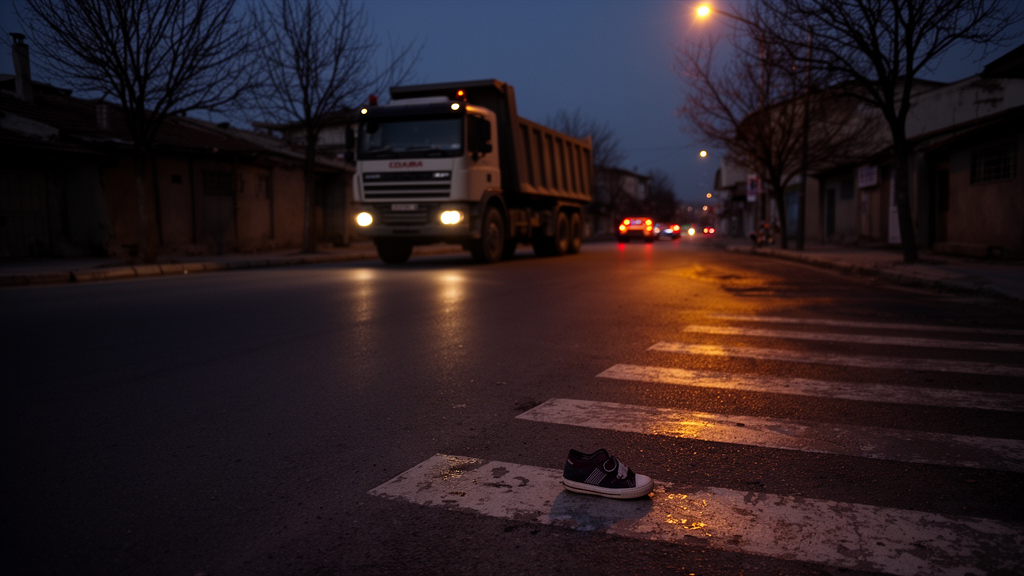
Every year, thousands of children in Türkiye are struck by vehicles while walking, and a new national analysis has now mapped, with unusual statistical precision, the circumstances that turn an ordinary traffic collision into a fatal one. Drawing on police records covering 31,499 pedestrians aged 14 or younger who were involved in injury or fatal crashes between 2021 and 2023, researchers from Gazi University and the Turkish National Police have identified the demographic, road, vehicle, environmental and driver-related factors most strongly associated with two related but distinct outcomes: whether a crash involved at least one death within 30 days, and whether the child pedestrian recorded in the file themselves died within that window. The study, published in BMC Pediatrics, offers one of the most comprehensive pictures to date of the system-level conditions surrounding child pedestrian fatalities in a middle-income country.
The scale of the dataset is what gives the findings their power. Rather than relying on a single city or a sample of hospital admissions, the team analyzed the full national corpus of police-reported crashes involving child pedestrians over three consecutive years. Out of those 31,499 records, 507 were linked to crashes in which at least one person died within 30 days, and 420 records represented children who themselves died within 30 days of the collision. That distinction matters more than it might first appear. A crash that kills someone is not necessarily a crash that kills the child pedestrian in the record; the victim could be a driver, a passenger, or another road user. By modeling both outcomes separately, the researchers could ask two complementary questions: what makes a crash severe, and what makes a particular child’s own outcome fatal?
The answer to both questions points, above all, to heavy vehicles. When the researchers ran prespecified multivariable logistic regressions adjusting for other factors, involvement of a heavy vehicle was associated with an odds ratio of 8.25 for fatal-crash involvement, with a 95 percent confidence interval of 5.45 to 12.48. In the child-mortality model, the corresponding odds ratio was 7.14. In plain terms, a child pedestrian struck in a crash involving a heavy vehicle was roughly seven to eight times more likely to be part of a deadly event than a child in a comparable crash without one. The physics is unforgiving: a large truck or heavy goods vehicle carries enormous kinetic energy at ordinary speeds, its front geometry tends to strike a child’s head and torso rather than legs, and its elevated cab can push a small body under the wheels rather than over the hood.
Speed-related driver fault, as coded by police, was the second dominant signal. Crashes in which officers attributed speed-related fault to a driver carried an odds ratio of 3.56 for fatal-crash involvement and 3.32 for the child’s own 30-day mortality. The confidence intervals, ranging from roughly 2.9 to 4.4, indicate a robust and consistent association across both outcome definitions. This aligns with decades of biomechanical research showing that the probability of a pedestrian’s death rises steeply with impact velocity. At 30 kilometers per hour, an adult pedestrian’s chance of dying is low; by 80 kilometers per hour, it approaches certainty. Children are more vulnerable still, because their shorter stature places their center of mass below typical hood lines and their smaller bodies absorb proportionally more energy per kilogram of tissue.
Road hierarchy emerged as a third pillar of risk. Crashes on major or higher-order roads were associated with an odds ratio of 3.60 for fatal-crash involvement and 3.52 for child mortality, while buses and minibuses carried an odds ratio of 3.09 in the fatal-crash model. Locations outside built-up areas doubled the odds of fatal-crash involvement, at 2.25, and nighttime conditions raised them by roughly 90 percent, at 1.90. Each of these factors tells a coherent story about exposure and energy. Major roads carry faster traffic and mix pedestrians with high-speed flows; rural and out-of-town settings combine higher speeds with longer emergency response times and less lighting; darkness reduces both driver detection distance and a child’s ability to judge approaching vehicles.
What makes the study methodologically interesting is the near-concordance between the two models. The fatal-crash involvement model, which captures the severity context of the entire collision, and the child-mortality model, which isolates the recorded child’s own outcome, produced broadly similar patterns across vehicle type, road class, speed fault, location and lighting. This consistency suggests that the same system-level conditions that make crashes severe in general are the ones that kill child pedestrians specifically. It also strengthens the case that the findings are not artifacts of a particular outcome definition or coding quirk. The researchers performed sensitivity analyses using alternative model specifications, and the core associations held.
The authors are careful, and rightly so, about what the numbers cannot say. Police-coded driver fault variables, including the speed-fault category, are recorded by officers at the scene and reflect administrative judgment as much as physical measurement. A police attribution of speed fault may correlate with actual impact speed, but it may also correlate with other unmeasured features of the crash, the driver, or the investigation itself. The study is retrospective and observational, so causal interpretation should be avoided, particularly for the fault variables. A heavy vehicle’s presence in a fatal crash, for instance, may partly reflect the routes such vehicles travel and the exposure of children along those routes, not only the vehicle’s destructive potential in a given impact.
Even with those caveats, the policy implications are hard to ignore, because they map directly onto the Safe System approach that the World Health Organization promotes and that Sweden pioneered under the name Vision Zero. Safe System thinking holds that road deaths are not primarily the product of individual carelessness but of a transport system that permits human error to coincide with lethal energy. The Turkish findings identify precisely where that coincidence occurs for children: where heavy vehicles and buses share space with young pedestrians, where major roads lack protected crossings, where speeds exceed survivable impact thresholds, and where darkness strips away the margins of perception. Countermeasures follow naturally. Lower speed limits around schools and residential zones, physically separated crossings on arterial roads, side-underrun guards and improved direct vision on trucks, lighting upgrades at known crossing points, and routing of heavy traffic away from child-dense corridors all address the specific risk factors the data isolate.
The study also fills an important gap in the global evidence base. Most detailed pedestrian fatality analyses come from high-income countries with mature data systems, yet the burden of child road deaths falls disproportionately on low- and middle-income countries. Türkiye’s national police crash registry, covering three years and more than thirty thousand child pedestrian records, demonstrates that administrative data collected for enforcement purposes can be repurposed for rigorous epidemiology. The researchers received the de-identified records under official institutional permission, no personal identifiers were involved, and no external funding supported the work. The team, led by Seda Hatipoğlu of Gazi University’s Department of Traffic Planning and Implementation, together with Tuğba Soy of the Turkish National Police and Ömer Asal of Gazi University’s Department of Manufacturing Engineering, spans the disciplines the problem demands: traffic engineering, enforcement data, and engineering analysis.
For the families behind the 420 child deaths in the dataset, the statistics will offer no comfort. But for the engineers, planners and policymakers responsible for the next decade of road design, the message is unusually clear and unusually well quantified. A child walking home at night, on a major road, outside a built-up area, in the path of a speeding truck, faces odds measured in multiples, not percentages, of a fatal outcome. Every one of those conditions is a design choice that a society has made and can remake. The study does not prove that changing any single factor will save a specific child’s life, but it shows with national-scale precision where the lethal energy in the system concentrates, and that is exactly where prevention should begin.
Subject of Research: System-level risk factors for fatal crashes and 30-day mortality among child pedestrians in Türkiye
Article Title: System-level factors associated with fatal-crash involvement and 30-day mortality among child pedestrians in Türkiye: a national retrospective study
Article References: Hatipoğlu, S., Soy, T., & Asal, Ö. (2026). System-level factors associated with fatal-crash involvement and 30-day mortality among child pedestrians in Türkiye: a national retrospective study. BMC Pediatrics. https://doi.org/10.1186/s12887-026-07827-x
Image Credits: AI Generated
DOI: 10.1186/s12887-026-07827-x
Keywords: child pedestrian safety, road traffic crashes, fatal-crash involvement, child mortality, heavy vehicles, speeding, Safe System, injury epidemiology, logistic regression, administrative crash records, Türkiye, road safety policy
News Source: Ophelia Keating. (October 9, 2026). Heavy Vehicles, Speed and Dark Roads Drive Deadly Child Pedestrian Crashes in Türkiye. Scienmag.