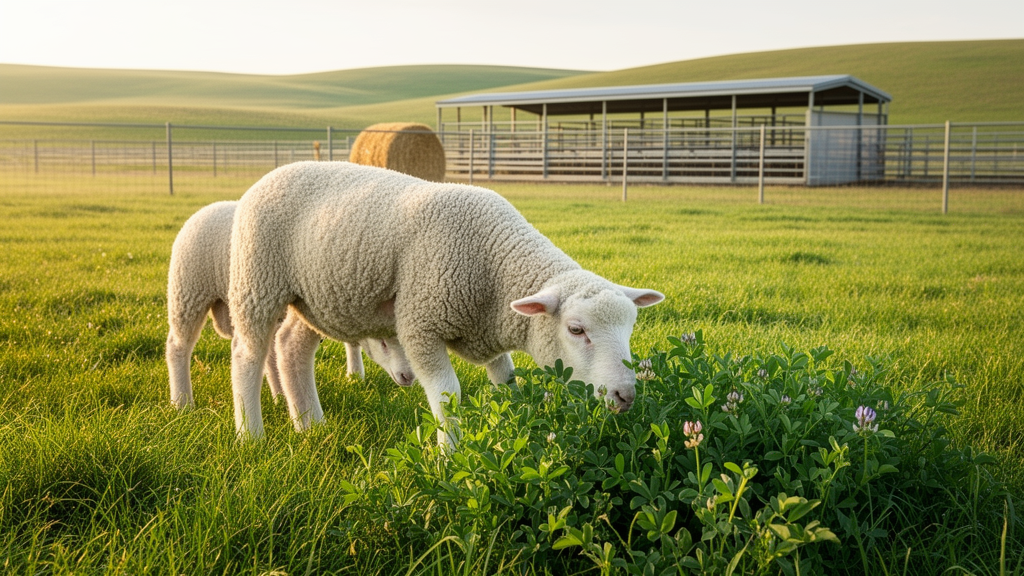
In the hills of northern Tunisia, a team of animal scientists has put a long-standing question in sustainable sheep farming to a rigorous test: can a modest daily dose of tannin-rich acacia foliage make lambs grow better, produce heavier carcasses, and yield tastier meat? The answer, published in Archives Animal Breeding by Yathreb Yagoubi and colleagues at the National Institute of Agronomic Research of Tunisia and the University of Jendouba, is more nuanced than a simple yes or no. Over a 60-day feeding trial, the fate of the tannin supplement depended almost entirely on what else the lambs were eating. For animals raised indoors on hay and concentrate, a small ration of Acacia cyanophylla foliage nudged growth upward. For lambs grazing on fresh vetch pasture, the same supplement tended to do the opposite. The one result that held firm across every treatment was that pasture itself was the most powerful driver of performance.
The experiment took place at the Lafareg research farm in Beja, a sub-humid zone receiving around 558 millimeters of rain annually. Twenty-eight five-month-old fat-tailed Barbarine ram lambs, weighing on average 22.5 kilograms, were divided into four groups of seven, balanced by body weight. Two groups were housed in stalls and fed 400 grams of concentrate per day with oat hay available freely. The other two groups rotationally grazed a cultivated vetch pasture, receiving the same daily concentrate allowance. Within each system, one group received an extra 100 grams of acacia foliage per head per day, offered an hour before the main feed, while the other received none. The acacia is a tannin-rich legume widespread in Tunisia, containing roughly 60 grams of condensed tannins per kilogram of dry matter, and it was chosen as a natural alternative to the antibiotic growth promoters that have been banned in many regions over concerns about toxic residues in meat.
The chemical analysis of the feeds explains much of what followed. The fresh vetch grass contained 21.9 percent crude protein, more than three times the 6.7 percent found in the hay offered indoors. The concentrate supplied 16.2 percent protein, and the acacia itself 12.6 percent. Because grazing lambs could harvest this protein-dense forage directly, their total dry matter intake reached 1,342 to 1,442 grams per day, compared with only 839 to 960 grams for the stall-fed animals. Grazing lambs derived about 70 percent of their intake from forage, eating nearly a kilogram of vetch daily, while stall-fed lambs drew 47 percent of their ration from concentrate and consumed less than half as much forage as their pastured counterparts.
Growth told the same story in striking numbers. Lambs on pasture gained an average of 180 grams per day, while stall-fed lambs gained 141 grams. The extremes were even more revealing: the fastest-growing group was pasture-fed lambs without acacia, at 192 grams per day, and the slowest was stall-fed lambs without acacia, at 110 grams. The statistical interaction between feeding system and tannin supply was significant, meaning the effect of the supplement could not be judged in isolation from the basal diet. Indoors, where nitrogen arrived as true protein in hay and concentrate, the tannins appeared to offer a slight benefit, consistent with the well-documented ability of condensed tannins at low doses to bind dietary protein in the rumen and protect it from degradation, thereby increasing the flow of amino acids to the small intestine.
On pasture, however, the chemistry worked differently. The nitrogen in fresh vetch is largely in soluble form, which tannins cannot bind in the same protective way, and the vetch biomass itself already carries measurable tannins, averaging around 360 milligrams of catechin equivalents per kilogram of dry matter. Adding acacia on top of this tannin-bearing forage apparently pushed total tannin intake toward a range where the compounds begin to work against the animal, suppressing feed intake, rumen microbial activity, and digestive enzyme function. The authors note that previous work has shown low to moderate tannin inclusion can be neutral or beneficial, while larger amounts reduce nutrient digestibility and growth. The lesson is that tannins are not a simple additive but a dietary variable whose consequences hinge on context.
At slaughter, the pasture advantage carried through to the carcass. Grazing lambs were heavier at slaughter, had higher empty body weights, and produced both heavier hot and cold carcasses. Their commercial dressing percentage averaged 45.8 percent against 40.5 percent for stall-fed lambs. The non-carcass components also reflected the different lives the animals had led: grazing lambs developed larger red organs, including heart, liver, and lungs, and heavier kidneys, a pattern the authors attribute to the greater physical activity of animals ranging over pasture. Testis weight was higher in both pasture groups and in the tannin-supplemented stall group compared with unsupplemented stall-fed lambs, while gut weights were similar across all treatments.
Within the carcass itself, the feeding system shaped the proportions of most commercial joints, including the leg, shoulder, loin, breast, and, notably, the signature fat tail of the Barbarine breed. Pastured lambs carried tails averaging 950 grams, about 6.05 percent of carcass weight, compared with 615 grams and 4.7 percent in stalled lambs. Muscle proportions were highest in unsupplemented stall-fed lambs, while fat deposition was greater in both pasture groups and in tannin-supplemented stall lambs, an outcome that runs counter to earlier studies in which grazing animals, burning more energy on movement, laid down less fat. Across all groups, the leg and shoulder together accounted for roughly 34 percent and 20 percent of the tailed carcass, supporting the principle of anatomic harmony, the idea that joint proportions remain consistent within a breed regardless of rearing conditions.
Perhaps the most commercially reassuring finding concerned the meat itself. Neither the feeding system nor the acacia supplement produced meaningful differences in pH measured one hour and 24 hours after slaughter, in water loss during cooking, in color coordinates of lightness, redness, and yellowness, or in the chemical composition of the longissimus dorsi muscle, including dry matter, ash, protein, and intramuscular fat. Lightness values averaged 43.5 across all groups, comfortably above the threshold of 34 at or above which meat is deemed acceptable by 95 percent of consumers. Trained panelists who roasted samples from each group and scored tenderness, juiciness, flavor, and overall acceptability on nine-point scales found the meat moderately tender, between 5.7 and 6, and moderately juicy, between 5.1 and 5.8, with no distinctive off-flavors and no differences among treatments. Every sample was judged acceptable.
The broader significance of the study lies in its demonstration that natural feed additives cannot be evaluated in a vacuum. Condensed tannins have attracted intense interest as antioxidants, antimicrobials, and rumen-protective compounds that could replace banned growth promoters, but their biological activity is a double-edged sword, beneficial at low doses and detrimental at high ones. This trial shows that the dose that matters is the total dose delivered by the whole diet, not just the supplement spooned out on top. A hundred grams of acacia that gently shields protein in a hay-based ration becomes an excess burden when the lambs are already browsing tannin-bearing vetch. For producers of fat-tailed breeds like the Barbarine, the practical takeaways are twofold: well-managed grazing on protein-rich cultivated pasture remains the most effective route to faster growth and heavier carcasses, and tannin supplementation should be matched carefully to the basal forage. The authors call for further research to define optimal inclusion levels and dose-response relationships under different feeding conditions, work that will help determine whether tannin-rich foliage can take its place as a reliable tool in sustainable, antibiotic-free lamb production.
Subject of Research: Effects of Acacia cyanophylla condensed tannin supplementation and grazing versus feedlot feeding on growth, carcass traits, and meat quality of Barbarine lambs
Article Title: Effects of Acacia cyanophylla-condensed tannin supply on growth performance, carcass characteristics and meat quality of fat-tailed Barbarine lambs studied under grazing conditions or in a feedlot
Article References: Yagoubi, Y., Atti, N., Smeti, S., Abidi, J., & Mahouachi, M. (2026). Effects of Acacia cyanophylla -condensed tannin supply on growth performance, carcass characteristics and meat quality of fat-tailed Barbarine lambs studied under grazing conditions or in a feedlot. Archives Animal Breeding, 69(3), 495-505. https://doi.org/10.5194/aab-69-495-2026
Image Credits: AI Generated
Keywords: Barbarine lambs, Acacia cyanophylla, condensed tannins, grazing, feedlot, carcass quality, meat quality, sheep nutrition, sustainable livestock, vetch pasture, animal growth, Tunisia
News Source: Daisy Hatcher. (October 9, 2026). Pasture Beats Feedlot for Lamb Growth, but Tannin Effects Depend on the Base Diet. Scienmag.