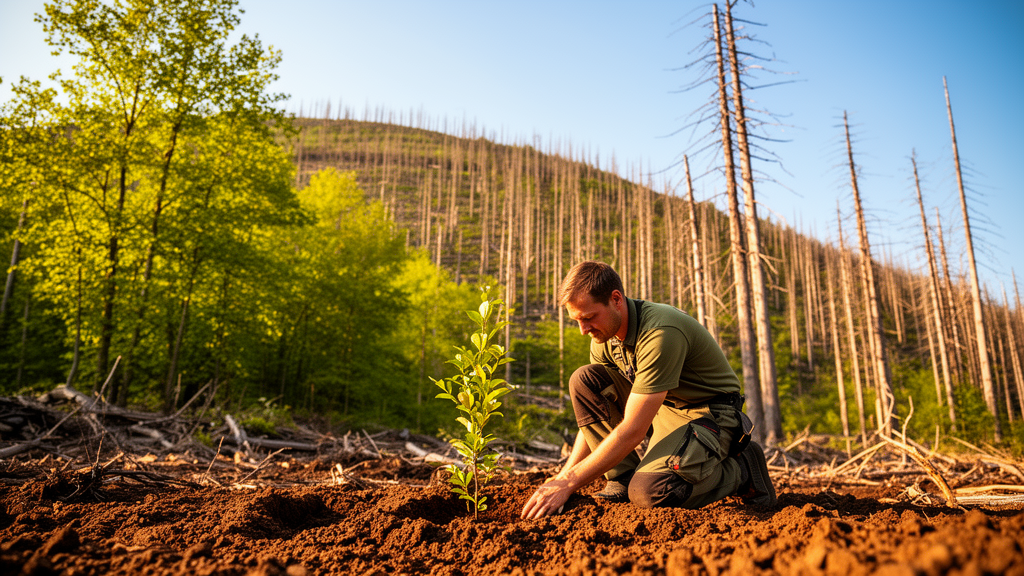
The summer of 2026 delivered a stark demonstration of what climate change means for the temperate forests of Europe. An early heatwave in May pushed temperatures in France and Portugal to record levels for the month, and by midsummer several European countries had registered all-time highs. The heat arrived alongside a precipitation deficit so severe that England recorded its driest July on record. The consequences were visible from the ground and from orbit: wildfires across Europe burned more than twice the long-term average area, and forests that had already been weakened by successive drought years showed the strain. For ecologists and forest managers, the message is difficult to ignore. The conditions that once counted as exceptional are becoming routine, and the tree species that dominate European woodlands were not selected, planted, or managed with this future in mind.
Germany offers a particularly instructive case study, because its forests have been under sustained pressure since 2018. Extreme weather events in the country have grown steadily worse, and they now push forest ecosystems beyond their tolerance limits with increasing regularity. Older trees, which established under the more moderate climatic conditions of previous decades, are especially vulnerable. Stressed and dehydrated, they become easy targets for pests such as bark beetles, whose outbreaks have devastated conifer stands across central Europe. By contrast, younger trees of species such as hornbeam, maple, wild cherry and service tree have proven markedly more resilient. These are species with a particular cultural and management history: for centuries they were cultivated as coppices, cut periodically to supply firewood for the charcoal that fuelled the historic glass and metal industries.
That history matters more than it might first appear. Once fossil fuels replaced charcoal in industry, the traditional coppice systems were progressively abandoned and replaced by high timber forests, within which the fast-growing Norway spruce became a favourite of foresters. Spruce grows quickly and produces valuable timber, but it demands large quantities of water, roots shallowly, and is acutely susceptible both to drought damage and to bark beetle attack. In other words, the composition of many modern German forests reflects economic priorities of the industrial era rather than the climatic realities of the twenty-first century. The events of recent years suggest that this legacy is now a liability, and that a deliberate, scientifically informed programme of forest engineering is required to rebuild resilience.
One of the most counterintuitive findings in the German data is that total precipitation has actually increased by roughly eight per cent since 1881. Drought damage in the forests is therefore not the result of less rain falling overall. What has changed is the distribution of that rain. More precipitation now falls during warm winters, above the freezing point, while summer rainfall has declined. At the same time, higher average air temperatures drive greater evaporation, and increasingly frequent heavy rain events, combined with growing soil sealing in the landscape, promote surface runoff rather than infiltration. The net effect is drier soils even under a wetter climate. When such conditions combine with an exceptional drought year like 2026, forests can sustain long-term damage from which recovery may take decades, if it occurs at all.
The hydrological role of forests extends far beyond the trees themselves. The forest floor functions as an enormous water reservoir: in a healthy forest, up to two million litres of water can be stored per hectare. This makes forest soils a critical component of groundwater regeneration, the process by which aquifers tapped for agriculture, industry and drinking water are replenished. As rising temperatures accelerate evaporation, forests will become even more important for securing groundwater supplies. Yet the relationship runs in both directions, and this is where the danger lies. Declining groundwater levels can in turn endanger the forests themselves, undermining the very water storage and regeneration capacity that depends on healthy woodland. A vicious cycle threatens to take hold, in which drying forests regenerate less groundwater, and lower groundwater further stresses the forests. Engineering resilient forests is therefore not merely a question of timber productivity; it is a matter of water security for entire regions.
Not all forests perform this hydrological function equally well. Groundwater regeneration capacity differs substantially among forest types, and it is lower beneath coniferous stands than beneath deciduous ones. Afforestation with conifers can actively reduce groundwater recharge, because the dense evergreen canopies enhance evapotranspiration and intercept a larger share of precipitation before it ever reaches the soil. Species composition and local conditions must therefore be weighed carefully in any planting or replanting decision. Two further factors govern the water storage capacity of forest floors: soil density and deadwood. Looser soils and abundant deadwood both support water retention, but exploiting these effects requires careful management, because the same features that store water can conflict with commercial forest use and can elevate fire risk. Balancing these trade-offs is precisely the kind of problem that forest engineering is meant to solve.
Resilience, in the emerging view, cannot be engineered against a single threat. As extreme weather events multiply, forests face damage from wildfires, storms, snow burst and late frost, often in combination, and such damage heightens susceptibility to pest outbreaks that further weaken the stands. The recent record illustrates how monocultures concentrate this risk. The wildfires that swept through Gironde and Landes in July 2026 struck maritime pine monocultures. The destruction caused by storm Johannes in Sweden in December 2025 fell on Norway spruce monocultures. And the bark beetle catastrophe in the Harz forest of Germany, which has unfolded since the severe drought of 2018 and the wildfires of 2022 and 2024, likewise devastated spruce plantations. In each case, a single species planted over large contiguous areas allowed one disturbance to cascade into landscape-scale loss.
Mixed forests, in general, buffer against this kind of cascading failure, because different species respond differently to drought, wind, fire and insects, and a diverse stand is unlikely to lose everything at once. But recent research adds an important caveat: diversity is not automatically beneficial. Studies of tree species composition suggest that the effect of neighbouring tree diversity on growth during drought depends on how long the drought lasts, and can shift from positive to negative as the drought period extends. Mixed forests therefore need to be specifically designed for local conditions, drawing on research into interspecific interactions and the hydraulic traits of the species involved. Which species can share a limited water supply during a months-long drought, and which compete destructively, is a question that only detailed physiological and ecological study can answer.
This is why researchers caution that mixed forests, though likely to expand in the decades ahead, are not a one-size-fits-all solution to climate change. The composition that thrives on a sandy lowland site with shallow groundwater may fail on a rocky upland slope with thin soils. The task facing forest science is to identify, for each combination of local climate, soil and expected disturbance regime, which species combinations produce the most resilient stands. That knowledge must then be translated into practice through planting decisions, thinning regimes, deadwood management and the gradual conversion of vulnerable monocultures. The scale of the challenge is enormous, given the area of forest involved and the speed at which climatic conditions are shifting, but the alternative is passive decline.
What the events of 2025 and 2026 make clear is that the window for gradual adjustment is narrowing. Forests are long-lived organisms, and the trees planted this decade will have to endure the climate of the second half of this century, not the climate in which they germinate. Treating forest composition as something that can be engineered, in the way that agriculture has long been engineered for changing conditions, represents a shift in mindset for a discipline that has often favoured natural regeneration and minimal intervention. The evidence now suggests that intervention, guided by research into water relations, species interactions and disturbance ecology, is the more responsible path. Resilient forests will not emerge by accident from a changing climate; they will have to be built, species by species and site by site, on the basis of the best available science.
Subject of Research: Climate-driven drought and disturbance in temperate forests and the engineering of resilient, locally adapted forest compositions
Article Title: Engineering resilient forests
Article References: Engineering resilient forests. (2026). Nature Plants, 12(9), 1647-1647. https://doi.org/10.1038/s41477-026-02414-5
Image Credits: AI Generated
DOI: 10.1038/s41477-026-02414-5
Keywords: forests, climate change, drought, forest management, bark beetles, wildfires, groundwater, mixed forests, Norway spruce, coppicing, tree diversity, evapotranspiration
News Source: Denise Maddox. (October 8, 2026). Why Europe’s forests need deliberate engineering to survive a hotter, drier climate. Scienmag.