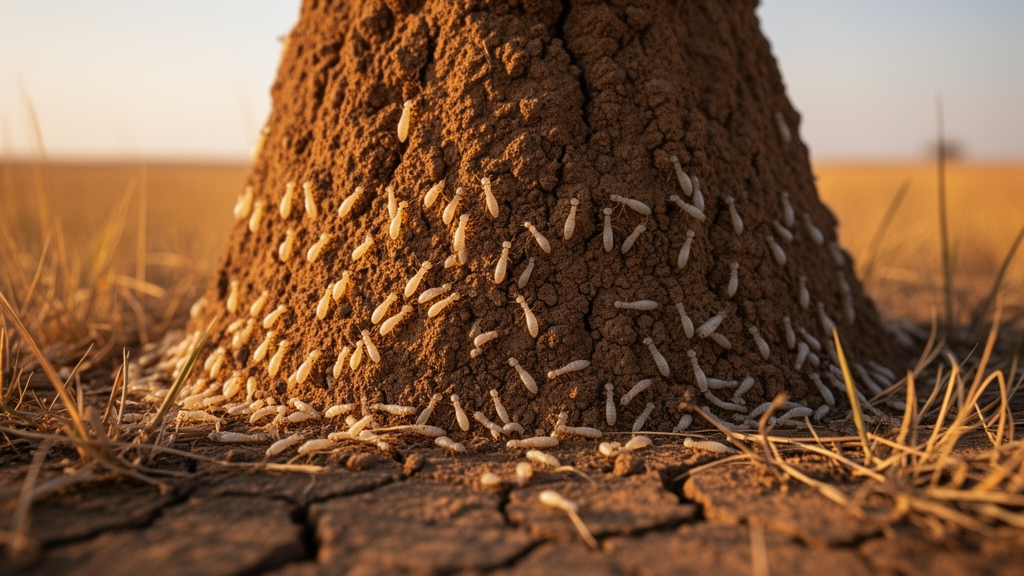
Termites, the wood-devouring insects best known for eating houses, may be far more important to the planet’s carbon budget than any global model has so far acknowledged. A new study published in the journal Biogeosciences presents the first process-based framework for folding termite activity into the soil organic carbon models that underpin Earth system predictions. Led by Umar Farooq of Australia’s CSIRO, an international team of ecologists and modelers shows that these insects process roughly 1,569 teragrams of carbon per year — about three percent of all annual litter inputs worldwide — while releasing carbon dioxide and methane and channeling hundreds of teragrams of carbon into soil pools. The finding challenges a foundational assumption of soil science: that microbes alone govern the fate of dead plant matter.
For decades, mechanistic soil organic carbon models such as MIMICS, Millennial, and MES-C have represented decomposition as an almost exclusively microbial affair. Litter falling to the ground is split into metabolic and structural pools, digested by microbial functional groups, and routed into dissolved carbon, particulate organic carbon, and mineral-associated organic carbon. Termites, despite being among the most abundant detritivores on Earth and occupying roughly 80 million square kilometers of habitat concentrated in the tropics and subtropics, have been entirely absent from these equations. The omission matters because field evidence has long shown that termites dominate deadwood breakdown in tropical forests, with exclusion experiments suggesting they account for 58 to 64 percent of wood decomposition in tropical rainforests.
The new framework extends the MES-C model by adding an explicit coarse woody debris pool and a parallel, termite-mediated decomposition pathway alongside the familiar microbial one. Three feeding guilds are represented: xylophagous termites that consume wood, fungus-growing termites that harvest plant residues through cultivated fungal combs, and soil-feeding termites that process partially decomposed organic matter. Carbon ingested by termites is partitioned among respiratory carbon dioxide, methane production, growth of termite biomass, and excreted residues. Two of those residues — frass, the finely processed and nutrient-rich waste that decomposes quickly, and necromass, the chitin-rich bodies of dead termites that break down more slowly — re-enter the soil as inputs to microbial and mineral-associated carbon pools.
A crucial subtlety in the model is the fate of termite methane. Between 20 and 80 percent of the methane produced inside termite colonies may be oxidized by methanotrophic microbes within mounds and galleries before it ever reaches the atmosphere, making net emissions highly sensitive to mound architecture, colony density, and soil conditions. The module therefore couples termite metabolism directly to microbial methane cycling, allowing methane that is consumed within mounds to still contribute to microbial biomass and carbon dioxide release. This level of mechanistic detail, the authors argue, is what allows termite processes to be represented without breaking the mass balance that global carbon models depend on.
To run the model globally, the team linked termite biomass to ecosystem productivity, using gross primary productivity as a proxy for the resources available to termite colonies. Potential habitat was constrained by a thermal mask that excludes regions where monthly minimum temperatures fall below minus eight degrees Celsius, consistent with observed limits on termite survival. Simulations across global vegetation classes reveal a striking biogeographic pattern. Tropical evergreen forests, with the highest mean termite biomass density of 8.9 grams of carbon per square meter, dominate every flux: they account for 733.4 teragrams of carbon consumed, 404.1 teragrams released as carbon dioxide, and 3.7 teragrams emitted as methane each year. Savannas, with somewhat lower biomass but vast extent, follow close behind.
Globally, the model estimates that termites release 864.7 teragrams of carbon per year as carbon dioxide — equivalent to roughly 3,171 teragrams of carbon dioxide, or about 3.2 to 4.7 percent of total global soil respiration — and 7.9 teragrams of carbon as methane, a figure consistent with the Global Methane Budget’s estimate that termites contribute around 1.8 percent of global methane emissions. At the same time, termites transfer 689.3 teragrams of carbon per year into labile and mineral-associated soil organic carbon pools, with 209.1 teragrams going to the more stable mineral-associated fraction. The carbon dioxide flux should not be read as an extra source on top of microbial respiration, the authors stress; rather, termites redirect a share of decomposition through a faunal route with different climate sensitivities.
That difference in sensitivity is where the climate implications become sharp. Microbial decomposition rates typically rise by a factor of about 2.2 to 4.6 for every ten degrees of warming, but empirical work on termites suggests their feeding and foraging rates can increase several-fold over the same range, corresponding to an effective behavioral temperature sensitivity close to a Q10 of seven. In other words, warming may disproportionately accelerate termite-driven decomposition and trace-gas fluxes. Model-based reconstructions indicate that termite methane emissions already increased during the twentieth century and may continue rising under warming and land-use change, positioning these insects as a potential amplifier of carbon-climate feedbacks in precisely the tropical and seasonally dry regions most vulnerable to climate shifts.
Sensitivity analysis identified which parameters matter most for taming the uncertainty. Termite ingestion capacity and biomass emerged as the dominant controls on flux magnitude, while the partitioning of consumed carbon among respiration, residues, and biomass governs the ultimate fate of processed carbon. Methane-related parameters, by contrast, had comparatively weak effects. Most of the uncertainty in the headline numbers stems from the wide range of ingestion rates reported in the literature, which points directly to the field measurements the authors say are needed next: biome-resolved termite biomass surveys, guild-specific ingestion rates measured under natural conditions, and better constraints on how termites split carbon between gas, waste, and body tissue.
The framework is deliberately minimal, and the authors are candid about its limits. Termite biomass is treated as uniform within grid cells even though colonies create intense local hotspots of consumption and gas exchange; interactions with competing or cooperating free-living microbes are not resolved; and the modeled inputs to mineral-associated carbon represent potential additions rather than guaranteed long-term storage, since mineral surface area and oxide content are not simulated. Evaluation also leans on a single global biomass synthesis from 1996 built on sparse observations. Even so, the consistency of the model’s spatial patterns with known termite biogeography, and the agreement of its flux magnitudes with independent empirical estimates, suggest the dominant controls are plausibly captured.
What the study ultimately offers is a template for a more complete theory of the terrestrial carbon cycle — one that moves beyond the microbe-centric paradigm that has shaped soil modeling for a generation. Because termites process about twelve percent of global coarse woody debris, models that ignore them may misjudge how long woody carbon persists in low-latitude forests, and because their activity peaks in warm, water-limited African savannas where microbial decomposition slows, they may buffer ecosystems against drought in ways current models cannot see. The authors propose that future frameworks aggregate soil fauna by shared substrate use and carbon effects, while keeping termites distinct, since no other faunal group combines massive litter processing with a direct biological source of methane. Embedding these six-legged engineers in next-generation Earth system models, the team concludes, is essential for predicting how the planet’s soils will store — or release — carbon as the climate warms.
Subject of Research: Integrating termite-mediated decomposition into global soil organic carbon and greenhouse gas models
Article Title: Ideas and perspectives: Beyond microbes – integrating termites into global soil carbon cycling models
Article References: Farooq, U., Pasut, C., Wang, Y.-P., Zanne, A. E., Flores-Moreno, H., Wijas, B. J., Forrester, D. I., England, J. R., Macdonald, B., Brown, Z. A., & Karunaratne, S. (2026). Ideas and perspectives: Beyond microbes – integrating termites into global soil carbon cycling models. Biogeosciences, 23(19), 7029-7041. https://doi.org/10.5194/bg-23-7029-2026
Image Credits: AI Generated
Keywords: termites, soil organic carbon, carbon cycle, decomposition, methane, carbon dioxide, tropical ecosystems, savannas, Earth system models, climate feedbacks, biogeosciences, detritivores
News Source: Gavin Prescott. (October 8, 2026). Termites Emerge as Hidden Giants of the Global Carbon Cycle. Scienmag.