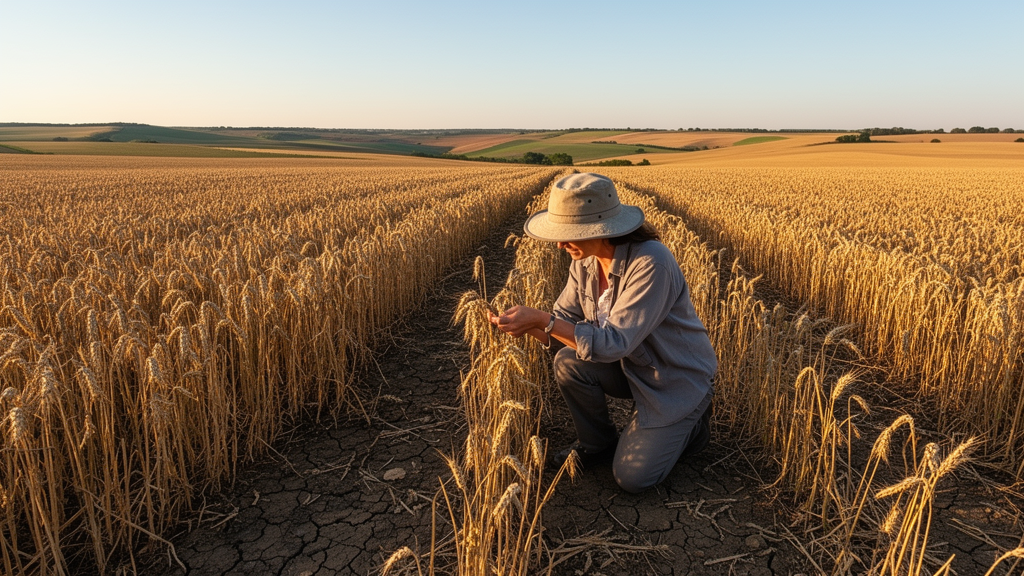
Wheat feeds more people than any other crop on Earth, yet the models scientists use to predict how extreme weather will dent its harvests have long been blunt instruments. A new study published in Nature Food by Yuchuan Luo of Southwest University, Zhao Zhang of Beijing Normal University, Fulu Tao of the Chinese Academy of Sciences and colleagues now shows that when those instruments are carefully sharpened, the picture that emerges is considerably darker than the one drawn by the existing generation of global crop models. Between 1981 and 2015, the refined framework finds that droughts on average cut global wheat yields by 9.7 percent, heatwaves by 5.8 percent, and compound drought-heatwave events by 13.3 percent — losses that mainstream multimodel ensembles have systematically underestimated.
The core problem the team set out to solve is a familiar one in climate-impact science: process-based crop models, which simulate how plants grow, develop and fail under stress, have struggled to reproduce the actual damage that extreme weather inflicts on fields. A landmark 2019 analysis had already concluded that state-of-the-art global models tend to underestimate the impacts of climate extremes, and subsequent work showed that rice models, for example, miss much of the damage from short-term heat spikes. For wheat, the stakes are enormous. Climate variation explains roughly a third of global crop yield variability, and wheat is grown across an extraordinary range of climates, from rainfed semi-arid plains to fully irrigated river deltas, each with its own vulnerability profile.
What distinguishes the new work is that the researchers improved both the structure and the parameterization of their crop model simultaneously, rather than treating these as separate tuning exercises. Working at a fine 10-kilometre resolution across the global wheat belt, they rebuilt key physiological processes — including how the crop responds to temperature stress at sensitive developmental stages and how water deficits propagate through the soil-plant system — and then calibrated the model’s parameters against an unusually rich set of observational data. That calibration drew on subnational yield statistics, wheat experimental data from agro-meteorological stations, satellite-derived leaf area index products such as GLASS, GIMMS LAI4g and GLOBMAP, high-resolution soil profiles, fertilizer input maps and the GGCMI phase 3 crop calendar.
The validation exercise is where the study becomes genuinely striking. The team benchmarked their improved model against the Global Gridded Crop Model Intercomparison (GGCMI) phase 3 multimodel ensemble, the de facto standard for global crop impact assessment. The refined parameterization alone increased model skill by 30 percent in simulating global wheat yield losses from droughts, by 20 percent for heatwaves, and by 7 percent for compound events during the 1981–2015 period. In other words, a substantial fraction of the uncertainty that has plagued wheat impact assessments was not irreducible noise but a fixable artifact of coarse model structure and poorly constrained parameters.
Underpinning the analysis is a careful framework for identifying extreme weather events themselves. The researchers classified droughts, heatwaves and compound drought-heatwave events (CHDEs) over each wheat-growing grid cell, drawing on the CHELSA-W5E5 and GSWP3-W5E5 meteorological forcing datasets and cross-checking event identification against the Emergency Events Database (EM-DAT). This event-based approach matters because compound events — hot, dry spells arriving together during critical growth windows — are disproportionately destructive. Heat accelerates crop development and shortens the grain-filling period, while drought starves the plant of the water needed to cool its canopy and fill grains; when the two coincide, the damage is more than additive, which is exactly why the 13.3 percent average loss from compound events exceeds the sum one might naively expect from the individual stressors.
The spatial texture of the results carries its own warnings. Because the model runs at 10-kilometre resolution, the team could resolve yield responses within major producing regions rather than averaging them away, revealing hotspots where losses concentrate and where the interaction between management and climate is decisive. The study builds on the team’s earlier GlobalWheatYield4km dataset, which reconstructed global wheat yields at 4-kilometre resolution from 1982 to 2020, giving them an unusually detailed observational target against which to test simulated losses.
One of the most consequential findings concerns irrigation. The analysis confirms that irrigation is an effective adaptation option — water supplied to the crop buffers both soil moisture deficits and, through evaporative cooling, the canopy temperatures that drive heat damage. Previous work had shown that irrigation contributes substantially to global wheat and maize yields and that it has reduced wheat’s heat sensitivity in India. But the new study adds a sobering temporal dimension: the countervailing effect of irrigation has markedly weakened over time as disasters have intensified. As droughts and heatwaves grow more severe, the protective capacity of existing irrigation systems erodes, meaning that a strategy that worked well in the 1980s delivers progressively less insurance per unit of water today.
That erosion has implications far beyond agronomy. Wheat price spikes and the economic inequality they amplify have been directly linked to extreme drought and heat under even modest warming scenarios, and amplified Rossby wave patterns have been shown to raise the risk of concurrent heatwaves striking several of the world’s breadbaskets simultaneously. If models calibrated the conventional way understate yield losses, then risk assessments built on those models — from insurance pricing to strategic grain reserves to import planning — inherit that optimism. The improved framework offers a corrective: by reproducing historical losses from droughts, heatwaves and their compounds with substantially higher skill, it provides a more trustworthy baseline for projecting future climate risk and for designing adaptation portfolios that do not over-rely on irrigation alone.
The methodological lesson may prove as important as the headline numbers. Uncertainty in crop impact projections flows from model structure, parameters and climate forcing, and the field has often responded by running ever-larger multimodel ensembles. This study demonstrates that targeted structural refinement, guided by station data, remote sensing and high-resolution yield reconstructions, can close a meaningful share of the gap between simulated and observed impacts without waiting for an entirely new generation of models. The team has released the code for their global gridded crop model calibration and their extreme-event identification and impact assessment pipeline, making the approach reproducible and extensible.
The road ahead is clear from the study’s own framing. The authors position the framework as a tool for climate-risk assessment and adaptation strategy development, and its logic extends naturally to other staples — maize, rice, soybean — where compound extremes are likewise intensifying. For wheat, the message is stark: droughts and heatwaves have already been quietly eroding global productivity at rates larger than standard models admitted, their compound strikes are the costliest of all, and the irrigation shield that once blunted them is dulling with every intensifying disaster. Closing the modelling gap, this work suggests, is not an academic refinement but a prerequisite for seeing the true size of the threat to the world’s most widely grown grain.
Subject of Research: Improved crop modelling of drought and heatwave impacts on global wheat productivity
Article Title: Refined crop modelling reveals intensifying impacts of droughts and heatwaves on global wheat productivity
Article References: Luo, Y., Zhang, Z., Cao, J., Han, J., Tang, Q., Jägermeyr, J., & Tao, F. (2026). Refined crop modelling reveals intensifying impacts of droughts and heatwaves on global wheat productivity. Nature Food. https://doi.org/10.1038/s43016-026-01432-y
Image Credits: AI Generated
DOI: 10.1038/s43016-026-01432-y
Keywords: wheat, crop modelling, drought, heatwave, compound events, climate change, irrigation, food security, yield losses, Nature Food, adaptation, climate risk
News Source: Alan Morgan. (October 8, 2026). Sharper crop model shows droughts and heatwaves are hitting global wheat harder than thought. Scienmag.