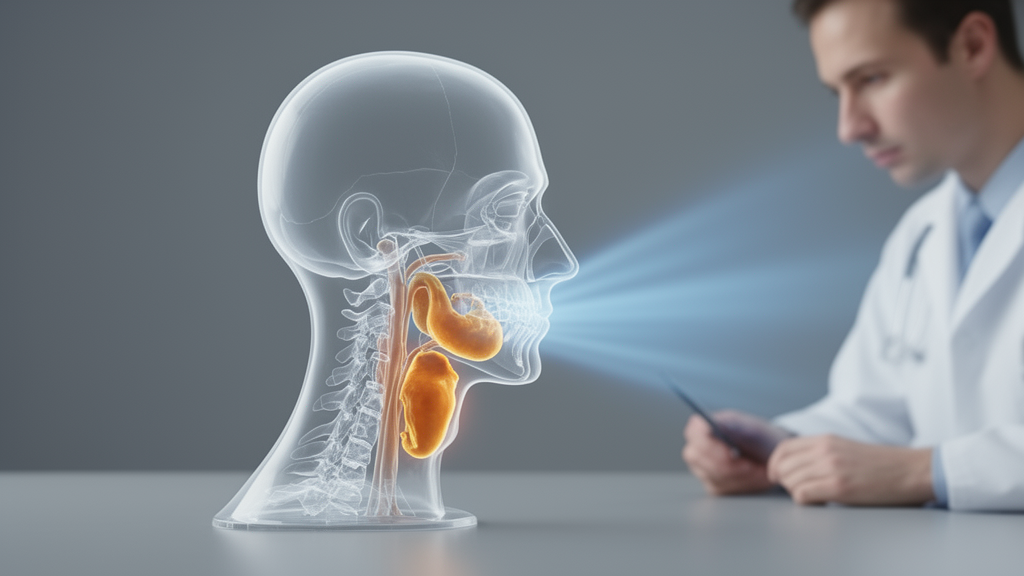
More people than ever are surviving throat cancer, and a new study has taken one of the most detailed looks yet at what life is actually like for them decades of years after treatment. Researchers at a large Australian tertiary cancer centre followed 344 patients with oropharyngeal squamous cell carcinoma, a cancer of the tonsils and base of the tongue that is increasingly driven by human papillomavirus, or HPV. Their findings, published in Cancer Reports, offer both reassurance and a warning: most long-term survivors report excellent overall quality of life and almost none regret their treatment, yet a persistent, dose-dependent side effect—dry mouth—continues to trouble many patients years after their radiation therapy ended, and the amount of radiation delivered to a single salivary gland turns out to be the strongest modifiable predictor of that burden.
The study’s clinical backdrop is a quiet epidemic. HPV-associated oropharyngeal cancer has been rising steadily in high-income countries, and although HPV vaccines will eventually blunt the trend, the long lag between infection and malignancy means case numbers will keep climbing for decades. The encouraging flip side is that these tumours respond well to treatment: in this cohort, 80 percent of patients had p16-positive disease, a marker of HPV-driven cancer, and their survival outcomes were dramatically better than those with HPV-negative tumours. Median overall survival for the entire group reached 15 years, with five-year overall survival of 85 percent and five-year disease-free survival of 81 percent. For patients with p16-positive tumours, five-year overall survival was 90 percent, compared with just 52 percent for those with p16-negative disease, and the hazard of death was 85 percent lower in the HPV-positive group.
Because so many patients now live for years or decades after curative-intent radiotherapy, the late effects of that treatment have become a survivorship problem in their own right. Modern techniques such as intensity-modulated radiotherapy and image-guided radiotherapy, delivered here with daily cone-beam CT verification and PET-based treatment planning, have steadily reduced collateral damage, but permanent side effects still affect the majority of head and neck cancer survivors. These can include difficulty swallowing, altered taste, dental problems, trismus, neck fibrosis, lymphedema and speech changes. For oropharyngeal cancers specifically, symptom scores tend to be more severe than for other head and neck sites, with higher rates of serious swallowing dysfunction, and the heaviest burden has been linked to trimodality treatment combining surgery, chemotherapy and radiation.
The research team identified all patients treated with curative-intent radiotherapy, with or without prior surgery, at their institution between January 2007 and May 2023. Most received the standard definitive regimen of 70 Gy in 35 fractions over seven weeks, with dose levels tiered to high-, intermediate- and low-risk target volumes, and 84 percent received chemotherapy, nearly all of it concurrent weekly cisplatin. In 2023, the team contacted every living patient and invited them to complete a comprehensive quality-of-life survey built around the European Organisation for Research and Treatment of Cancer QLQ-HN43 module, plus the global health status scale from the QLQ-C30. Of 232 patients contacted, 186—80 percent—completed the survey in full, a remarkably high response rate for a survivorship study, with a median of 6.3 years elapsed between radiotherapy and questionnaire completion.
The headline quality-of-life results were strikingly positive. The median global health status score was 83.3 on a 100-point scale, with a mean of 81.3—more than ten points above published general-population reference values, a difference considered clinically significant, though the authors caution that only survivors well enough to respond were surveyed. Ninety-three percent of respondents reported no treatment regret at all, and 77 percent had a fully normal performance status. Only 16 percent reported severe side effects requiring major interventions such as surgery, hyperbaric oxygen or hospitalisation. Many domains of the head-and-neck-specific questionnaire, including body image, social contact, shoulder problems, coughing and neck swelling, had median scores of zero, indicating no symptom burden at all for the typical respondent.
But one symptom stood out. Dry mouth and sticky saliva—xerostomia—was the most affected domain, with a median score of 33.3 and a mean of 41.9 on the 100-point scale where higher means worse. More than a quarter of patients described their health as somewhat or much worse than before treatment, and of those, roughly two-thirds attributed the decline directly to radiotherapy. For a cancer whose treatment is increasingly successful, this persistent oral dryness represents the principal unfinished business of curative therapy: it impairs taste, chewing, swallowing, dental health and sleep, and it rarely resolves completely once high doses have been delivered to salivary tissue.
The study’s most technically valuable contribution lies in its dosimetric analysis. Rather than testing every radiation parameter against every symptom, the researchers prespecified eleven organ-at-risk and target-volume pairings and applied false-discovery-rate correction to guard against spurious findings. The result was unambiguous: each 10 Gy increase in mean dose to the contralateral parotid gland—the salivary gland on the side of the neck opposite the tumour—was associated with a 10.1-point worsening in dry mouth and sticky saliva scores, an association that remained statistically significant after adjustment for age, smoking, stage, chemotherapy and time since treatment, and after multiple-comparison correction. Ipsilateral parotid dose showed a weaker, non-significant trend in the same direction. Notably, mean parotid doses in this cohort were already lower than those achieved in the landmark PARSPORT trial of parotid-sparing IMRT, suggesting that even more aggressive salivary sparing is technically feasible.
Other dosimetric hypotheses did not survive scrutiny. Mean doses to the pharyngeal constrictor muscles and larynx were not associated with swallowing or speech scores after adjustment, and the volumes of tissue receiving high, intermediate or low radiation doses showed no significant relationship with global quality of life. On the clinical side, older age predicted worse global health status, with a 4.9-point decline per decade of age, and worse swallowing scores, while current smoking showed a possible association with poorer global quality of life that narrowly missed statistical significance. One clinically meaningful finding was that patients whose necks were irradiated on one side only reported dry mouth scores 14 points better than those treated bilaterally—supporting unilateral neck treatment for well-lateralised tonsil tumours where oncologically safe. Longer time since radiotherapy was linked to marginally worse speech scores, an unexpected signal the authors suggest warrants prospective confirmation.
The authors are candid about their study’s limits. Because no baseline quality-of-life assessment existed, the symptom scores capture a single post-treatment snapshot and cannot cleanly separate radiation effects from pre-existing conditions. Survivorship bias looms large: patients who died or were too unwell could not respond, and survey completers were younger, more often p16-positive, earlier stage and treated with lower dose volumes than non-completers, meaning the reported quality of life is likely more optimistic than that of the treated population as a whole. The near-universal p16 positivity among respondents also made it impossible to analyse HPV status as a predictor of late quality of life. Still, the long median follow-up, high completion rate and standardised treatment protocols across nearly two decades give the findings unusual weight for a single-centre study.
The practical message for radiotherapy planning is clear: sparing the contralateral parotid gland deserves continued priority, and unilateral irradiation should be pursued wherever the tumour’s location allows it. The results also provide a real-world baseline against which the many ongoing de-escalation trials for HPV-positive oropharyngeal cancer can be judged—including the institution’s own trial using FMISO PET imaging to identify patients suitable for reduced radiation doses. As the population of long-term throat cancer survivors grows, studies like this one shift the question from whether patients survive to how well they live, and point to precisely which milligrays of radiation, delivered to which glands, make the difference between a comfortable recovery and a lifetime of dry-mouth discomfort.
Subject of Research: Long-term quality of life and dosimetric predictors after curative-intent radiotherapy for oropharyngeal squamous cell carcinoma
Article Title: Long‐Term Patient‐Reported Outcomes and Dosimetric Predictors of Quality of Life After Curative‐Intent Radiation Therapy for Oropharyngeal Squamous Cell Carcinoma: A Cross‐Sectional Study
Article References: Lawless, A., Jayamanne, D., Parker, L., Duruchukwu, E., Macleod, P., Venkatesha, V., Brown, C., Guminski, A., Lee, A., Back, M., Eade, T., & Bergamin, S. (2026). Long‐Term Patient‐Reported Outcomes and Dosimetric Predictors of Quality of Life After Curative‐Intent Radiation Therapy for Oropharyngeal Squamous Cell Carcinoma: A Cross‐Sectional Study. Cancer Reports, 9(10), Article e70712. https://doi.org/10.1002/cnr2.70712
Image Credits: AI Generated
DOI: 10.1002/cnr2.70712
Keywords: oropharyngeal cancer, HPV, radiotherapy, quality of life, xerostomia, parotid gland, dosimetry, IMRT, survivorship, EORTC QLQ-HN43, p16, dry mouth
News Source: Nathaniel Bowman. (October 8, 2026). Radiation Dose to Salivary Gland Predicts Lifelong Dry Mouth in Throat Cancer Survivors. Scienmag.