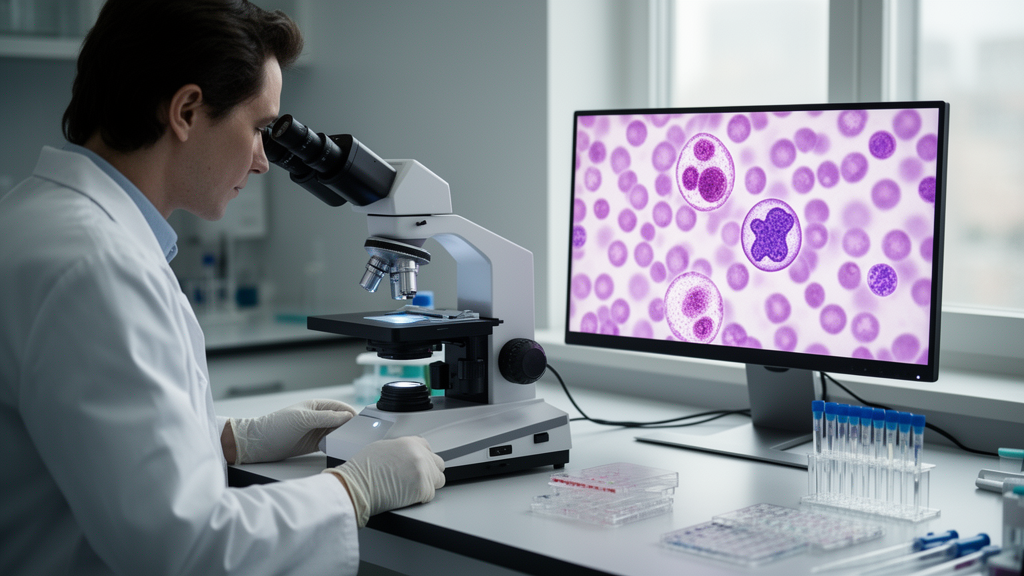
For more than a century, the humble light microscope has been the frontline weapon against parasitic disease. Trained eyes peer down at blood smears and stool samples, hunting for the telltale shapes of malaria parasites, intestinal worms and other pathogens that collectively burden hundreds of millions of people worldwide. Now, a sweeping new analysis suggests that artificial intelligence is poised to transform that ritual — but it also warns that the technology remains largely trapped in the laboratory, unproven in the clinics where it is needed most.
The study, published in PLOS Neglected Tropical Diseases, is a scoping review led by Rose Mary Maniraj and colleagues at Universiti Kebangsaan Malaysia, working with researchers at Malaysia’s National Institutes of Health. The team systematically searched seven electronic databases for studies published between January 2015 and July 2025, a decade chosen because it marks the era when convolutional neural networks began to dominate biomedical image analysis. After screening more than 1,000 records and supplementing the search with backward citation tracking, the researchers assembled 118 primary studies that applied deep learning models to parasite microscopy images for human clinical diagnosis and reported quantitative performance metrics.
The verdict on raw technical capability is striking. Across the included studies, deep learning models consistently achieved high performance in detecting and classifying parasites, with some systems matching the accuracy of trained microscopists under controlled conditions. Yet the review’s authors caution that these headline numbers conceal a fragmented and uneven evidence base. Studies varied enormously in datasets, architectures, evaluation metrics and experimental designs, making direct comparison of one model against another essentially impossible. More troubling, most studies validated their models internally — on subsets of the very same data used for training — rather than testing them on genuinely independent patient populations, staining protocols or laboratory conditions.
The technical landscape mapped by the review is dominated by three computer vision tasks. Image classification, in which a model decides whether an image contains a parasite and often which species, was the most common, appearing in 69 of the 118 studies. Object detection, which goes further by drawing bounding boxes around individual parasites and enabling quantification of infection burden, accounted for 43 studies. Image segmentation — pixel-level delineation of parasite structures that permits detailed morphological analysis — was the rarest, with just six studies. The scarcity of segmentation work likely reflects the enormous labor required to produce pixel-accurate annotations, a bottleneck familiar to anyone who has worked in medical image labeling.
Malaria looms large over the field. Plasmodium species, the parasites responsible for a disease that caused an estimated 263 million cases and nearly 600,000 deaths in 2023, dominated both the classification and detection literature, driven in part by the availability of large, publicly labeled datasets of stained blood smear images. Classification studies leaned heavily on convolutional neural network architectures — VGG, ResNet, DenseNet, EfficientNet and custom variants — often enhanced with attention mechanisms, transfer learning and, increasingly, transformer-based designs. Detection studies overwhelmingly favored the YOLO family of single-shot detectors, spanning versions from YOLOv2 through YOLOv11, alongside lightweight adaptations engineered for speed and low computational cost.
Beyond malaria, the review catalogued deep learning applications across a striking breadth of parasites. Protozoan targets included Babesia, Giardia lamblia, Trypanosoma cruzi, Toxoplasma gondii, Trichomonas and Leishmania species, the latter detected in bone marrow and cutaneous lesion microscopy. Helminth studies covered Schistosoma haematobium and S. mansoni eggs, Ascaris lumbricoides, Taenia saginata, Opisthorchis viverrini, Trichuris trichiura, microfilariae and the broader category of soil-transmitted helminths. Detection frameworks such as SSD MobileNet, Faster R-CNN, RetinaNet and even transformer-based detectors like RT-DETR appeared alongside the YOLO mainstream, while segmentation efforts centered on U-Net and its many variants.
What sets this review apart from earlier syntheses of artificial intelligence in parasitology is its explicit focus on implementation — the unglamorous question of whether any of these algorithms can actually function in a working diagnostic laboratory. The answer, mostly, is not yet. Several studies proposed integration pathways: deep learning models serving as preliminary screening tools that flag suspicious samples for human review, outputs feeding into clinical decision support systems, or deployment on smartphone-based microscopes and single-board computers such as the Raspberry Pi for point-of-care use. Others sketched visions of cloud-based platforms, Internet of Medical Things architectures and telemedicine frameworks that would allow remote expert consultation in resource-limited settings.
A handful of studies did venture beyond proof-of-concept. The review highlights real-time and near real-time implementations, including smartphone applications for automated malaria screening, mobile digital microscopy paired with deep learning for detecting soil-transmitted helminths and schistosome eggs in field settings, and a semi-automated workflow combining whole-slide scanning, AI analysis and expert verification that achieved rapid turnaround times. One study compared AI-supported microscopy against manual reading of Kato-Katz smears in a primary healthcare setting. But these remain exceptions. The overwhelming majority of the 118 studies never left the experimental bench, and considerations such as usability, scalability, cost-effectiveness and regulatory compliance were rarely addressed.
The authors are candid about the limitations of their own analysis. Only English-language articles were included, no formal critical appraisal of study quality was performed — consistent with scoping review methodology — and the reliance on published performance metrics raises the specter of publication bias, since studies reporting favorable results are more likely to see print. They also note a representation problem: the heavy reliance on publicly available malaria datasets may skew the field toward well-studied parasites, leaving neglected infections underrepresented. Dataset sizes, moreover, were reported in incompatible units — whole-slide images, fields of view, individual cells, image patches — further muddying any attempt at quantitative synthesis. No formal meta-analysis was attempted, and the review’s performance findings are presented descriptively rather than pooled.
The bottom line is a field brimming with promise but facing a translational gap. Deep learning has demonstrated that it can see parasites — reliably, quickly and, in some architectures, cheaply enough to run on a phone. What it has not yet demonstrated, in most cases, is that it can survive contact with the messy realities of clinical parasitology: variable staining, ambiguous morphology, unfamiliar patient populations and overworked laboratory staff. The review’s authors call for standardised datasets, rigorous external validation and prospective, implementation-focused studies that measure not just accuracy but operational feasibility and clinical utility. Until then, the gold standard remains a trained human eye — increasingly assisted, but not yet replaced, by the machine.
Subject of Research: Deep learning applications for automated parasite detection and diagnosis in clinical microscopy
Article Title: Deep learning applications in parasite microscopy: A scoping review
Article References: Maniraj, R. M., Osman, E., Sheikh Abdullah, S. N. H., Azil, A. H., & Mahmud, M. A. F. (2026). Deep learning applications in parasite microscopy: A scoping review. PLOS Neglected Tropical Diseases, 20(10), e0014774. https://doi.org/10.1371/journal.pntd.0014774
Image Credits: AI Generated
DOI: 10.1371/journal.pntd.0014774
Keywords: deep learning, parasitology, microscopy, malaria, convolutional neural networks, object detection, image classification, image segmentation, diagnostic AI, neglected tropical diseases, scoping review, clinical validation
News Source: Ophelia Keating. (October 8, 2026). AI Reads the Microscope: Deep Learning Powers Parasite Diagnosis, But Real-World Tests Lag Behind. Scienmag.